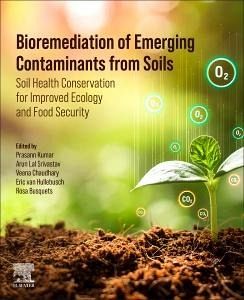
Bioremediation of Emerging Contaminants from Soils
Soil Health Conservation for Improved Ecology and Food Security Herausgeber: Srivastav, Arun Lal; Chaudhary, Veena; Busquets, Rosa; Kumar, Prasann; Hullebusch, Eric D. van
Schade – dieser Artikel ist leider ausverkauft. Sobald wir wissen, ob und wann der Artikel wieder verfügbar ist, informieren wir Sie an dieser Stelle.
Bioremediation of Emerging Contaminants from Soils
Soil Health Conservation for Improved Ecology and Food Security Herausgeber: Srivastav, Arun Lal; Chaudhary, Veena; Busquets, Rosa; Kumar, Prasann; Hullebusch, Eric D. van
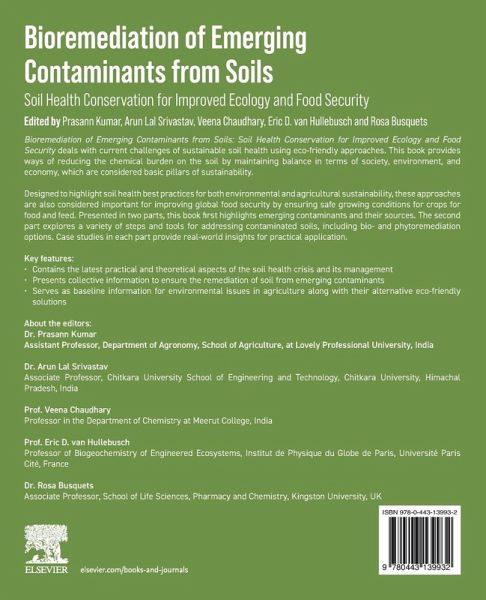
Bioremediation of Emerging Contaminants from Soils: Soil Health Conservation for Improved Ecology and Food Security deals with current challenges of sustainable soil health using eco-friendly approaches. This book provides ways of reducing the chemical burden on the soil by maintaining balance in terms of society, environment, and economy, which are considered basic pillars of sustainability. Designed to highlight soil health best practices for both environmental and agricultural sustainability, these approaches are also considered important for improving global food security by ensuring safe…mehr
Bioremediation of Emerging Contaminants from Soils: Soil Health Conservation for Improved Ecology and Food Security deals with current challenges of sustainable soil health using eco-friendly approaches. This book provides ways of reducing the chemical burden on the soil by maintaining balance in terms of society, environment, and economy, which are considered basic pillars of sustainability. Designed to highlight soil health best practices for both environmental and agricultural sustainability, these approaches are also considered important for improving global food security by ensuring safe growing conditions for crops for food and feed.¿Presented in two parts, this book first highlights emerging contaminants and their sources.¿The second part explores a variety of steps and tools for addressing contaminated soils, including bio- and phytoremediation options.¿Case studies in each part provide real-world insights for practical application.
1 Exponential population growth and global food security: challenges and alternatives 2 Agricultural soil contamination due to industrial discharges: challenges for public health protection and food security 3 Traditional approaches of agriculture soil remediation: boon or bane for global food security 4 Polycyclic aromatic hydrocarbons bioremediation mechanisms by nonligninolytic fungi: a multiscale approach 5 Phenolic compounds: a significant threat to agricultural soils 6 Pharmaceutical compounds: a recent threat to agricultural soils (sources, transport, and negative impacts on the crop’s quality and other adjacent ecosystems) 7 Sources of inorganic nonmetallic contaminants (synthetic fertilizers, pesticides) in agricultural soil and their impacts on the adjacent ecosystems 8 Sources of inorganic metallic contaminants (lead, cadmium, arsenic, etc.) in agricultural soil and their impacts on the adjacent ecosystems 9 Environmental threats posed by xenobiotics 10 Bioremediation of xenobiotic contamination in soil 11 Transgenic plants as a source of xenobiotic remediation 12 Xenobiotic stress management by microbial endophytes 13 Case studies on emerging contamination of soil 14 Bioremediation of metal-contaminated soil: comparison of microbial agents with plants 15 Phytoremediation of metal contaminated soil using energy crops: soil health maintenance along with biofuel production 16 Phytoremediation of phenolic compounds from soil 17 Phytoremediation of pharmaceutical compounds in soil 18 Alternative natural options of synthesized agrochemicals 19 Role of enzymes in the optimization of traditional phytoremediation processes of soil 20 Optimized phytoremediation process for the sustainable management radionuclides 21 Role of indigenous knowledge in agricultural soil reclamation without disturbing other ecosystems 22 Role of hyperaccumulators in the reduction of emerging industrial pollutants from soil 23 Microbes-assisted bioaugmentation process in the reduction of emerging industrial pollutants from soil 24 Application of genetically modified crops against metallic contaminations 25 Crop rotation patterns and soil health management 26 Application of microphytes for soil reclamation 27 Utilization of genetically modified weed plants against industrial contaminants: a promising tool of phytoremediation 28 Case studies on management practices for emerging contamination of soil, challenges and future scope
1 Exponential population growth and global food security: challenges and alternatives 2 Agricultural soil contamination due to industrial discharges: challenges for public health protection and food security 3 Traditional approaches of agriculture soil remediation: boon or bane for global food security 4 Polycyclic aromatic hydrocarbons bioremediation mechanisms by nonligninolytic fungi: a multiscale approach 5 Phenolic compounds: a significant threat to agricultural soils 6 Pharmaceutical compounds: a recent threat to agricultural soils (sources, transport, and negative impacts on the crop’s quality and other adjacent ecosystems) 7 Sources of inorganic nonmetallic contaminants (synthetic fertilizers, pesticides) in agricultural soil and their impacts on the adjacent ecosystems 8 Sources of inorganic metallic contaminants (lead, cadmium, arsenic, etc.) in agricultural soil and their impacts on the adjacent ecosystems 9 Environmental threats posed by xenobiotics 10 Bioremediation of xenobiotic contamination in soil 11 Transgenic plants as a source of xenobiotic remediation 12 Xenobiotic stress management by microbial endophytes 13 Case studies on emerging contamination of soil 14 Bioremediation of metal-contaminated soil: comparison of microbial agents with plants 15 Phytoremediation of metal contaminated soil using energy crops: soil health maintenance along with biofuel production 16 Phytoremediation of phenolic compounds from soil 17 Phytoremediation of pharmaceutical compounds in soil 18 Alternative natural options of synthesized agrochemicals 19 Role of enzymes in the optimization of traditional phytoremediation processes of soil 20 Optimized phytoremediation process for the sustainable management radionuclides 21 Role of indigenous knowledge in agricultural soil reclamation without disturbing other ecosystems 22 Role of hyperaccumulators in the reduction of emerging industrial pollutants from soil 23 Microbes-assisted bioaugmentation process in the reduction of emerging industrial pollutants from soil 24 Application of genetically modified crops against metallic contaminations 25 Crop rotation patterns and soil health management 26 Application of microphytes for soil reclamation 27 Utilization of genetically modified weed plants against industrial contaminants: a promising tool of phytoremediation 28 Case studies on management practices for emerging contamination of soil, challenges and future scope
Es gelten unsere Allgemeinen Geschäftsbedingungen: www.buecher.de/agb
Impressum
www.buecher.de ist ein Internetauftritt der buecher.de internetstores GmbH
Geschäftsführung: Monica Sawhney | Roland Kölbl | Günter Hilger
Sitz der Gesellschaft: Batheyer Straße 115 - 117, 58099 Hagen
Postanschrift: Bürgermeister-Wegele-Str. 12, 86167 Augsburg
Amtsgericht Hagen HRB 13257
Steuernummer: 321/5800/1497
USt-IdNr: DE450055826