
Andere Kunden interessierten sich auch für
 Assemblage d'oiseaux de la colline Hornos de Cal, Sancti Spíritus, Cuba26,99 €
 Vogelassemblage van de Hornos de Cal heuvel, Sancti Spíritus, Cuba26,99 €
 Ensamble de aves del cerro Hornos de Cal, Sancti Spíritus, Cuba26,99 €
 Conjunto de aves do monte Hornos de Cal, Sancti Spíritus, Cuba26,99 €
 Assemblaggio di uccelli dalla collina Hornos de Cal, Sancti Spíritus, Cuba26,99 €
 Vogelansammlung vom Hügel Hornos de Cal, Sancti Spíritus, Kuba39,90 €
 Zespó¿ ptaków z wzgórza Hornos de Cal, Sancti Spíritus, Kuba26,99 €
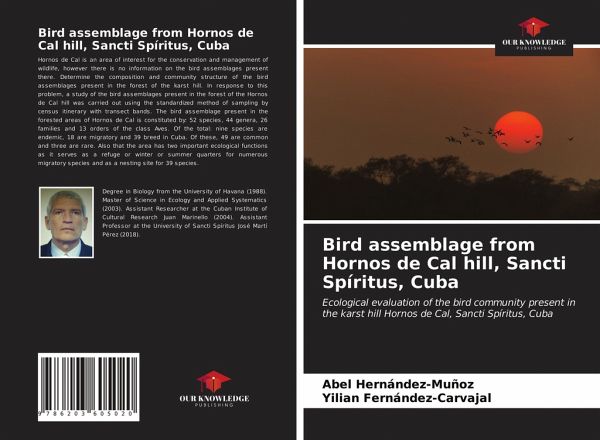
Hornos de Cal is an area of interest for the conservation and management of wildlife, however there is no information on the bird assemblages present there. Determine the composition and community structure of the bird assemblages present in the forest of the karst hill. In response to this problem, a study of the bird assemblages present in the forest of the Hornos de Cal hill was carried out using the standardized method of sampling by census itinerary with transect bands. The bird assemblage present in the forested areas of Hornos de Cal is constituted by: 52 species, 44 genera, 26 families and 13 orders of the class Aves. Of the total: nine species are endemic, 18 are migratory and 39 breed in Cuba. Of these, 49 are common and three are rare. Also that the area has two important ecological functions as it serves as a refuge or winter or summer quarters for numerous migratory species and as a nesting site for 39 species.