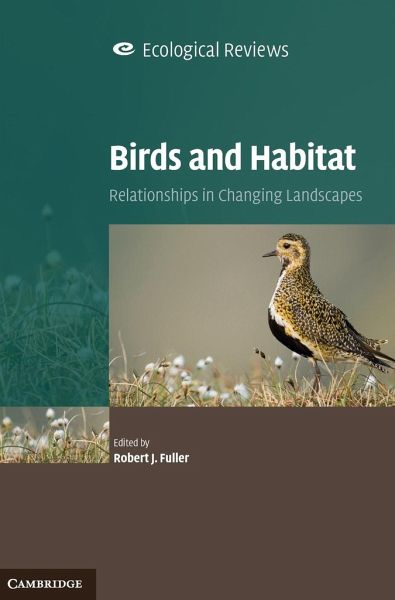
Birds and Habitat
Relationships in Changing Landscapes
Herausgeber: Fuller, Robert J
Birds and Habitat
Relationships in Changing Landscapes
Herausgeber: Fuller, Robert J
- Gebundenes Buch
- Merkliste
- Auf die Merkliste
- Bewerten Bewerten
- Teilen
- Produkt teilen
- Produkterinnerung
- Produkterinnerung
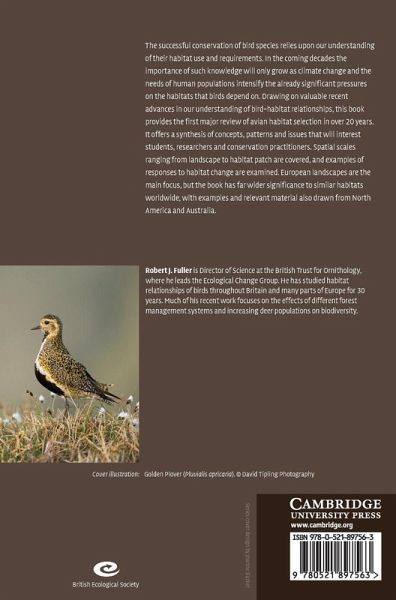
Synthesises important concepts, patterns and issues relating to avian habitat selection, drawing on examples from Europe, North America and Australia.
Andere Kunden interessierten sich auch für
Amir MaharjanPrincipal Diet Analysis And Habitat Suitabiliy Mapping Of Bengal Tiger32,99 €
S. P. SinhaCorridor Viability and Habitat Restoration39,99 €
Iinger NordalFlora of Tropical East Africa - Anthericaceae (1997)22,99 €
Kush KushwahBiodiversity and Habitat Mapping41,99 €
Study of Plant diversity & ecophysiology in KSKV Kachchh university30,99 €
Haibo ZhouHabitat Management and Biological Control for Aphids in China43,99 €
Mohit AryaBiodiversity, Habitat Utilization and Trophic Relationships56,99 €-
-
-
Synthesises important concepts, patterns and issues relating to avian habitat selection, drawing on examples from Europe, North America and Australia.
Produktdetails
- Produktdetails
- Verlag: Cambridge University Press
- Seitenzahl: 554
- Erscheinungstermin: 8. November 2012
- Englisch
- Abmessung: 250mm x 175mm x 34mm
- Gewicht: 1129g
- ISBN-13: 9780521897563
- ISBN-10: 0521897564
- Artikelnr.: 35937449
- Herstellerkennzeichnung
- Libri GmbH
- Europaallee 1
- 36244 Bad Hersfeld
- gpsr@libri.de
- Verlag: Cambridge University Press
- Seitenzahl: 554
- Erscheinungstermin: 8. November 2012
- Englisch
- Abmessung: 250mm x 175mm x 34mm
- Gewicht: 1129g
- ISBN-13: 9780521897563
- ISBN-10: 0521897564
- Artikelnr.: 35937449
- Herstellerkennzeichnung
- Libri GmbH
- Europaallee 1
- 36244 Bad Hersfeld
- gpsr@libri.de
List of contributors; Preface; Part I. The Complexity of Patterns and
Processes: 1. The bird and its habitat: an overview of concepts Robert J.
Fuller; 2. Habitat quality and habitat occupancy by birds in variable
environments Robert J. Fuller; 3. Spatial variation and temporal shifts in
habitat use by birds at the European scale Tomasz Wesöowski and Robert J.
Fuller; 4. Mechanisms and processes underlying landscape structure effects
on bird populations Paul M. Dolman; 5. Avian responses to transitional
habitats in temperate cultural landscapes: woodland edges and young growth
Robert J. Fuller; 6. Habitat associations of birds in complex changing
cultural landscapes Shelley A. Hinsley and Simon Gillings; 7. The
importance of habitat heterogeneity at multiple scales for birds in
European agricultural landscapes Juliet Vickery and Raphaël Arlettaz; Part
II. Case Studies of Habitat Use and Selection: 8. Spatial variation and
habitat relationships in moorland bird assemblages: a British perspective
Murray C. Grant and James W. Pearce-Higgins; 9. Arctic-alpine mountain
birds in northern Europe: contrasts between specialists and generalists Des
B. A. Thompson, John Atle Kålås and Ingvar Byrkjedal; 10. Bird-habitat
relationships in reedswamps and fens Gillian Gilbert and Ken W. Smith; 11.
Breeding waders on wet grassland: factors influencing habitat suitability
Malcolm Ausden and Mark Bolton; 12. Processes influencing bird use of
estuarine mudflats and saltmarshes in western Europe Jennifer A. Gill; 13.
Avian habitat use on the non-estuarine intertidal coast Niall H. K. Burton;
14. Temperate western European woodland as a dynamic environment for birds:
a resource-based view Robert J. Fuller, Ken W. Smith and Shelley A.
Hinsley; Part III. Wider Perspectives: 15. What is habitat quality?
Dissecting a research portfolio on shorebirds Theunis Piersma; 16.
Understanding individual life histories and habitat choices: implications
for explaining population patterns and processes Beat Naef-Daenzer; 17.
Insufficient adaptation to climate change alters avian habitat quality and
thereby changes habitat selection Christiaan Both; 18. Australian birds in
a changing landscape: 220 years of European colonisation Tara G. Martin,
Carla P. Catterall, Adrian D. Manning and Judit Szabo; 19. Birds in
cultural landscapes: actual and perceived differences between north-east
North America and western Europe Jean-Louis Martin, Pierre Drapeau, Lenore
Fahrig, Kathryn Freemark Lindsay, David Anthony Kirk, Adam C. Smith and
Marc-André Villard; 20. Birds and their changing habitat: thoughts on
research and conservation strategies Robert J. Fuller; Index.
Processes: 1. The bird and its habitat: an overview of concepts Robert J.
Fuller; 2. Habitat quality and habitat occupancy by birds in variable
environments Robert J. Fuller; 3. Spatial variation and temporal shifts in
habitat use by birds at the European scale Tomasz Wesöowski and Robert J.
Fuller; 4. Mechanisms and processes underlying landscape structure effects
on bird populations Paul M. Dolman; 5. Avian responses to transitional
habitats in temperate cultural landscapes: woodland edges and young growth
Robert J. Fuller; 6. Habitat associations of birds in complex changing
cultural landscapes Shelley A. Hinsley and Simon Gillings; 7. The
importance of habitat heterogeneity at multiple scales for birds in
European agricultural landscapes Juliet Vickery and Raphaël Arlettaz; Part
II. Case Studies of Habitat Use and Selection: 8. Spatial variation and
habitat relationships in moorland bird assemblages: a British perspective
Murray C. Grant and James W. Pearce-Higgins; 9. Arctic-alpine mountain
birds in northern Europe: contrasts between specialists and generalists Des
B. A. Thompson, John Atle Kålås and Ingvar Byrkjedal; 10. Bird-habitat
relationships in reedswamps and fens Gillian Gilbert and Ken W. Smith; 11.
Breeding waders on wet grassland: factors influencing habitat suitability
Malcolm Ausden and Mark Bolton; 12. Processes influencing bird use of
estuarine mudflats and saltmarshes in western Europe Jennifer A. Gill; 13.
Avian habitat use on the non-estuarine intertidal coast Niall H. K. Burton;
14. Temperate western European woodland as a dynamic environment for birds:
a resource-based view Robert J. Fuller, Ken W. Smith and Shelley A.
Hinsley; Part III. Wider Perspectives: 15. What is habitat quality?
Dissecting a research portfolio on shorebirds Theunis Piersma; 16.
Understanding individual life histories and habitat choices: implications
for explaining population patterns and processes Beat Naef-Daenzer; 17.
Insufficient adaptation to climate change alters avian habitat quality and
thereby changes habitat selection Christiaan Both; 18. Australian birds in
a changing landscape: 220 years of European colonisation Tara G. Martin,
Carla P. Catterall, Adrian D. Manning and Judit Szabo; 19. Birds in
cultural landscapes: actual and perceived differences between north-east
North America and western Europe Jean-Louis Martin, Pierre Drapeau, Lenore
Fahrig, Kathryn Freemark Lindsay, David Anthony Kirk, Adam C. Smith and
Marc-André Villard; 20. Birds and their changing habitat: thoughts on
research and conservation strategies Robert J. Fuller; Index.
List of contributors; Preface; Part I. The Complexity of Patterns and
Processes: 1. The bird and its habitat: an overview of concepts Robert J.
Fuller; 2. Habitat quality and habitat occupancy by birds in variable
environments Robert J. Fuller; 3. Spatial variation and temporal shifts in
habitat use by birds at the European scale Tomasz Wesöowski and Robert J.
Fuller; 4. Mechanisms and processes underlying landscape structure effects
on bird populations Paul M. Dolman; 5. Avian responses to transitional
habitats in temperate cultural landscapes: woodland edges and young growth
Robert J. Fuller; 6. Habitat associations of birds in complex changing
cultural landscapes Shelley A. Hinsley and Simon Gillings; 7. The
importance of habitat heterogeneity at multiple scales for birds in
European agricultural landscapes Juliet Vickery and Raphaël Arlettaz; Part
II. Case Studies of Habitat Use and Selection: 8. Spatial variation and
habitat relationships in moorland bird assemblages: a British perspective
Murray C. Grant and James W. Pearce-Higgins; 9. Arctic-alpine mountain
birds in northern Europe: contrasts between specialists and generalists Des
B. A. Thompson, John Atle Kålås and Ingvar Byrkjedal; 10. Bird-habitat
relationships in reedswamps and fens Gillian Gilbert and Ken W. Smith; 11.
Breeding waders on wet grassland: factors influencing habitat suitability
Malcolm Ausden and Mark Bolton; 12. Processes influencing bird use of
estuarine mudflats and saltmarshes in western Europe Jennifer A. Gill; 13.
Avian habitat use on the non-estuarine intertidal coast Niall H. K. Burton;
14. Temperate western European woodland as a dynamic environment for birds:
a resource-based view Robert J. Fuller, Ken W. Smith and Shelley A.
Hinsley; Part III. Wider Perspectives: 15. What is habitat quality?
Dissecting a research portfolio on shorebirds Theunis Piersma; 16.
Understanding individual life histories and habitat choices: implications
for explaining population patterns and processes Beat Naef-Daenzer; 17.
Insufficient adaptation to climate change alters avian habitat quality and
thereby changes habitat selection Christiaan Both; 18. Australian birds in
a changing landscape: 220 years of European colonisation Tara G. Martin,
Carla P. Catterall, Adrian D. Manning and Judit Szabo; 19. Birds in
cultural landscapes: actual and perceived differences between north-east
North America and western Europe Jean-Louis Martin, Pierre Drapeau, Lenore
Fahrig, Kathryn Freemark Lindsay, David Anthony Kirk, Adam C. Smith and
Marc-André Villard; 20. Birds and their changing habitat: thoughts on
research and conservation strategies Robert J. Fuller; Index.
Processes: 1. The bird and its habitat: an overview of concepts Robert J.
Fuller; 2. Habitat quality and habitat occupancy by birds in variable
environments Robert J. Fuller; 3. Spatial variation and temporal shifts in
habitat use by birds at the European scale Tomasz Wesöowski and Robert J.
Fuller; 4. Mechanisms and processes underlying landscape structure effects
on bird populations Paul M. Dolman; 5. Avian responses to transitional
habitats in temperate cultural landscapes: woodland edges and young growth
Robert J. Fuller; 6. Habitat associations of birds in complex changing
cultural landscapes Shelley A. Hinsley and Simon Gillings; 7. The
importance of habitat heterogeneity at multiple scales for birds in
European agricultural landscapes Juliet Vickery and Raphaël Arlettaz; Part
II. Case Studies of Habitat Use and Selection: 8. Spatial variation and
habitat relationships in moorland bird assemblages: a British perspective
Murray C. Grant and James W. Pearce-Higgins; 9. Arctic-alpine mountain
birds in northern Europe: contrasts between specialists and generalists Des
B. A. Thompson, John Atle Kålås and Ingvar Byrkjedal; 10. Bird-habitat
relationships in reedswamps and fens Gillian Gilbert and Ken W. Smith; 11.
Breeding waders on wet grassland: factors influencing habitat suitability
Malcolm Ausden and Mark Bolton; 12. Processes influencing bird use of
estuarine mudflats and saltmarshes in western Europe Jennifer A. Gill; 13.
Avian habitat use on the non-estuarine intertidal coast Niall H. K. Burton;
14. Temperate western European woodland as a dynamic environment for birds:
a resource-based view Robert J. Fuller, Ken W. Smith and Shelley A.
Hinsley; Part III. Wider Perspectives: 15. What is habitat quality?
Dissecting a research portfolio on shorebirds Theunis Piersma; 16.
Understanding individual life histories and habitat choices: implications
for explaining population patterns and processes Beat Naef-Daenzer; 17.
Insufficient adaptation to climate change alters avian habitat quality and
thereby changes habitat selection Christiaan Both; 18. Australian birds in
a changing landscape: 220 years of European colonisation Tara G. Martin,
Carla P. Catterall, Adrian D. Manning and Judit Szabo; 19. Birds in
cultural landscapes: actual and perceived differences between north-east
North America and western Europe Jean-Louis Martin, Pierre Drapeau, Lenore
Fahrig, Kathryn Freemark Lindsay, David Anthony Kirk, Adam C. Smith and
Marc-André Villard; 20. Birds and their changing habitat: thoughts on
research and conservation strategies Robert J. Fuller; Index.