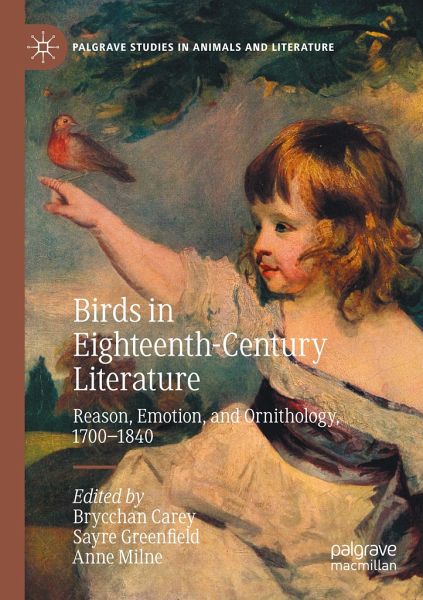
This book examines literary representations of birds from across the world in anage of expanding European colonialism. It offers important new perspectives intothe ways birds populate and generate cultural meaning in a variety of literary andnon-literary genres from 1700-1840 as well as throughout a broad range ofecosystems and bioregions. It considers a wide range of authors, including someof the most celebrated figures in eighteenth-century literature such as John Gay,Henry Fielding, Laurence Sterne, Anna Letitia Barbauld, William Cowper, MaryWollstonecraft, Thomas Bewick, Charlotte Smith, William Wordsworth, andGilbert White. ignwogwog[p…mehr
This book examines literary representations of birds from across the world in anage of expanding European colonialism. It offers important new perspectives intothe ways birds populate and generate cultural meaning in a variety of literary andnon-literary genres from 1700-1840 as well as throughout a broad range ofecosystems and bioregions. It considers a wide range of authors, including someof the most celebrated figures in eighteenth-century literature such as John Gay,Henry Fielding, Laurence Sterne, Anna Letitia Barbauld, William Cowper, MaryWollstonecraft, Thomas Bewick, Charlotte Smith, William Wordsworth, andGilbert White. ignwogwog[p
Brycchan Carey is Professor of English at Northumbria University, Newcastle upon Tyne, UK. The author of numerous publications on eighteenth-century literature and culture, his monographs include British Abolitionism and the Rhetoric of Sensibility: Writing, Sentiment, and Slavery, 1760-1807 (2005) and From Peace to Freedom: Quaker Rhetoric and the Birth of American Antislavery, 1657-1761 (2012). Sayre Greenfield is Professor of English at the University of Pittsburgh at Greensburg, USA. He has been a research fellow at Chawton House Library and has recently contributed an essay on Shakespearean allusions to The Cambridge Guide to the Worlds of Shakespeare and various essays on Austen to Persuasions: The Jane Austen Journal. He is also the co-editor of Jane Austen in Hollywood (2001) and the author of The Ends of Allegory (1998). Anne Milne is Lecturer at the University of Toronto Scarborough, Canada. She was a Carson Fellow at the Rachel Carson Center for Environment and Society in Munich, Germany (2011) and published 'Lactilla Tends Her Fav'rite Cow': Ecocritical Readings of Animals and Women in Eighteenth-Century British Labouring-Class Women's Poetry in 2008. Her research highlights animals, environment, and local cultural production in eighteenth-century British poetry.
Inhaltsangabe
1. Introduction; Brycchan Carey, Sayre Greenfield, and Anne Milne.- 2. Avian Encounters and Moral Sentiment in Poetry from Eighteenth-Century Ireland; Lucy Collins.- 3. Ortolans, Partridges, and Pullets: Birds as Prey in Henry Fielding's Tom Jones; Leslie Aronson.- 4. 'In Clouds Unnumber'd': Anna Letitia Barbauld's 'Birds and Insects', Speculative Ecology, and the Politics of Naturalism; D. T. Walker.- 5. Charlotte Smith and the Nightingale; Bethan Roberts.- 6. The Labouring-Class Bird; Nancy M. Derbyshire.- 7. The Language of Birds and the Language of Real Men: Wordsworth, Coleridge and the 'Best Part' of Language; Francesca Mackenney.- 8. 'No Parrot, Either in Morality or Sentiment': Talking Birds and Mechanical Copying in the Age of Sensibility; Alex Wetmore.- 9. Placing Birds in Place: Reading Habitat in Beilby's and Bewick's History of British Birds; Anne Milne.- 10. The Literary Gilbert White; Brycchan Carey.- 11. When Poet Meets Penguin: British Verse Confronts Exotic Avifauna; Sayre Greenfield.- 12. Bird Metaphors in Racialised Ethnographic Description, c. 1700-1800'; George T. Newberry.- 13.'The Incomparable Curiosity of Every Feather!': Cotton Mather's Birds; Nicholas Junkerman.- 14. The Passenger Pigeon and the New World Myth of Plenitude; Kevin Joel Berland.
1. Introduction; Brycchan Carey, Sayre Greenfield, and Anne Milne.- 2. Avian Encounters and Moral Sentiment in Poetry from Eighteenth-Century Ireland; Lucy Collins.- 3. Ortolans, Partridges, and Pullets: Birds as Prey in Henry Fielding's Tom Jones; Leslie Aronson.- 4. 'In Clouds Unnumber'd': Anna Letitia Barbauld's 'Birds and Insects', Speculative Ecology, and the Politics of Naturalism; D. T. Walker.- 5. Charlotte Smith and the Nightingale; Bethan Roberts.- 6. The Labouring-Class Bird; Nancy M. Derbyshire.- 7. The Language of Birds and the Language of Real Men: Wordsworth, Coleridge and the 'Best Part' of Language; Francesca Mackenney.- 8. 'No Parrot, Either in Morality or Sentiment': Talking Birds and Mechanical Copying in the Age of Sensibility; Alex Wetmore.- 9. Placing Birds in Place: Reading Habitat in Beilby's and Bewick's History of British Birds; Anne Milne.- 10. The Literary Gilbert White; Brycchan Carey.- 11. When Poet Meets Penguin: British Verse Confronts Exotic Avifauna; Sayre Greenfield.- 12. Bird Metaphors in Racialised Ethnographic Description, c. 1700-1800'; George T. Newberry.- 13.'The Incomparable Curiosity of Every Feather!': Cotton Mather's Birds; Nicholas Junkerman.- 14. The Passenger Pigeon and the New World Myth of Plenitude; Kevin Joel Berland.
Es gelten unsere Allgemeinen Geschäftsbedingungen: www.buecher.de/agb
Impressum
www.buecher.de ist ein Internetauftritt der buecher.de internetstores GmbH
Geschäftsführung: Monica Sawhney | Roland Kölbl | Günter Hilger
Sitz der Gesellschaft: Batheyer Straße 115 - 117, 58099 Hagen
Postanschrift: Bürgermeister-Wegele-Str. 12, 86167 Augsburg
Amtsgericht Hagen HRB 13257
Steuernummer: 321/5800/1497
USt-IdNr: DE450055826