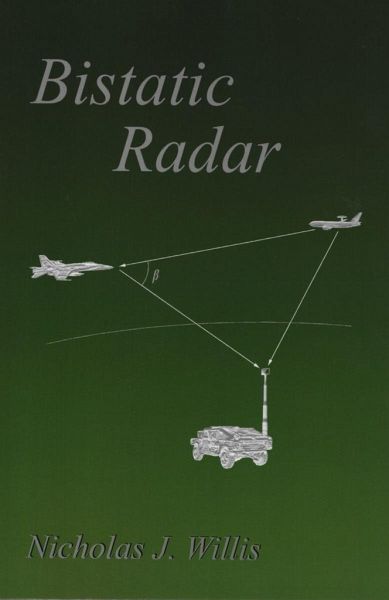
This is the only English language book on bistatic radar and provides a history of bistatic systems that points out to potential designers, the applications that have worked and the dead-ends not worth pursuing.
This is the only English language book on bistatic radar and provides a history of bistatic systems that points out to potential designers, the applications that have worked and the dead-ends not worth pursuing.
Nicholas J. Willis received a BS degree in mathematics from Stanford University in 1956 under an NROTC-Holloway scholarship. He spent five years in the U.S. Navy, two on destroyers and three the Talos guided missile program sixteen years in industry with Philco-Ford, SRI International and Systems Control, Inc.; five years at DARPA; and a final 17 years at Technology Service Corp. Mr Willis now consults and conducts short courses for government and industry. As an SES-3 at DARPA's Tactical Technology Office, Mr Willis was responsible for radar, EW and land warfare programs, including bistatic radars, LPI radars and in particular Pave Mover, the forerunner of JSTARS. When at TSC, he designed one of the F-22 radar modes. Mr Willis has won the DoD's JDR Best Paper Award twice.
Inhaltsangabe
Chapter 1: Introduction and Overview Chapter 2: History Chapter 3: Coordinate Systems, Geometry, and Equations Chapter 4: Range Relationships Chapter 5: Location and Area Relationships Chapter 6: Doppler Relationships Chapter 7: Target Resolution Chapter 8: Target Cross Section Chapter 9: Clutter Chapter 10: Electronic Countermeasures and Counter-Countermeasures Chapter 11: Multistatic Radars Chapter 12: Special Concepts and Applications Chapter 13: Special Problems and Requirements Appendix A: Early Publications of Bistatic Radar Phenomenology Appendix B: Width of a Bistatic Range Cell Appendix C: Approximation to the Location Equation Appendix D: Area within a Maximum Range Oval of Cassini Appendix E: Relationships Between Parameters in Target Location and Clutter Doppler Spread Equations Appendix F: Orthogonal Conic Section Theorems
Chapter 1: Introduction and Overview Chapter 2: History Chapter 3: Coordinate Systems, Geometry, and Equations Chapter 4: Range Relationships Chapter 5: Location and Area Relationships Chapter 6: Doppler Relationships Chapter 7: Target Resolution Chapter 8: Target Cross Section Chapter 9: Clutter Chapter 10: Electronic Countermeasures and Counter-Countermeasures Chapter 11: Multistatic Radars Chapter 12: Special Concepts and Applications Chapter 13: Special Problems and Requirements Appendix A: Early Publications of Bistatic Radar Phenomenology Appendix B: Width of a Bistatic Range Cell Appendix C: Approximation to the Location Equation Appendix D: Area within a Maximum Range Oval of Cassini Appendix E: Relationships Between Parameters in Target Location and Clutter Doppler Spread Equations Appendix F: Orthogonal Conic Section Theorems
Es gelten unsere Allgemeinen Geschäftsbedingungen: www.buecher.de/agb
Impressum
www.buecher.de ist ein Internetauftritt der buecher.de internetstores GmbH
Geschäftsführung: Monica Sawhney | Roland Kölbl | Günter Hilger
Sitz der Gesellschaft: Batheyer Straße 115 - 117, 58099 Hagen
Postanschrift: Bürgermeister-Wegele-Str. 12, 86167 Augsburg
Amtsgericht Hagen HRB 13257
Steuernummer: 321/5800/1497
USt-IdNr: DE450055826