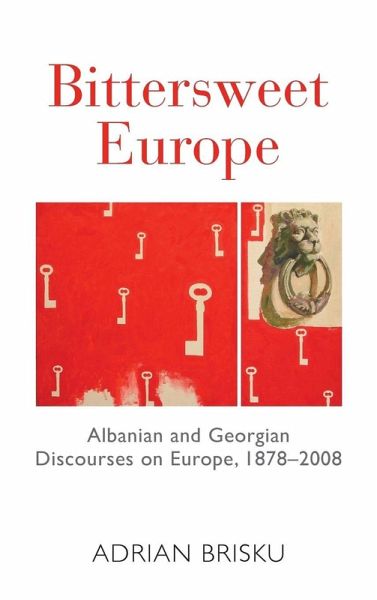
A rare comparative account of how ‘Europe’, as a cultural category, has been seen from its margins as opposed to how "Europe" has viewed its peripheries, "demi-Orient" or "Orient". Valuable historical perspective on political and geo-political discourses on ‘Europe’ as well as socio-economic alternatives generated from two peripheral countries. Illuminates tensions, conflicts, debates and dilemmas triggered by the normativity of "Europeanness", and the desire to make it a component of national identities. Draws on massive new material unknown outside Georgia and Albania.
Adrian Brisku is a research fellow at the University of Helsinki, working on the "Research Project Europe 1815-1914," funded by the European Research Council (ERC). His interests include comparative political and intellectual European history with a particular focus on modern Albania and Georgia and nineteenth-century Ottoman and Russian empires.
Inhaltsangabe
Chapter 1. Nationhood and Empire: A Tale of Historical and Ethno-cultural Similarities and Differences Chapter 2. From Empire to Independence: Europe as the Future Chapter 3. The Nation-State in Imperial/Supranational Shadow: the Apparent Decline of Europe Chapter 4. Communist Experiences in a Divided Europe Chapter 5. 'Return to Europe', 'Closer to Europe': Post-communist Expectations Epilogue: Is 'Europe' still the Future? Bibliograhpy Index
Es gelten unsere Allgemeinen Geschäftsbedingungen: www.buecher.de/agb
Impressum
www.buecher.de ist ein Internetauftritt der buecher.de internetstores GmbH
Geschäftsführung: Monica Sawhney | Roland Kölbl | Günter Hilger
Sitz der Gesellschaft: Batheyer Straße 115 - 117, 58099 Hagen
Postanschrift: Bürgermeister-Wegele-Str. 12, 86167 Augsburg
Amtsgericht Hagen HRB 13257
Steuernummer: 321/5800/1497
USt-IdNr: DE450055826