
Sunil Gupta, Hitesh Kumar Sharma, Monit Kapoor
Blockchain for Secure Healthcare Using Internet of Medical Things (IoMT)
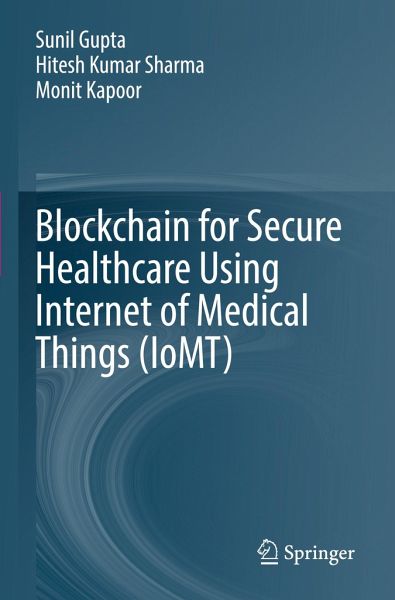
Sunil Gupta, Hitesh Kumar Sharma, Monit Kapoor
Blockchain for Secure Healthcare Using Internet of Medical Things (IoMT)
- Broschiertes Buch
- Merkliste
- Auf die Merkliste
- Bewerten Bewerten
- Teilen
- Produkt teilen
- Produkterinnerung
- Produkterinnerung
Healthcare has become an extremely important and relevant topic in day to day discussions ever since the COVID-19 pandemic has been encountered by the global population. This has led to a renewed focus and attention that researchers from every discipline have put in to realize better strategies for healthcare management in general. This book is an attempt to put to use recent advancements in the field of the Internet of Medical Things often called IoMT, which is an extension of IoT for real-time, data analytics-driven prompt and quality healthcare to global citizens. Security has been always a…mehr
Andere Kunden interessierten sich auch für
") Sunil GuptaBlockchain for Secure Healthcare Using Internet of Medical Things (IoMT)136,99 €
Sunil GuptaBlockchain for Secure Healthcare Using Internet of Medical Things (IoMT)136,99 € Decision and Game Theory for Security38,99 €
 Blockchain Intelligence113,99 €
 Smart Cities38,99 €
 Blockchain Intelligence113,99 €
 SharlinMachine Learning: The Guardian Angel of the Burgeoning Internet of Things26,10 €
 Blockchain in Life Sciences38,99 €
-
-
-


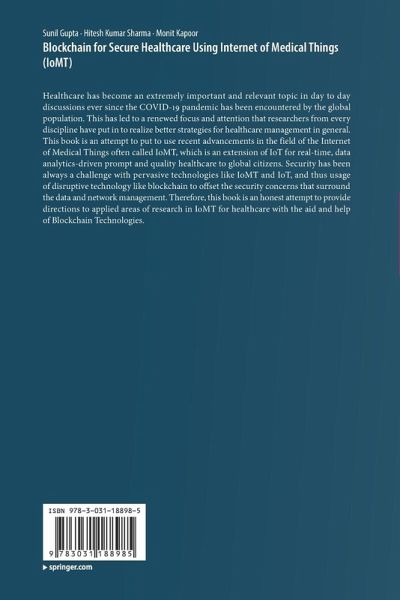
Healthcare has become an extremely important and relevant topic in day to day discussions ever since the COVID-19 pandemic has been encountered by the global population. This has led to a renewed focus and attention that researchers from every discipline have put in to realize better strategies for healthcare management in general. This book is an attempt to put to use recent advancements in the field of the Internet of Medical Things often called IoMT, which is an extension of IoT for real-time, data analytics-driven prompt and quality healthcare to global citizens. Security has been always a challenge with pervasive technologies like IoMT and IoT, and thus usage of disruptive technology like blockchain to offset the security concerns that surround the data and network management. Therefore, this book is an honest attempt to provide directions to applied areas of research in IoMT for healthcare with the aid and help of Blockchain Technologies.
Produktdetails
- Produktdetails
- Verlag: Springer / Springer International Publishing / Springer, Berlin
- Artikelnr. des Verlages: 978-3-031-18898-5
- Seitenzahl: 220
- Erscheinungstermin: 16. Dezember 2023
- Englisch
- Abmessung: 235mm x 155mm x 13mm
- Gewicht: 341g
- ISBN-13: 9783031188985
- ISBN-10: 3031188985
- Artikelnr.: 69481641
- Herstellerkennzeichnung
- Springer-Verlag KG
- Sachsenplatz 4-6
- 1201 Wien, AT
- ProductSafety@springernature.com
- Verlag: Springer / Springer International Publishing / Springer, Berlin
- Artikelnr. des Verlages: 978-3-031-18898-5
- Seitenzahl: 220
- Erscheinungstermin: 16. Dezember 2023
- Englisch
- Abmessung: 235mm x 155mm x 13mm
- Gewicht: 341g
- ISBN-13: 9783031188985
- ISBN-10: 3031188985
- Artikelnr.: 69481641
- Herstellerkennzeichnung
- Springer-Verlag KG
- Sachsenplatz 4-6
- 1201 Wien, AT
- ProductSafety@springernature.com
Dr. Gunjan Chhabra is a PhD in computer science and engineering, working as Associate Professor in the Department of Computer Science and Engineering, Graphic Era Hill University, Dehradun. He has a teaching experience of 9 years and the area of his expertise is algorithms, image processing and machine learning. He has published eight patents, with two granted patents from IPR. Also, he has published several research papers in various renowned journals. Additionally, he has authored two textbooks in the domain of the Internet of Things and image processing. He has also mentored many projects in different domains of computer science. Under his guidance, his students have successfully incubated their ideas as start-ups. His area of research is Artificial Intelligence, Machine Learning, IoT, and Cyber Security. Dr. Sunil Kumar is Assistant Professor (Selection Grade) in the Cybernetics Cluster under School of Computer Science at the University of Petroleum and Energy Studies (UPES), Dehradun (India). He received B.Tech. (2006) in Computer Science and Engineering from Kurukshetra University, Kurukshetra, India, M.Tech. in Computer Science and Engineering from MMU, Ambala, India, and Ph.D. (2021) in Computer Science and Engineering from University of Petroleum and Energy Studies, Dehradun, India. He is Founder Member of OPEN community under University of Petroleum and Energy Studies, Dehradun. He has published more than 20 papers including refereed journals and international conferences. His area of research is WSN, deep learning, IoT, and data mining. Dr. Sunil Gupta has over more than 19 years of experience in teaching, research, and industry in the field of computer science and engineering. Prior to joining UPES as Professor, he has worked with BML Munjal University, Delhi Technical Campus, IP University, Northern India Engineering College, IP University, IIMT, Baddi University of Emerging Science, IFTM University, and Physical Laboratory. He is Active Member of IEEE Society, Computer Society of India, Member, Computer Science Teacher Association, Life Member, International Association of Engineers, Member, International Association of Computer Science and Information Technology, Member, and Internet Society (ISOC). He has conducted various workshops, conferences, and FDP. He guides various students for research and project work. He has authored 69 research papers, six patents, and two textbooks, namely Cryptography and Network Security and Wireless Sensor Networks. His academic interest includes security, cloud computing, big data, sensor, wireless networks, and health care. He has successfully completed various research projects and consultancy from government and private organization like Department of Science and technology, Xcrino Business Solutions, and more. He has been regularly invited as Technical Expert in different committees by both private and government organizations and as Expert for recruiting faculty by different colleges affiliated to GGSIPU. He has been nominated in JAC (Joint Assessment Committee) as Technical Expert by GGSIPU to evaluate the functioning of various colleges (both Govt. and Private) affiliated to same. He is Reviewer of international journal namely Journal of Supercomputing, published by Springer Netherlands, International Journal of Wireless Networks by Springer, International Journal of Computer and Electrical Engineering, Singapore, and Member of Scientific Committee and Editorial Review Board on Engineering and Physical Sciences for World Academy of Science, Engineering and Technology and many more. Dr. Pooja Nagpal is working as Associate Professor at School of Engineering and Technology, K R Mangalam University, Gurgaon, Haryana, India. She has completed her Ph.D. in Computer Science and Engineering (2021). She has attained her M.Tech. in CSE (2011) from NIT Kurukshetra and B.Tech. CSE from Kurukshetra University. Her total work experience is around 14 years. Her research area inc
1. Chapter.- 1.1. Introduction.- 1.2. Smart Healthcare and Telemedical System.- 1.2.1. Smart Healthcare Technology.- 1.2.2. Remote monitoring and automated healthcare system.- 1.2.3. Remote Care and Telehealth.- 1.2.4. Emergency response solution for connectivity.- 1.2.5. Smart Hospital Management.- 1.3. Telemedical Healthcare.- 1.3.1. Registration Phase.- 1.3.2. Login Phase and Mutual Authentication.- 1.3.3. Telemedicine Server.- 1.4. Intelligent Medical Care using IoT.- 1.5. Smart Healthcare: Challenges and Threats.- Conclusion.- References.- 2. Chapter.- 2.1. Introduction.- 2.2. IoT Related Sub-Components.- 2.2.1. Embedded programming.- 2.2.2. Hardware device.- 2.2.3. Security.- 2.2.4. Networking and cloud Integration.- 2.2.5. Data Analytics and prediction.- 2.2.6. Machine Learning and AI.- 2.3. Architecture of IoT.- .- 2.3.1. Sensors and Actuators.- 2.3.2. Internet gateway.- 2.3.3. Edge Computing IT System.- 2.3.4. Data Centre and Cloud.- 2.3.5. Application of IoT.- 2.3.6. Smart Homes.- 2.3.7. Smart Agriculture.- 2.3.8. Energy Management.- 2.3.9. Industrial Internet.- 2.4. IoT In Healthcare.- 2.4.1. Remote patient monitoring.- 2.4.2. Real time Data Tracking.- 2.4.3. Connected wearables.- 2.5. Internet of Medical Things (IoMT or IoMedT).- 2.6. Challenges for IoMT.- Conclusion.- References.- 3. Chapter.- 3.1. Introduction.- 3.2. IoT Components.- 3.2.1. Devices/Sensors.- 3.2.2. Connectivity.- 3.2.3. Data Processing.- 3.2.4. User Interface.- 3.3. IoMedT Components.- 3.3.1. Patient and Payer.- 3.3.2. Connected Medical Devices.- 3.3.3. Communication Services (Connectivity).- 3.3.4. Analytics Platform (Data Processing.- .- 3.3.5. Service Providers.- 3.4. Integration of Latest Technology with IoMedT .- 3.5. Benefits and Challenges of IoMedT .- 3.5.1. Benefits of IoMedT .- 3.5.2. Challenges in IoMedT.- Conclusion.- References.- 4. Chapter .- 4.1. Introduction to Smart healthcare and IoMT.- 4.2. Perception layer - Sensor systems for data collection .- 4.2.1. Gateway layer .- 4.2.2. Management service layer/application support layer- data storage .- 4.2.3. Application/service layer .- 4.3. IoMT: A boon in healthcare.- 4.4. Challenges of IoMT .- 4.5. Benefits of IoMT .- 4.6. Structural components of IoMT .- 4.7. Functional components of IoMT.- 4.8. Structural and Functional Challenges .- Conclusion.- References.- 5. Chapter.- 5.1. Introduction.- 5.2. Working of Blockchain .- 5.2.1. Distributed Database.- 5.2.2. A network of nodes.- 5.2.3. Building Trust.- 5.3. Benefits of Blockchain Technology.- 5.3.1. Time-saving.- .- 5.3.2. Cost-saving .- 5.3.3. Tighter security.- 5.4. Application of Blockchain .- 5.4.1. Asset Management .- 5.4.2. Cross-Border Payments .- 5.4.3. Healthcare .- 5.4.4. Cryptocurrency .- 5.4.5. Birth and Death Certificates .- 5.4.6. Online Identity Verification.- 5.4.7. Internet of Things .- 5.4.8. Copyright and Royalties .- 5.5. Application of Blockchain in Smart Healthcare .- 5.5.1. Research .- 5.5.2. Seamless switching of patients between providers .- 5.5.3. Faster, cheaper, better patient care .- 5.5.4. Interoperable electronic health records .- 5.5.5. Data security .- 5.5.6. Mobile health apps and remote monitoring .- 5.5.7. Tracing and securing medical supplies .- 5.5.8. Health insurance claims .- 5.5.9. Tracking diseases and outbreaks .- 5.5.10. Safeguarding genomics .- Conclusion.- References.- 6. Chapter .- 6.1. Introduction.- 6.2. Possible Security Attacks in DMR Internet of Things Networks.- 6.3. Security Schemes and There Challenges in DMR.- Conclusion.- .- References.- 7. Chapter.- 7.1. Introduction .- 7.2. Benefits of IoMT in Smart Healthcare .- 7.2.1. Cost Reduction .- 7.2.2. Improve Treatment .- 7.2.3. Faster Disease Diagnosis .- 7.2.4. Drug and Equipment Management .- 7.2.5. Error Reduction .- 7.3. Tools and Technique for IoMT in Smart Healthcare .- 7.3.1. Electronic Health Record (EHR) .- 7.3.2. Referral Trackers .- 7.3.3. Patient Portals .- 7.3.4. Remote Patient Monitoring .- 7.3.5. Computerized Provider Order Entry .- 7.4. Use case of IoMT in Healthcare Industry .- 7.4.1. Internet of things for patients.- 7.4.2. Internet of things for Hospitals .- 7.4.3. Internet of things for Physicians.- 7.4.4. Internet of things for Business .- 7.4.5. Internet of things for Health Insurance Companies .- 7.5. Privacy and Security Issue in IoMT.- 7.5.1. Patients are not in charge of their own information .- 7.5.2. Present to Your Own Device (BYOD) .- 7.5.3. Telecommuting presents security chances .- 7.6. Challenges of IoMT in Smart Healthcare .- 7.6.1. Underdeveloped Initiatives .- 7.6.2. Unavailability of Memory .- 7.6.3. Keeping Updated.- 7.6.4. Data Security .- 7.6.5. Global healthcare regulations .- 7.6.6. Scalable Platforms .- 7.6.7. Data Overloading .- 7.7. Impact of IoMT on the future of the healthcare industry .- Conclusion .- References.- 8. Chapter .- 8.1. Introduction .- 8.1.1. Big Data relation with Cloud Computing .- 8.1.2. Relationship between IoMT and Big Data.- 8.1.3. Big Data and the Internet of Medical Things .- 8.1.4. IoT and Cloud Computing.- 8.1.5. Benefits of using big data, IoT and the cloud .- 8.2. IoMT needs to be integrated with cloud computing .- 8.3. Integration of IoT and Cloud Computing .- 8.4. Benefits of integrating IoT and cloud computing .- Conclusion .- References .- 9. Chapter .- 9.1. Introduction.- 9.1.1. IoT in Smart Healthcare Systems.- 9.2. Background/Present state in Data security.- 9.2.1. Data Security requirements in Smart Healthcare Systems.- 9.3. Privacy and QoS in smart healthcare.- 9.4. Data Security and Privacy Issues in Healthcare .- 9.5. QoS Parameters for Smart Healthcare.- 9.6. Suggested Security Techniques to Preserve QoS.- Conclusion .- References .- 10. Chapter .- 10.1. Introduction.- 10.2. Authentication Schemes for Tele Medical Healthcare System.- 10.3. Processes of an authentication protocol.- Conclusion .- References .- 11. Chapter .- 11.1. Introduction.- 11.1.1. Security .- 11.1.2. Features.- 11.2. Types of Blockchain Networks .- 11.2.1. Public blockchain network .- 11.2.2. Private blockchain network.- 11.2.3. Permissioned blockchain network.- 11.2.4. Consortium Blockchain networks.- 11.3. Applications of Blockchain.- 11.3.1. Smart contracts.- 11.3.2. Involving Blockchain into Internet of Things (IOT).- 11.3.3. Preventing Identity Theft .- 11.4. Application of Blockchain in Smart Healthcare.- 11.4.1. Keeping transparency in delivering healthcare goods.- 11.4.2. Storing of medical data of patients.- 11.4.3. Remote health monitoring using IOT and blockchain .- 11.5. Electronic Health Record (EHR) and its Storage.- 11.5.1. Medical Big Data Mining and Processing in e-Healthcar.- 11.5.2. Smart healthcare systems using big data.- 11.6. Significance of Blockchain in Security of Electronic Health Record (EHR).- Conclusion.- References .- 12. Chapter .- 12.1. Introduction.- 12.1.1. A Different Healthcare World.- 12.2. Components of Telemedicine.- 12.2.1. Teleconsultation.- 12.2.2. Telementoring.- 12.2.3. Telemonitoring.- 12.3. Emerging technologies in telemedicine .- 12.3.1. Technologies proceeding telemedicine.- 12.3.2. mRNA Technology.- 12.3.3. Neurotechnology.- 12.3.4. Precision Medicine.- 12.3.5. Clustered Regularly Interspaced Short Palindromic Repeats (CRISPR).- 12.3.6. Health Wearables.- 12.3.7. Technology in Mental Health.- 12.3.8. Artificial Intelligence.- 12.3.9. Augmented and virtual reality.- 12.3.10. Tele-robots .- 12.3.11. IoT and nanotechnology .- 12.3.12. 3D Printing.- 12.3.13. Enhanced Access to Medical Data and Information.- 12.3.14. Big Data.- 12.3.15. Improved Lines of Communication.- 12.3.16. Electronic Health Records.- 12.3.17. Metaverse.- Conclusion .- References .- 13. Chapter.- 13.1. Introduction.- 13.1.1. AI and Machine Learning .- 13.1.2. Cloud Computing .- 13.1.3. Cyber security/Cloud Security .- 13.2. Role of Artificial Intelligence, Cloud Computing, and Internet Security in Smart Healthcare .- 13.2.1. Artificial Intelligence and Machine Learning (AIML) in Healthcare Systems 182.- 13.2.2. Early Cancer Diagnosis .- 13.2.3. Diagnosis of Fatal Blood Diseases .- 13.2.4. Customer Service Chatbots .- 13.2.5. Managing the Medical Records .- 13.2.6. Dosage Errors .- 13.2.7. Robotic Surgeries .- 13.3. Cloud Computing in Healthcare Systems .- 13.4. Security Challenge in Smart Healthcare .- Conclusion.- References .- 14. Chapter .- 14.1. Introduction .- 14.1.1. Capturing storage techniques for healthcare data .- 14.1.2. About Healthcare Data .- 14.1.3. Data storage .- 14.1.4. Onsite data storage .- 14.1.5. Public cloud data storage .- 14.1.6. Hybrid cloud data storage solution .- 14.1.7. Benefits of storing data on the cloud from multiple sources .- 14.2. ML-enabled storage systems .- 14.3. The current state of technology .- 14.4. Enhancing existing Enterprise Data Warehouses (EDW) .- 14.5. Background work .- 14.6. ML techniques for treatment of healthcare data .- 14.7. Smart access techniques for storage systems .- 14.8. Prediction of diseases on healthcare data, both batch, and real-time data streams 197.- Conclusion .- References .- 15. Chapter .- 15.1. Introduction .- 15.2. Smart Healthcare Tools and Techniques .- 15.2.1. Cloud Computing in Smart Healthcare .- 15.2.2. Medical Records Centralization .- 15.2.3. Promoting Patient Engagement .- 15.2.4. Better Scalability .- 15.2.5. Cost-Effectiveness .- 15.2.6. Advanced Analytics for Healthcare .- 15.3. Current and Future application of AI, IoT, Blockchain and Cloud Computing in Smart Healthcare . 210.- 15.3.1. Applications of Artificial Intelligence in Smart Healthcare .- 15.3.2. Machine learning neural networks and deep learning .- 15.3.3. Physical robots 15.3.4. Natural language processing (NLP) .- 15.3.5. Applications of Internet of Things (IoT) in Smart Healthcare.- 15.3.6. Applications of Blockchain in Smart Healthcare .- 15.3.7. Applications of Cloud Computing in Smart Healthcare .- 15.4. Challenges in Smart Healthcare .- 15.4.1. Availability .- 15.4.2. Data Centralization .- 15.4.3. Privacy/Security .- 15.4.4. Open Access.- 15.5. Future of Smart Healthcare and Telemedicine.- Conclusion.- References.
1. Chapter.- 1.1. Introduction.- 1.2. Smart Healthcare and Telemedical System.- 1.2.1. Smart Healthcare Technology.- 1.2.2. Remote monitoring and automated healthcare system.- 1.2.3. Remote Care and Telehealth.- 1.2.4. Emergency response solution for connectivity.- 1.2.5. Smart Hospital Management.- 1.3. Telemedical Healthcare.- 1.3.1. Registration Phase.- 1.3.2. Login Phase and Mutual Authentication.- 1.3.3. Telemedicine Server.- 1.4. Intelligent Medical Care using IoT.- 1.5. Smart Healthcare: Challenges and Threats.- Conclusion.- References.- 2. Chapter.- 2.1. Introduction.- 2.2. IoT Related Sub-Components.- 2.2.1. Embedded programming.- 2.2.2. Hardware device.- 2.2.3. Security.- 2.2.4. Networking and cloud Integration.- 2.2.5. Data Analytics and prediction.- 2.2.6. Machine Learning and AI.- 2.3. Architecture of IoT.- .- 2.3.1. Sensors and Actuators.- 2.3.2. Internet gateway.- 2.3.3. Edge Computing IT System.- 2.3.4. Data Centre and Cloud.- 2.3.5. Application of IoT.- 2.3.6. Smart Homes.- 2.3.7. Smart Agriculture.- 2.3.8. Energy Management.- 2.3.9. Industrial Internet.- 2.4. IoT In Healthcare.- 2.4.1. Remote patient monitoring.- 2.4.2. Real time Data Tracking.- 2.4.3. Connected wearables.- 2.5. Internet of Medical Things (IoMT or IoMedT).- 2.6. Challenges for IoMT.- Conclusion.- References.- 3. Chapter.- 3.1. Introduction.- 3.2. IoT Components.- 3.2.1. Devices/Sensors.- 3.2.2. Connectivity.- 3.2.3. Data Processing.- 3.2.4. User Interface.- 3.3. IoMedT Components.- 3.3.1. Patient and Payer.- 3.3.2. Connected Medical Devices.- 3.3.3. Communication Services (Connectivity).- 3.3.4. Analytics Platform (Data Processing.- .- 3.3.5. Service Providers.- 3.4. Integration of Latest Technology with IoMedT .- 3.5. Benefits and Challenges of IoMedT .- 3.5.1. Benefits of IoMedT .- 3.5.2. Challenges in IoMedT.- Conclusion.- References.- 4. Chapter .- 4.1. Introduction to Smart healthcare and IoMT.- 4.2. Perception layer - Sensor systems for data collection .- 4.2.1. Gateway layer .- 4.2.2. Management service layer/application support layer- data storage .- 4.2.3. Application/service layer .- 4.3. IoMT: A boon in healthcare.- 4.4. Challenges of IoMT .- 4.5. Benefits of IoMT .- 4.6. Structural components of IoMT .- 4.7. Functional components of IoMT.- 4.8. Structural and Functional Challenges .- Conclusion.- References.- 5. Chapter.- 5.1. Introduction.- 5.2. Working of Blockchain .- 5.2.1. Distributed Database.- 5.2.2. A network of nodes.- 5.2.3. Building Trust.- 5.3. Benefits of Blockchain Technology.- 5.3.1. Time-saving.- .- 5.3.2. Cost-saving .- 5.3.3. Tighter security.- 5.4. Application of Blockchain .- 5.4.1. Asset Management .- 5.4.2. Cross-Border Payments .- 5.4.3. Healthcare .- 5.4.4. Cryptocurrency .- 5.4.5. Birth and Death Certificates .- 5.4.6. Online Identity Verification.- 5.4.7. Internet of Things .- 5.4.8. Copyright and Royalties .- 5.5. Application of Blockchain in Smart Healthcare .- 5.5.1. Research .- 5.5.2. Seamless switching of patients between providers .- 5.5.3. Faster, cheaper, better patient care .- 5.5.4. Interoperable electronic health records .- 5.5.5. Data security .- 5.5.6. Mobile health apps and remote monitoring .- 5.5.7. Tracing and securing medical supplies .- 5.5.8. Health insurance claims .- 5.5.9. Tracking diseases and outbreaks .- 5.5.10. Safeguarding genomics .- Conclusion.- References.- 6. Chapter .- 6.1. Introduction.- 6.2. Possible Security Attacks in DMR Internet of Things Networks.- 6.3. Security Schemes and There Challenges in DMR.- Conclusion.- .- References.- 7. Chapter.- 7.1. Introduction .- 7.2. Benefits of IoMT in Smart Healthcare .- 7.2.1. Cost Reduction .- 7.2.2. Improve Treatment .- 7.2.3. Faster Disease Diagnosis .- 7.2.4. Drug and Equipment Management .- 7.2.5. Error Reduction .- 7.3. Tools and Technique for IoMT in Smart Healthcare .- 7.3.1. Electronic Health Record (EHR) .- 7.3.2. Referral Trackers .- 7.3.3. Patient Portals .- 7.3.4. Remote Patient Monitoring .- 7.3.5. Computerized Provider Order Entry .- 7.4. Use case of IoMT in Healthcare Industry .- 7.4.1. Internet of things for patients.- 7.4.2. Internet of things for Hospitals .- 7.4.3. Internet of things for Physicians.- 7.4.4. Internet of things for Business .- 7.4.5. Internet of things for Health Insurance Companies .- 7.5. Privacy and Security Issue in IoMT.- 7.5.1. Patients are not in charge of their own information .- 7.5.2. Present to Your Own Device (BYOD) .- 7.5.3. Telecommuting presents security chances .- 7.6. Challenges of IoMT in Smart Healthcare .- 7.6.1. Underdeveloped Initiatives .- 7.6.2. Unavailability of Memory .- 7.6.3. Keeping Updated.- 7.6.4. Data Security .- 7.6.5. Global healthcare regulations .- 7.6.6. Scalable Platforms .- 7.6.7. Data Overloading .- 7.7. Impact of IoMT on the future of the healthcare industry .- Conclusion .- References.- 8. Chapter .- 8.1. Introduction .- 8.1.1. Big Data relation with Cloud Computing .- 8.1.2. Relationship between IoMT and Big Data.- 8.1.3. Big Data and the Internet of Medical Things .- 8.1.4. IoT and Cloud Computing.- 8.1.5. Benefits of using big data, IoT and the cloud .- 8.2. IoMT needs to be integrated with cloud computing .- 8.3. Integration of IoT and Cloud Computing .- 8.4. Benefits of integrating IoT and cloud computing .- Conclusion .- References .- 9. Chapter .- 9.1. Introduction.- 9.1.1. IoT in Smart Healthcare Systems.- 9.2. Background/Present state in Data security.- 9.2.1. Data Security requirements in Smart Healthcare Systems.- 9.3. Privacy and QoS in smart healthcare.- 9.4. Data Security and Privacy Issues in Healthcare .- 9.5. QoS Parameters for Smart Healthcare.- 9.6. Suggested Security Techniques to Preserve QoS.- Conclusion .- References .- 10. Chapter .- 10.1. Introduction.- 10.2. Authentication Schemes for Tele Medical Healthcare System.- 10.3. Processes of an authentication protocol.- Conclusion .- References .- 11. Chapter .- 11.1. Introduction.- 11.1.1. Security .- 11.1.2. Features.- 11.2. Types of Blockchain Networks .- 11.2.1. Public blockchain network .- 11.2.2. Private blockchain network.- 11.2.3. Permissioned blockchain network.- 11.2.4. Consortium Blockchain networks.- 11.3. Applications of Blockchain.- 11.3.1. Smart contracts.- 11.3.2. Involving Blockchain into Internet of Things (IOT).- 11.3.3. Preventing Identity Theft .- 11.4. Application of Blockchain in Smart Healthcare.- 11.4.1. Keeping transparency in delivering healthcare goods.- 11.4.2. Storing of medical data of patients.- 11.4.3. Remote health monitoring using IOT and blockchain .- 11.5. Electronic Health Record (EHR) and its Storage.- 11.5.1. Medical Big Data Mining and Processing in e-Healthcar.- 11.5.2. Smart healthcare systems using big data.- 11.6. Significance of Blockchain in Security of Electronic Health Record (EHR).- Conclusion.- References .- 12. Chapter .- 12.1. Introduction.- 12.1.1. A Different Healthcare World.- 12.2. Components of Telemedicine.- 12.2.1. Teleconsultation.- 12.2.2. Telementoring.- 12.2.3. Telemonitoring.- 12.3. Emerging technologies in telemedicine .- 12.3.1. Technologies proceeding telemedicine.- 12.3.2. mRNA Technology.- 12.3.3. Neurotechnology.- 12.3.4. Precision Medicine.- 12.3.5. Clustered Regularly Interspaced Short Palindromic Repeats (CRISPR).- 12.3.6. Health Wearables.- 12.3.7. Technology in Mental Health.- 12.3.8. Artificial Intelligence.- 12.3.9. Augmented and virtual reality.- 12.3.10. Tele-robots .- 12.3.11. IoT and nanotechnology .- 12.3.12. 3D Printing.- 12.3.13. Enhanced Access to Medical Data and Information.- 12.3.14. Big Data.- 12.3.15. Improved Lines of Communication.- 12.3.16. Electronic Health Records.- 12.3.17. Metaverse.- Conclusion .- References .- 13. Chapter.- 13.1. Introduction.- 13.1.1. AI and Machine Learning .- 13.1.2. Cloud Computing .- 13.1.3. Cyber security/Cloud Security .- 13.2. Role of Artificial Intelligence, Cloud Computing, and Internet Security in Smart Healthcare .- 13.2.1. Artificial Intelligence and Machine Learning (AIML) in Healthcare Systems 182.- 13.2.2. Early Cancer Diagnosis .- 13.2.3. Diagnosis of Fatal Blood Diseases .- 13.2.4. Customer Service Chatbots .- 13.2.5. Managing the Medical Records .- 13.2.6. Dosage Errors .- 13.2.7. Robotic Surgeries .- 13.3. Cloud Computing in Healthcare Systems .- 13.4. Security Challenge in Smart Healthcare .- Conclusion.- References .- 14. Chapter .- 14.1. Introduction .- 14.1.1. Capturing storage techniques for healthcare data .- 14.1.2. About Healthcare Data .- 14.1.3. Data storage .- 14.1.4. Onsite data storage .- 14.1.5. Public cloud data storage .- 14.1.6. Hybrid cloud data storage solution .- 14.1.7. Benefits of storing data on the cloud from multiple sources .- 14.2. ML-enabled storage systems .- 14.3. The current state of technology .- 14.4. Enhancing existing Enterprise Data Warehouses (EDW) .- 14.5. Background work .- 14.6. ML techniques for treatment of healthcare data .- 14.7. Smart access techniques for storage systems .- 14.8. Prediction of diseases on healthcare data, both batch, and real-time data streams 197.- Conclusion .- References .- 15. Chapter .- 15.1. Introduction .- 15.2. Smart Healthcare Tools and Techniques .- 15.2.1. Cloud Computing in Smart Healthcare .- 15.2.2. Medical Records Centralization .- 15.2.3. Promoting Patient Engagement .- 15.2.4. Better Scalability .- 15.2.5. Cost-Effectiveness .- 15.2.6. Advanced Analytics for Healthcare .- 15.3. Current and Future application of AI, IoT, Blockchain and Cloud Computing in Smart Healthcare . 210.- 15.3.1. Applications of Artificial Intelligence in Smart Healthcare .- 15.3.2. Machine learning neural networks and deep learning .- 15.3.3. Physical robots 15.3.4. Natural language processing (NLP) .- 15.3.5. Applications of Internet of Things (IoT) in Smart Healthcare.- 15.3.6. Applications of Blockchain in Smart Healthcare .- 15.3.7. Applications of Cloud Computing in Smart Healthcare .- 15.4. Challenges in Smart Healthcare .- 15.4.1. Availability .- 15.4.2. Data Centralization .- 15.4.3. Privacy/Security .- 15.4.4. Open Access.- 15.5. Future of Smart Healthcare and Telemedicine.- Conclusion.- References.