
Andere Kunden interessierten sich auch für
 Blue Economy in Indian Sundarbans76,99 €
 Blue Economy and Smart Sea Transport Systems38,99 €
 The Blue Economy106,99 €
 The Blue Economy76,99 €
 Sustainability Conflicts in Coastal India76,99 €
 Blue Carbon Dynamics of the Indian Ocean160,49 €
 Blue Carbon Dynamics of the Indian Ocean83,99 €


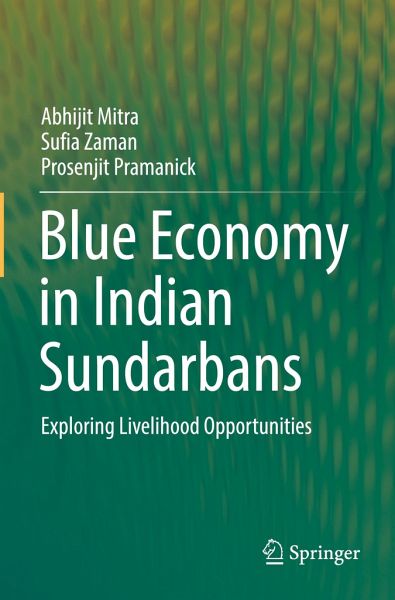
This book provides a cross-sectoral, multidisciplinary assessment of the major verticals of Blue Economy relevant to the mangrove ecosystem in Indian Sundarbans, which is a deltaic complex at the apex of Bay of Bengal. This book evaluates the feasibility of Blue Economy considering the natural resource base in this mangrove dominated deltaic complex.
Chapter 1 discusses the need of expanding different marine and estuarine oriented verticals of Blue Economy as the land resources are gradually becoming depleted. Chapter 2 highlights the wide spectrum of biotic and abiotic resources of the Indian Sundarbans which can serve as the strong foundation of expanding Blue Economy in the region. Chapter 3 highlights several mangrove based livelihoods that are not only innovative, but may present new opportunities to initiate cottage industries. Chapter 4 highlights the threats associated with Blue Economy in Indian Sundarbans like, sea level rise, acidification of water, weather extremes, pollution, over-exploitation of natural resources, etc., along with ground-zero environmental data collated over three decades. Chapter 5 offers several solutions to combat the threats to regional Blue Economy emphasizing both technology and policy based management. The book attempts to align the proliferation of different sectors of Blue Economy in the framework of Indian Sundarbans.
Chapter 1 discusses the need of expanding different marine and estuarine oriented verticals of Blue Economy as the land resources are gradually becoming depleted. Chapter 2 highlights the wide spectrum of biotic and abiotic resources of the Indian Sundarbans which can serve as the strong foundation of expanding Blue Economy in the region. Chapter 3 highlights several mangrove based livelihoods that are not only innovative, but may present new opportunities to initiate cottage industries. Chapter 4 highlights the threats associated with Blue Economy in Indian Sundarbans like, sea level rise, acidification of water, weather extremes, pollution, over-exploitation of natural resources, etc., along with ground-zero environmental data collated over three decades. Chapter 5 offers several solutions to combat the threats to regional Blue Economy emphasizing both technology and policy based management. The book attempts to align the proliferation of different sectors of Blue Economy in the framework of Indian Sundarbans.