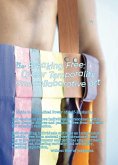
Derek Jarman’s Blue weaves a sensory tapestry that serves as both a political call to action and a meditation on illness, dying, and love. “For Blue there are no boundaries or solutions.” —Derek Jarman Originally released as a feature film in 1993, the year before the acclaimed artist and filmmaker Derek Jarman’s death due to an AIDS-related illness, Blue is a daring and powerful work of art. The film and its script, as reproduced in this volume, serve as an impassioned response to the lack of political engagement with the AIDS crisis. Jarman’s Blue moves through myriad scenes, some banal,…mehr
Derek Jarman’s Blue weaves a sensory tapestry that serves as both a political call to action and a meditation on illness, dying, and love. “For Blue there are no boundaries or solutions.” —Derek Jarman Originally released as a feature film in 1993, the year before the acclaimed artist and filmmaker Derek Jarman’s death due to an AIDS-related illness, Blue is a daring and powerful work of art. The film and its script, as reproduced in this volume, serve as an impassioned response to the lack of political engagement with the AIDS crisis. Jarman’s Blue moves through myriad scenes, some banal, others fantastical. Stories of quotidian life––getting coffee, reading the newspaper, and walking down the sidewalk––escalate to visions of Marco Polo, the Taj Mahal, or blue fighting yellow. Facing death and a cascade of pills, Jarman presents his illness in delirium and metaphors. He contemplates the physicality of emotions in lyrical prose as he grounds this story in the constant return to Blue—a color, a feeling, a funk. Michael Charlesworth’s compelling introduction brings Blue into conversation with Jarman’s visual paintings.
Derek Jarman (1942–1994) was an English artist, filmmaker, set designer, diarist, author, and gardener. After attending King's College London and the Slade School of Art, he began a career as a painter. As a set designer, he worked on such productions as The Royal Ballet’s Jazz Calendar (1968) and The English National Opera’s production of Don Giovanni (1968), as well as a number of films. In the early 1970s, Jarman began a series of filmworks made with Super 8, followed by his first full-length feature film, Sebastiane, in 1975. He went on to make ten more feature films, among them the famous experimental Caravaggio (1986) and The Garden (1990). His final feature, Blue, was first shown at the Biennale Arte, Venice, in June 1993, seven months before his death.
Es gelten unsere Allgemeinen Geschäftsbedingungen: www.buecher.de/agb
Impressum
www.buecher.de ist ein Internetauftritt der buecher.de internetstores GmbH
Geschäftsführung: Monica Sawhney | Roland Kölbl | Günter Hilger
Sitz der Gesellschaft: Batheyer Straße 115 - 117, 58099 Hagen
Postanschrift: Bürgermeister-Wegele-Str. 12, 86167 Augsburg
Amtsgericht Hagen HRB 13257
Steuernummer: 321/5800/1497
USt-IdNr: DE450055826