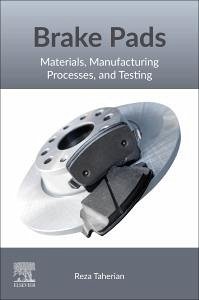
Brake Pads: Materials, Manufacturing Processes, and Testing offers a comprehensive resource on this vital component of the braking system of a variety of vehicles (passenger cars, light commercial vehicles, buses, trucks, and airplanes). This specialized volume aims to bridge the theory and practice of designing and producing well-performing, greener, and cost-effective brake pads. It encompasses, in Part I, an overview of friction materials already available on the market and other more recently developed formulations and, in Part II, step-by-step examinations of a range of manufacturing…mehr
Brake Pads: Materials, Manufacturing Processes, and Testing offers a comprehensive resource on this vital component of the braking system of a variety of vehicles (passenger cars, light commercial vehicles, buses, trucks, and airplanes). This specialized volume aims to bridge the theory and practice of designing and producing well-performing, greener, and cost-effective brake pads. It encompasses, in Part I, an overview of friction materials already available on the market and other more recently developed formulations and, in Part II, step-by-step examinations of a range of manufacturing parameters with related effects on the specific properties of the selected compounds as well as testing techniques. Discussions on regulatory standards, literature reviews, case studies, application scenarios, and analytical modeling make for a unique contribution that is not only timely but also shows the field’s potential for ever-growing transformation.
Reza Taherian, Associate Professor and Head of the Polymer Research Laboratory, Faculty of Chemical and Materials Engineering, Shahrood University of Technology, Iran. He received his PhD in Materials Engineering from Shiraz University in 2011. His research interests and related publication works center on carbon-polymer composites, with investigations of their porosity, conductivity, and mechanical and thermal properties. For Elsevier, he has previously authored Electrical Conductivity in Polymer-Based Composites (2018). He has commercialized products through his company in the field of electrically and thermally conductive adhesives, and is actively involved in manufacturing and consulting with various companies on the production of composites reinforced with carbon and glass fibers for applications such as PEM fuel cells, aircraft bodies, and similar technologies.
Inhaltsangabe
Part I: Materials 1. Classification of brake pads in automotive and aerospace applications 2. An overview of composite materials 3. Binders for brake pads 4. Reinforcement fiber materials for brake pads 5. Organic additives for brake pads 6. Filler materials for brake pads 7. Abrasive and lubricant materials for brake pads 8. Carbon allotropes in Brake Pads 9. Using eco-friendly materials in brake pads 10. Design and materials of aircraft brake pads: types, formulations, and case studies Part II: Manufacturing, testing, and modeling 11. Manufacturing parameters (i.e., temperature, pressure, mixing method, and heat treatment) and their effect on the properties of brake pads 12. Mechanical and tribological testing in brake pads: wear resistance, coefficient of friction, hardness, tensile, and compression tests 13. Thermal conductivity in brake pads 14. Noise testing 15. Porosity in brake pads: origins, measurement, and its influence on performance 16. Advancements in brake pad modeling and predictive maintenance
Part I: Materials 1. Classification of brake pads in automotive and aerospace applications 2. An overview of composite materials 3. Binders for brake pads 4. Reinforcement fiber materials for brake pads 5. Organic additives for brake pads 6. Filler materials for brake pads 7. Abrasive and lubricant materials for brake pads 8. Carbon allotropes in Brake Pads 9. Using eco-friendly materials in brake pads 10. Design and materials of aircraft brake pads: types, formulations, and case studies Part II: Manufacturing, testing, and modeling 11. Manufacturing parameters (i.e., temperature, pressure, mixing method, and heat treatment) and their effect on the properties of brake pads 12. Mechanical and tribological testing in brake pads: wear resistance, coefficient of friction, hardness, tensile, and compression tests 13. Thermal conductivity in brake pads 14. Noise testing 15. Porosity in brake pads: origins, measurement, and its influence on performance 16. Advancements in brake pad modeling and predictive maintenance
Es gelten unsere Allgemeinen Geschäftsbedingungen: www.buecher.de/agb
Impressum
www.buecher.de ist ein Internetauftritt der buecher.de internetstores GmbH
Geschäftsführung: Monica Sawhney | Roland Kölbl | Günter Hilger
Sitz der Gesellschaft: Batheyer Straße 115 - 117, 58099 Hagen
Postanschrift: Bürgermeister-Wegele-Str. 12, 86167 Augsburg
Amtsgericht Hagen HRB 13257
Steuernummer: 321/5800/1497
USt-IdNr: DE450055826