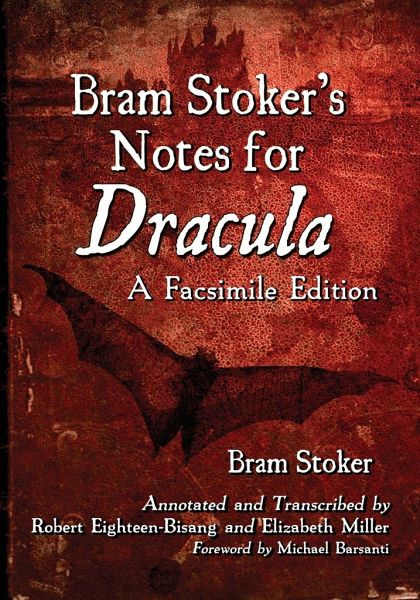
Bram Stoker's initial notes and outlines for his landmark horror novel Dracula were auctioned at Sotheby's in London in 1913 and eventually made their way to the Rosenbach Museum and Library in Philadelphia, where they are housed today. Until now, few of the 124 pages have been transcribed or analyzed. This painstaking work reproduces the handwritten notes both in facsimile and in annotated transcription. It also includes Stoker's typewritten research notes and thoroughly analyzes all of the materials, which range from Stoker's thoughts on the novel's characters and settings to a nine-page…mehr
Bram Stoker's initial notes and outlines for his landmark horror novel Dracula were auctioned at Sotheby's in London in 1913 and eventually made their way to the Rosenbach Museum and Library in Philadelphia, where they are housed today. Until now, few of the 124 pages have been transcribed or analyzed. This painstaking work reproduces the handwritten notes both in facsimile and in annotated transcription. It also includes Stoker's typewritten research notes and thoroughly analyzes all of the materials, which range from Stoker's thoughts on the novel's characters and settings to a nine-page calendar of events that includes most of the now-familiar story. Ample annotations guide readers through the construction of the novel and the changes that were made to its structure, plot, setting and characters. Nine appendices provide insight into Stoker's personal life, his other works and his early literary influences.
Born November 8th, 1847, in Dublin Ireland, Bram Stoker was raised a Protestant in the Church of Ireland. Bedridden with a mysterious illness until he was 7 years old, he nevertheless lived a healthy and successful life. He became the only student to ever be both the auditor of the College Historical Society and the president of the University Philosophical Society at Trinity College, Dublin.He curated a peerless friend group which consisted of Henry Irving, Oscar Wilde, and Sir Arthur Conan Doyle. Through his friendship with Irving, he was invited to the White House and met both William McKinley and Theodore Roosevelt. During these trips, he also became acquainted with Walt Whitman.While working as Irving's manager and as director of London's Lyceum Theatre, Stoker began to write his stories, including Dracula, The Lady of the Shroud, and, the last work before his death, The Lair of the White Worm. After suffering from several strokes, he died in London on April 20, 1912.
Inhaltsangabe
Table of Contents Acknowledgments Foreword by Michael Barsanti Introduction Methodology Bram Stoker's Original Foundation Notes & Data for His "Dracula" Part I: Handwritten Notes on the Plot Part II: Handwritten Research Notes ("'Dracula' Notes, etc.") Part III: Typed Research Notes ("'Dracula' Notes. etc.") Overview The Myth of Dracula Appendices: I. The Rosenbach Page Numbers II. Bram Stoker: A Brief Biography III. Bram Stoker: A Brief Bibliography IV. Bram Stoker's Nonfiction Sources for Dracula V. "Vampire" from the Encyclopædia Britannica (1888) VI. Possible Literary Influences VII. Bram Stoker's Library VIII. Dracula: The Novel vs. the Notes IX. Dracula: The Novel We Could Have Read Works Cited Index of Bram Stoker's Original Notes (as Transcribed) Index of Editors' Annotations
Table of Contents Acknowledgments Foreword by Michael Barsanti Introduction Methodology Bram Stoker's Original Foundation Notes & Data for His "Dracula" Part I: Handwritten Notes on the Plot Part II: Handwritten Research Notes ("'Dracula' Notes, etc.") Part III: Typed Research Notes ("'Dracula' Notes. etc.") Overview The Myth of Dracula Appendices: I. The Rosenbach Page Numbers II. Bram Stoker: A Brief Biography III. Bram Stoker: A Brief Bibliography IV. Bram Stoker's Nonfiction Sources for Dracula V. "Vampire" from the Encyclopædia Britannica (1888) VI. Possible Literary Influences VII. Bram Stoker's Library VIII. Dracula: The Novel vs. the Notes IX. Dracula: The Novel We Could Have Read Works Cited Index of Bram Stoker's Original Notes (as Transcribed) Index of Editors' Annotations
Es gelten unsere Allgemeinen Geschäftsbedingungen: www.buecher.de/agb
Impressum
www.buecher.de ist ein Internetauftritt der buecher.de internetstores GmbH
Geschäftsführung: Monica Sawhney | Roland Kölbl | Günter Hilger
Sitz der Gesellschaft: Batheyer Straße 115 - 117, 58099 Hagen
Postanschrift: Bürgermeister-Wegele-Str. 12, 86167 Augsburg
Amtsgericht Hagen HRB 13257
Steuernummer: 321/5800/1497
USt-IdNr: DE450055826