
Andere Kunden interessierten sich auch für
 Bertolt Brecht in America124,99 €
 Bertolt Brecht in America45,99 €
 Theatre of Meyerhold and Brecht52,99 €
 Collected Short Stories of Bertolt Brecht101,99 €
 The Life and Work of Gunter Grass38,99 €
 Woyzeck14,99 €
 Geschichten vom Herrn Keuner24,00 €
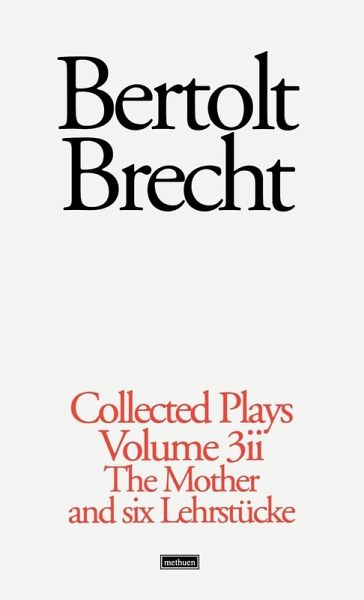
"One of the greatest poets and dramatists of our century" (Observer) Brecht's Lehrstücke or short 'didactic' pieces written during the years 1929 to 1933, are some of his most experimental work. Rejecting conventional theatre, they are spare and highly formalised, drawing on traditional Japanese and Chinese theatre. They show Brecht in collaboration with the composers Hindemith, Weill and Eisler, influenced by the new techniques of montage in the visual arts and seeking new means of expression. Brecht intended them for performance by schools, workers' groups and choral societies rather than by professionals, with the idea that the moral and political lessons contained in them are best conveyed by participating in an actual production. In addition to the Lehrstücke, the volume contains The Mother, a longer play, again with music by Eisler, based on the novel by Gorky. A story of dawning political consciousness, told with irony and narrative drive, its central character is one of Brecht's great female roles. The original production starred Brecht's wife Helene Weigel and Brecht was buried with the red flag that was a prop in the production.
Bertolt Brecht (1898-1956) is acknowledged as one of the great dramatists whose plays, work with the Berliner Ensemble and critical writings have had a considerable influence on the theatre. His landmark plays include The Threepenny Opera, Fear and Misery of the Third Reich, The Life of Galileo, Mother Courage and Her Childrenand The Caucasian Chalk Circle.
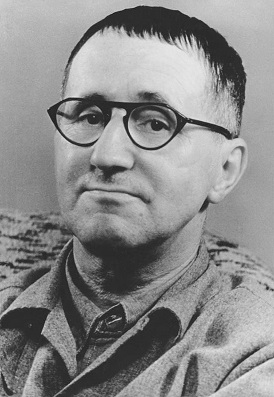
Bundesarchiv, Bild 183-W0409-300 / Kolbe, Jörg / CC-BY-SA