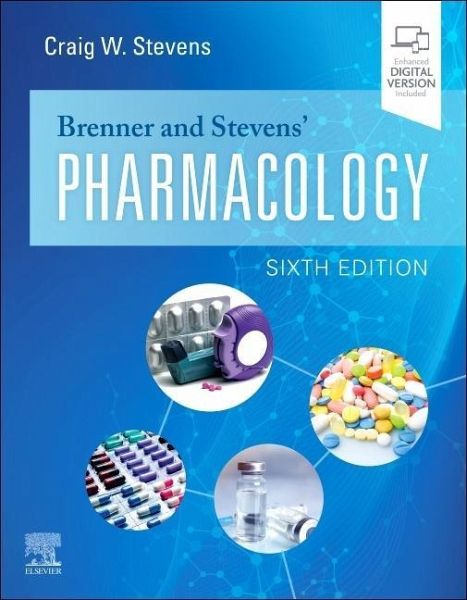
More detailed than an outlined review but less overwhelming than an encyclopedic reference, Brenner and Stevens' Pharmacology, 6th Edition, focuses on the essential principles you need to know in a concise, easy-to-understand manner. Authored by Craig W. Stevens, PhD, this highly illustrated introductory text helps you learn and retain key information in pharmacology-taking you from course exams and the USMLE Step 1 right through to clinical practice. New and extensively revised content keeps you up to date with the latest pharmacologic mechanisms and applications. Teaches the fundamental…mehr
More detailed than an outlined review but less overwhelming than an encyclopedic reference, Brenner and Stevens' Pharmacology, 6th Edition, focuses on the essential principles you need to know in a concise, easy-to-understand manner. Authored by Craig W. Stevens, PhD, this highly illustrated introductory text helps you learn and retain key information in pharmacology-taking you from course exams and the USMLE Step 1 right through to clinical practice. New and extensively revised content keeps you up to date with the latest pharmacologic mechanisms and applications. Teaches the fundamental aspects of pharmacology using full-color illustrations, detailed explanations, and a consistent format to present classification of drugs for each system/diseaseHelps you understand both the basic science foundations and clinical applications of pharmacology, with useful tables, drug classifications boxes, case studies, and self-assessments in each chapter to help you review and prepare for course exams and Step 1Includes the latest drugs and therapeutic indications (more than 100 are new to this edition), along with an entirely new chapter on recent developments of immunopharmacology drugs, including antivirals and vaccinationsAddresses key topics such as antiviral and monoclonal drugs to treat COVID-19, the opioid epidemic, and gene therapyFeatures more than 700 new and updated images, with many revised figures focused on clearing presenting the mechanism of action of drugsIncludes access to bonus eBook content such as animations, an additional glossary, chapter-by-chapter summaries and case studies, a full list of featured drugs, 150 USMLE-style self-assessment questions, and moreEnhanced eBook version included with purchase. Your enhanced eBook allows you to access all of the text, figures, and references from the book on a variety of devices
Craig W. Stevens, Ph.D. is a professor of Pharmacology at Oklahoma State University and is co-author of Brenner and Stevens' Pharmacology, a popular pharmacology textbook now in its 5th Edition. He also wrote and edited two books on G-protein coupled receptors entitled Methods for the Discovery and Characterization of G Protein-Coupled Receptors (Springer Protocols, 2011) and G Protein-Coupled Receptor Genetics: Research and Methods in the Post-Genomic Era (Springer Methods in Pharmacology and Toxicology, 2014). He has just finished working on a new book for the Science and Technology Pharmacology list called The Drug Expert: A Practical Guide to the Impact of Drug Use in Legal Proceedings which is a guide for pharmacologists aiming to be successful as drug litigation consultants and a helpful book for the lawyers that hire them. Dr. Stevens maintains a second career as an expert witness in Pharmacology (Drug Expert) and has consulted for lawyers on over 80 cases in both criminal and civil proceedings.
Inhaltsangabe
Section I PRINCIPLES OF PHARMACOLOGY 1. Introduction to Pharmacology and Drug Names 2. Pharmacokinetics or What the Body Does to the Drug 3. Pharmacodynamics or What the Drug Does to the Body 4. Drug Development and Drug Safety 35 5. Toxicology Principles and the Treatment of Poisoning Section II AUTONOMIC AND NEUROMUSCULAR PHARMACOLOGY 6. Parasympathetic, Neuromuscular Pharmacology, and Cholinergic Agonists 7. Cholinergic Receptor Antagonists 8. Sympathetic Neuropharmacology and Adrenergic Agonists 9. Adrenergic Receptor Antagonists Section III CARDIOVASCULAR, RENAL, AND HEMATOLOGIC PHARMACOLOGY 10. Antihypertensive Drugs 11. Antianginal Drugs 12. Drugs for the Treatment of Heart Failure 13. Diuretic Drugs 14. Drugs for Cardiac Dysrhythmia 15. Drugs for Hyperlipidemia 16. Antithrombotic and Thrombolytic Drugs 17. Hematopoietic Drugs Section IV CENTRAL NERVOUS SYSTEM PHARMACOLOGY 18. Introduction to Central Nervous System Pharmacology 19. Sedative-Hypnotic and Anxiolytic Drugs 20. Antiepileptic Drugs 21. Local and General Anesthetics 22. Psychotherapeutic Drugs 23. Opioid Analgesics and Antagonists 24. Drugs for Neurodegenerative Diseases 25. Drugs of Abuse Section V PHARMACOLOGY OF RESPIRATORY AND OTHER SYSTEMS 26. Autacoid Drugs That Mimic Endogenous Substances 27. Pharmacological Treatment of Respiratory Disorders 28. Pharmacological Treatment of Gastrointestinal Disorders 29. Drugs for Headache Disorders 30. Drugs for Pain, Inflammation, and Arthritic Disorders Section VI ENDOCRINE PHARMACOLOGY 31. Hypothalamic and Pituitary Hormone Drugs 32. Drugs for the Treatment of Thyroid Disorders 33. Adrenal Steroids and Related Drugs 34. Fertility and Reproduction Drugs 35. Drugs for the Treatment of Diabetes 36. Drugs Affecting Calcium and Bone Formation Section VII ANTIMICROBIAL AND CHEMOTHERAPEUTIC AGENTS 37. Principles of Antimicrobial Chemotherapy 38. Antibiotics That Inhibit Bacterial Cell Wall Synthesis 39. Antibiotics That Inhibit Bacterial Protein Synthesis 40. Other Antimicrobial Agents Such as Quinolones and Antifolate Drugs 41. Antimycobacterial Drugs for Treating Tuberculosis and Other Diseases 42. Drugs for the Treatment of Fungal Infections 43. Drugs for the Treatment of Viral Infections 44. Drugs for the Treatment of Parasites 45. Antineoplastic Agents 46. Immunopharmacology, Biologicals, and Gene Therapy
Es gelten unsere Allgemeinen Geschäftsbedingungen: www.buecher.de/agb
Impressum
www.buecher.de ist ein Internetauftritt der buecher.de internetstores GmbH
Geschäftsführung: Monica Sawhney | Roland Kölbl | Günter Hilger
Sitz der Gesellschaft: Batheyer Straße 115 - 117, 58099 Hagen
Postanschrift: Bürgermeister-Wegele-Str. 12, 86167 Augsburg
Amtsgericht Hagen HRB 13257
Steuernummer: 321/5800/1497
USt-IdNr: DE450055826