
Andere Kunden interessierten sich auch für
 British Light Cruisers 1939-4515,99 €
 Commonwealth Cruisers 1939-4515,99 €
 Blitz on Britain, 1939-4522,99 €
 Italian Navy & Air Force Elite Units & Special Forces 1940-4516,99 €
 Swansea's Frontline Kids 1939-4515,99 €
 Hong Kong 1941-4519,99 €
 Typhoon Wings of 2nd TAF 1943-4519,99 €
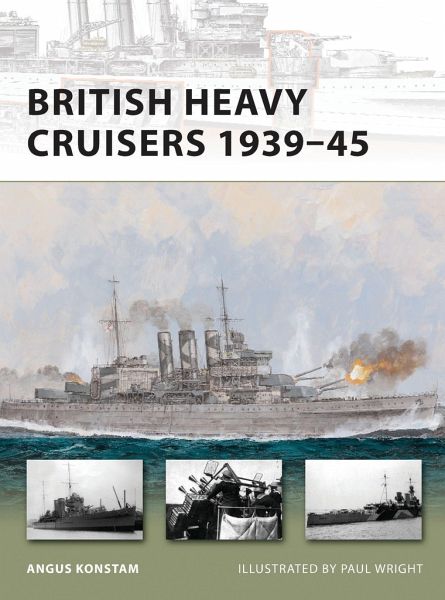
The idea of a heavy cruiser emerged in the aftermath of the First World War, and was closely linked to the limits set by the inter-war Washington Treaty on naval armament. The pre-Great War concept of armoured cruisers had been abandoned, but in their stead the Admiralty saw a place for powerful cruisers, able to patrol the sea lanes of the British Empire, and which were well-enough armed that they could destroy enemy commerce cruisers of the kind used by the Germans in the last war. The result was a group of British warships which were collectively known as the "Washington Treaty Cruisers", which did everything the Admiralty wanted, but which fitted within the limits imposed by the Washington Treaty - an armament of 8-inch guns, and a displacement of less than 10,000 tons. These impressive cruisers were high-sided, spacious and stately - perfect peacetime ambassadors for British power. In war they also packed a considerable punch. While they all carried powerful 8-inch guns, they were also given an effective armoured belt, making them proof against any foreign cruisers then in service. During the Second World War the Royal Navy's thirteen heavy cruisers saw service in every theatre of war, whether taking part in major sea battles in the Mediterranean, delivering the coup de grace to the Bismarck in the North Atlantic, or enduring the unwanted attention of kamikaze pilots in the Pacific.