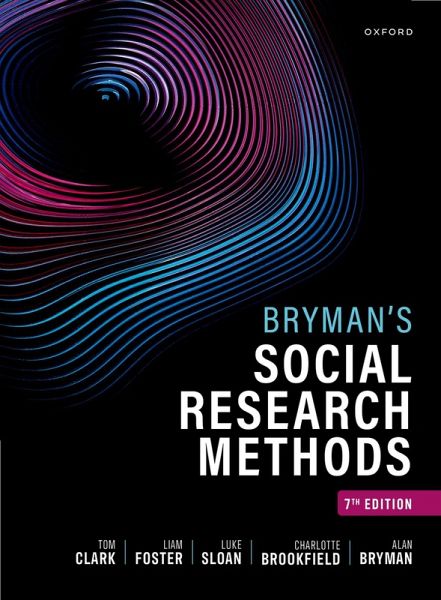
62,99 €
inkl. MwSt.
Versandkostenfrei*Erscheint vorauss. 2. April 2026
Melden Sie sich
hier
hier
für den Produktalarm an, um über die Verfügbarkeit des Produkts informiert zu werden.

31 °P sammeln
Andere Kunden interessierten sich auch für
 Doing Digital Methods Paperback with Interactive eBook50,99 €
 Little Quick Fixes for Research Projects Set 202174,99 €
 Conversations about Qualitative Communication Research45,99 €
 Is The Bible For Real6,99 €
 Methods and Assessment in Culture and Psychology46,99 €
 Using Qualitative Methods to Answer Your Research Question32,99 €
 Developing and Evaluating Methods for Using American Community Survey Data to Support the School Meals Programs43,99 €

The bestselling introduction to research methods, offering unrivalled coverage of both quantitative and qualitative methods to support students through the whole research process. Clear, comprehensive, and trusted, Bryman's Social Research Methods has guided over a quarter of a million students through their research methods course and student research project. The seventh edition offers unrivalled coverage of quantitative, qualitative, and mixed methods, reflecting today's evolving landscape. Key Features: - Exceptionally comprehensive but practical and student-friendly, offering clear and complete coverage of all the key areas of social research methods. - Clear theoretical explanations in the main text are enhanced by 'Key concept' boxes, which summarize important terms and processes, and 'Thinking deeply' boxes, which encourage students to go further in considering an issue or debate. - Numerous examples of published research, in 'Research in focus' boxes, help bridge the gap between theory and practice. Spanning cultures, geographies, and academic disciplines, these studies reflect the breadth of issues explored in social science: they cover a huge range of topics, from climate change, ageing, and gender, to true-crime podcasts, gambling, and exorcisms. - Students seeking practical guidance for conducting their own research can hone in on punchy 'Tips and skills' boxes, end-of-chapter 'Checklists', and 'Learn from experience' boxes in which recent graduates share insights from their research into a variety of fascinating topics - including social media attitudes towards the LGBT+ community, and the experiences of Pakistani Muslim single mothers. - Also available as an e-book enhanced with self-assessment activities and multi-media content to offer a fully immersive experience and extra learning support. Extensive digital resources help students grasp key concepts and develop practical research skills. They include multiple choice questions, quantitative self-test activities, videos from the 'Learn from experience' graduates, and screencast tutorials for the main data analysis software programmes (Excel, SPSS, Nvivo, R, and Stata). New to this edition: - Meet your author team: Tom Clark, Liam Foster, and Luke Sloan return with their trusted expertise, and are now joined by Charlotte Brookfield, who brings fresh insights. Together, they've worked closely with students and lecturers to make the book even more relevant to your studies. - Know before you dive in: Each chapter now starts with clear learning objectives, helping you focus your reading, understand key takeaways, and prepare more effectively for assignments and exams. - Stay ahead with up-to-date content: New material on cutting-edge topics like artificial intelligence in research, ethical challenges in the digital age, and how technology is transforming data collection and analysis prepares you to engage with the latest developments in the field. - See how research works in the real world: Updated examples and citations reflect current methods and global contexts, helping you connect theory to practice and understand how research is applied across disciplines and cultures. - Explore creative ways to do research: A brand-new chapter, Chapter 23, introduces innovative qualitative methods-like arts-based, sensory, and Indigenous approaches-giving you fresh ideas for designing your own projects. - Get confident with data analysis: Chapter 15 now features a case study on social media use, plus new coverage of ANOVA and T-tests, helping you build practical skills in quantitative analysis. - Boost your skills with interactive digital resources: Test your knowledge with video quizzes and interactive activities, and get hands-on support using key software tools like SPSS, NVivo, R, Stata, and Excel. Only available in the enhanced eBook.