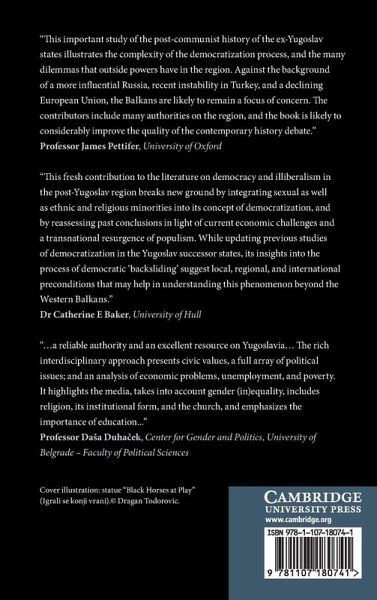
Building democracy in societies that have known only authoritarian rule for half a century is complicated. Taking the post-Yugoslav region as its case study, this volume shows how success with democratisation depends on various factors, including establishing the rule of law, the consolidation of free media, and society's acceptance of ethnic, religious and sexual minorities. Surveying the seven successor states, the authors argue that Slovenia is in a class by itself as the most successful, with Croatia and Serbia not far behind. The other states - Bosnia-Herzegovina, Macedonia, Montenegro,…mehr
Building democracy in societies that have known only authoritarian rule for half a century is complicated. Taking the post-Yugoslav region as its case study, this volume shows how success with democratisation depends on various factors, including establishing the rule of law, the consolidation of free media, and society's acceptance of ethnic, religious and sexual minorities. Surveying the seven successor states, the authors argue that Slovenia is in a class by itself as the most successful, with Croatia and Serbia not far behind. The other states - Bosnia-Herzegovina, Macedonia, Montenegro, and Kosovo - are all struggling with problems of corruption, poverty, and unemployment. The authors treat the issue of values as a policy problem in its own right, debating the extent to which values have been transformed by changes in education and the media, how churches and women's organisations have entered into the policy debate, and whether governments have embraced a programme designed to effect changes in values.
Table of contents; Preface; List of tables; Part I. Introduction and Theory: 1. The challenge of democratization: an introduction Sabrina P. Ramet; 2. Post-Yugoslav patterns of democratization Florian Bieber; 3. The importance of tolerance: intolerance and its consequences in the Yugoslav successor states Zachary T. Irwin; 4. Institutional trust in the Yugoslav successor states: a comparative approach Karin Dyrstad and Ola Listhaug; 5. Political culture in the Yugoslav successor states Andrej Kirbi and Sergej Flere; 6. The impact of the ICTY on democratization in the Yugoslav successor states Jovana Mihajlovi Trbovc and Vladimir Petrovi ; Part II. Country Studies: 7. Building democracy in Serbia: one step forward, three steps back Jelena Suboti ; 8. Building democracy in Croatia since 1990 Dunja Mel i ; 9. A durable oligarchy: Bosnia and Herzegovina's false postwar democratic transition Kurt Bassuener; 10. Liberal democracy in Slovenia: from seventh heaven to the lobby of hell in only two decades Alenka Kraovec and Sabrina P. Ramet; 11. Macedonia's post-Yugoslav reality: corruption, wiretapping, and stolen elections Sabrina P. Ramet; 12. Building democracy in the Western Balkans: the case of Kosovo Vladimir or evi ; 13. The trajectory and parameters of democratic transition in Montenegro Kenneth Morrison; 14. Building democracy in Vojvodina Angela Ili ; Part III. Conclusion: 15. Where does Europe end? A conclusion Christine M. Hassenstab; About the editors and contributors; For further reading.
Es gelten unsere Allgemeinen Geschäftsbedingungen: www.buecher.de/agb
Impressum
www.buecher.de ist ein Internetauftritt der buecher.de internetstores GmbH
Geschäftsführung: Monica Sawhney | Roland Kölbl | Günter Hilger
Sitz der Gesellschaft: Batheyer Straße 115 - 117, 58099 Hagen
Postanschrift: Bürgermeister-Wegele-Str. 12, 86167 Augsburg
Amtsgericht Hagen HRB 13257
Steuernummer: 321/5800/1497
USt-IdNr: DE450055826