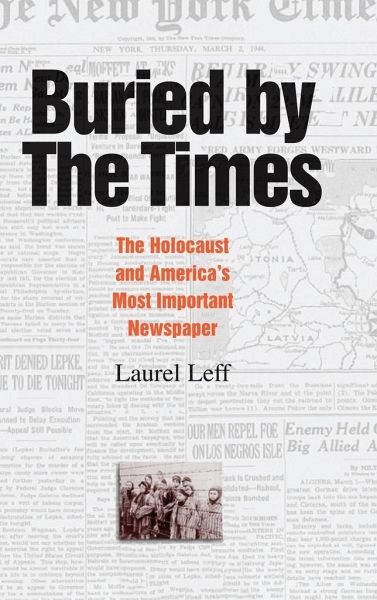
An in-depth look at how The New York Times failed in its coverage of the fate of European Jews from 1939-45. It examines how the decisions that were made at The Times ultimately resulted in the minimizing and misunderstanding of modern history's worst genocide. Laurel Leff, a veteran journalist and professor of journalism, recounts how personal relationships at the newspaper, the assimilationist tendencies of The Times' Jewish owner, and the ethos of mid-century America, all led The Times to consistently downplay news of the Holocaust. It recalls how news of Hitler's 'final solution' was…mehr
An in-depth look at how The New York Times failed in its coverage of the fate of European Jews from 1939-45. It examines how the decisions that were made at The Times ultimately resulted in the minimizing and misunderstanding of modern history's worst genocide. Laurel Leff, a veteran journalist and professor of journalism, recounts how personal relationships at the newspaper, the assimilationist tendencies of The Times' Jewish owner, and the ethos of mid-century America, all led The Times to consistently downplay news of the Holocaust. It recalls how news of Hitler's 'final solution' was hidden from readers and - because of the newspaper's influence on other media - from America at large. Buried by The Times is required reading for anyone interested in America's response to the Holocaust and for anyone curious about how journalists determine what is newsworthy.
Laurel Leff has been a faculty member at Northeastern University since 1996. Prior to her university appointment, she was a professional journalist, reporting for 18 years for such newspapers as The Wall Street Journal and The Miami Herald. She served also as an editor for American Lawyer Media and The Hartford Courant. This is her first book.
Inhaltsangabe
Introduction: the last voice from the abyss; Part I. 1933-41: 1. 'Not a Jewish problem': the publisher's perspective on the Nazis' rise and the refugee crisis; 2. 'This here is Germany': reporting from the Berlin bureau; 3. 'Worthy of France': the Vichy government's anti-semitic laws and concentration camps; 4. 'A new life in Nazi-built ghettos': German domination of Poland, Rumania and the Baltic States; Part II 1941-5: 5. 'To awaken the conscience of Christendom': pressure to publicize the first news of the extermination campaign; 6. 'Amidst the advertisements on page 19': placement decisions and the role of the news editors; 7. 'All Jews are not brothers': the publisher's battle with Zionists; 8. 'The semitic question should be avoided': German atrocities and US Government propaganda; 9. 'Final phase of supreme tragedy has begun': the War Refugee Board and the destruction of Hungary's Jews; 10. 'Political prisoners, slave laborers and civilians of many nationalities': the liberation of the concentration camps; 11. 'Lessons from the Hitler tragedy': the publisher and the aftermath of war; Conclusion: 'the horrible story was not told'.
Introduction: the last voice from the abyss; Part I. 1933-41: 1. 'Not a Jewish problem': the publisher's perspective on the Nazis' rise and the refugee crisis; 2. 'This here is Germany': reporting from the Berlin bureau; 3. 'Worthy of France': the Vichy government's anti-semitic laws and concentration camps; 4. 'A new life in Nazi-built ghettos': German domination of Poland, Rumania and the Baltic States; Part II 1941-5: 5. 'To awaken the conscience of Christendom': pressure to publicize the first news of the extermination campaign; 6. 'Amidst the advertisements on page 19': placement decisions and the role of the news editors; 7. 'All Jews are not brothers': the publisher's battle with Zionists; 8. 'The semitic question should be avoided': German atrocities and US Government propaganda; 9. 'Final phase of supreme tragedy has begun': the War Refugee Board and the destruction of Hungary's Jews; 10. 'Political prisoners, slave laborers and civilians of many nationalities': the liberation of the concentration camps; 11. 'Lessons from the Hitler tragedy': the publisher and the aftermath of war; Conclusion: 'the horrible story was not told'.
Introduction: the last voice from the abyss; Part I. 1933-41: 1. 'Not a Jewish problem': the publisher's perspective on the Nazis' rise and the refugee crisis; 2. 'This here is Germany': reporting from the Berlin bureau; 3. 'Worthy of France': the Vichy government's anti-semitic laws and concentration camps; 4. 'A new life in Nazi-built ghettos': German domination of Poland, Rumania and the Baltic States; Part II 1941-5: 5. 'To awaken the conscience of Christendom': pressure to publicize the first news of the extermination campaign; 6. 'Amidst the advertisements on page 19': placement decisions and the role of the news editors; 7. 'All Jews are not brothers': the publisher's battle with Zionists; 8. 'The semitic question should be avoided': German atrocities and US Government propaganda; 9. 'Final phase of supreme tragedy has begun': the War Refugee Board and the destruction of Hungary's Jews; 10. 'Political prisoners, slave laborers and civilians of many nationalities': the liberation of the concentration camps; 11. 'Lessons from the Hitler tragedy': the publisher and the aftermath of war; Conclusion: 'the horrible story was not told'.
Introduction: the last voice from the abyss; Part I. 1933-41: 1. 'Not a Jewish problem': the publisher's perspective on the Nazis' rise and the refugee crisis; 2. 'This here is Germany': reporting from the Berlin bureau; 3. 'Worthy of France': the Vichy government's anti-semitic laws and concentration camps; 4. 'A new life in Nazi-built ghettos': German domination of Poland, Rumania and the Baltic States; Part II 1941-5: 5. 'To awaken the conscience of Christendom': pressure to publicize the first news of the extermination campaign; 6. 'Amidst the advertisements on page 19': placement decisions and the role of the news editors; 7. 'All Jews are not brothers': the publisher's battle with Zionists; 8. 'The semitic question should be avoided': German atrocities and US Government propaganda; 9. 'Final phase of supreme tragedy has begun': the War Refugee Board and the destruction of Hungary's Jews; 10. 'Political prisoners, slave laborers and civilians of many nationalities': the liberation of the concentration camps; 11. 'Lessons from the Hitler tragedy': the publisher and the aftermath of war; Conclusion: 'the horrible story was not told'.
Rezensionen
'This is the best book yet about American media coverage of the Holocaust, as well as an extremely important contribution to our understanding of America's response to the mass murder of the Jews.' David S. Wyman, author of The Abandonment of the Jews: America and the Holocaust
Es gelten unsere Allgemeinen Geschäftsbedingungen: www.buecher.de/agb
Impressum
www.buecher.de ist ein Internetauftritt der buecher.de internetstores GmbH
Geschäftsführung: Monica Sawhney | Roland Kölbl | Günter Hilger
Sitz der Gesellschaft: Batheyer Straße 115 - 117, 58099 Hagen
Postanschrift: Bürgermeister-Wegele-Str. 12, 86167 Augsburg
Amtsgericht Hagen HRB 13257
Steuernummer: 321/5800/1497
USt-IdNr: DE450055826