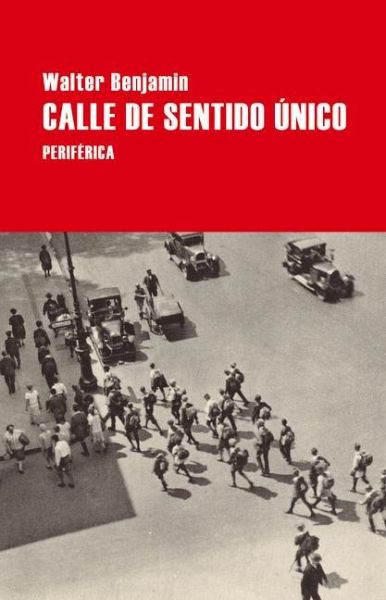
Begun when Benjamin meets and falls in love with the Latvian revolutionary Asja Lacis, to whom it is dedicated, One-Way Street is a text that inaugurates a new way of making literature and of thinking about aesthetics. Rather than a simple collection of clairvoyant aphorisms (on the political reality of a Weimar Germany that today resonates sinisterly familiar or on a subtle psychology of love), this book is an urban map arranged according to the logic of the shop windows of a shopping arcade. Benjamin's will was, in the words of his friend Theodor Adorno, "to contemplate all objects as…mehr
Begun when Benjamin meets and falls in love with the Latvian revolutionary Asja Lacis, to whom it is dedicated, One-Way Street is a text that inaugurates a new way of making literature and of thinking about aesthetics. Rather than a simple collection of clairvoyant aphorisms (on the political reality of a Weimar Germany that today resonates sinisterly familiar or on a subtle psychology of love), this book is an urban map arranged according to the logic of the shop windows of a shopping arcade. Benjamin's will was, in the words of his friend Theodor Adorno, "to contemplate all objects as closely as possible, until they became alien and gave up their secret." And this secret tells us as much about our way of relating to the things of everyday life as about the dreams we project onto them: in the landscapes drawn on stamps and banknotes, in the faith of the early riser or in the experience of childhood as that of a time projected into the future. In One Way Street, Benjamin found a writing that emancipates itself from the pretentious "universal gesture of the book" and bets on a new way of understanding aesthetics in brochures and posters, in archives and catalogues, in the resistance to disappearing from the ephemeral time of life. Since its publication in 1928, its influence has not stopped growing.
El desesperado suicidio de Walter Benjamin durante su huida de los nazis, el 26 de septiembre 1940 en Portbou, se ha convertido en un símbolo que define la trágica historia del pensamiento en el convulso siglo XX. El autor alemán combinó una rarísima mezcla de erudición, imaginación interpretativa, sagacidad política y sensibilidad literaria. Su obra, afortunadamente asistemática e inagotable, condensa las reflexiones más lúcidas de nuestro tiempo sobre arte, política y literatura. Por eso, ochenta años después de su trágica muerte, su eco está más vivo que nunca. > The desperate suicide of Walter Benjamin during his flight from the Nazis, on September 26, 1940 in Portbou, has become a defining symbol of the tragic history of thought in the troubled 20th century. The German author combined a rare mix of scholarship, interpretive imagination, political sagacity, and literary sensibility. His work, fortunately unsystematic and inexhaustible, condenses the most lucid reflections of our time on art, politics and literature. That is why, eighty years after his tragic death, the echo of him is more alive than ever.
Es gelten unsere Allgemeinen Geschäftsbedingungen: www.buecher.de/agb
Impressum
www.buecher.de ist ein Internetauftritt der buecher.de internetstores GmbH
Geschäftsführung: Monica Sawhney | Roland Kölbl | Günter Hilger
Sitz der Gesellschaft: Batheyer Straße 115 - 117, 58099 Hagen
Postanschrift: Bürgermeister-Wegele-Str. 12, 86167 Augsburg
Amtsgericht Hagen HRB 13257
Steuernummer: 321/5800/1497
USt-IdNr: DE450055826