
Andere Kunden interessierten sich auch für
 Remarks on the Colony of Liberia and the American Colonization Society14,99 €
 American Colonization Society, and the Colony at Liberia14,99 €
 The Future of Africa: Being Addresses, Sermons, Etc., Etc., Delivered in the Republic of Liberia23,99 €
 Land Of Hope: Reminiscences Of Liberia And Cape Palmas, With Incidents Of The Voyage20,99 €
 Prize Essay On Political Economy15,99 €
 History of Liberia15,99 €
 Emigration to Liberia. One-thousand Applicants for a Passage to Liberia in 184814,99 €




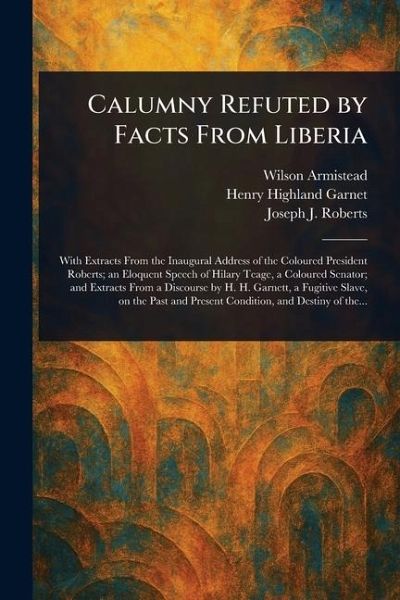
"Calumny Refuted: Facts from Liberia" offers a crucial 19th-century perspective on the colonization of Liberia by African Americans. Authored by Wilson Armistead, known for "A Tribute For The Negro," this work, "Presented to the Boston Anti-Slavery Bazaar, U.S.," directly addresses misconceptions surrounding the movement and the realities faced by those establishing new lives in Africa. This historical document serves as a powerful counter-narrative, providing firsthand accounts and factual information to refute the slanderous claims leveled against the colonization effort. Delving into the complex history of African Americans, anti-slavery movements, and abolition in the 19th century, "Calumny Refuted" sheds light on the motivations and experiences of individuals involved in this pivotal chapter of American and African history. It stands as a vital resource for understanding the hopes and challenges of colonization, and the ongoing struggle for equality and self-determination. A significant historical artifact meticulously prepared for print republication. This work has been selected by scholars as being culturally important, and is part of the knowledge base of civilization as we know it. This work is in the public domain in the United States of America, and possibly other nations. Within the United States, you may freely copy and distribute this work, as no entity (individual or corporate) has a copyright on the body of the work. Scholars believe, and we concur, that this work is important enough to be preserved, reproduced, and made generally available to the public. We appreciate your support of the preservation process, and thank you for being an important part of keeping this knowledge alive and relevant.