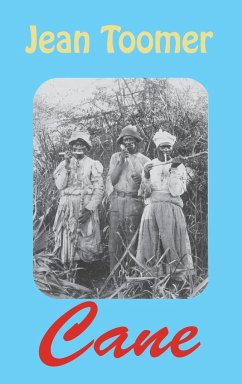
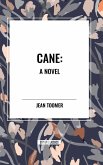
2018 Reprint of 1923 Edition. Cane is structured as a series of vignettes revolving around the origins and experiences of African Americans in the United States. The vignettes alternate in structure between narrative prose, poetry, and play-like passages of dialogue. As a result, the novel has been classified as a composite novel or as a short story cycle. Though some characters and situations recur between vignettes, the vignettes are mostly freestanding, tied to the other vignettes thematically and contextually more than through specific plot details. The ambitious, nontraditional structure…mehr
2018 Reprint of 1923 Edition. Cane is structured as a series of vignettes revolving around the origins and experiences of African Americans in the United States. The vignettes alternate in structure between narrative prose, poetry, and play-like passages of dialogue. As a result, the novel has been classified as a composite novel or as a short story cycle. Though some characters and situations recur between vignettes, the vignettes are mostly freestanding, tied to the other vignettes thematically and contextually more than through specific plot details. The ambitious, nontraditional structure of the novel - and its later influence on future generations of writers - have helped Cane gain status as a classic of High Modernism. In The Negro Novel in America, Robert A. Bone wrote: "By far the most impressive product of the Negro Renaissance, Cane ranks with Richard Wright's Native Son and Ralph Ellison's Invisible Man as a measure of the Negro novelist's highest achievement. Jean Toomer belongs to that first rank of writers who use words almost as a plastic medium, shaping new meanings from an original and highly personal style." Alice Walker said of the book, "It has been reverberating in me to an astonishing degree. I love it passionately, could not possibly exist without it."
Jean Toomer was an American poet and novelist born on December 26, 1894, in Washington, D.C., to Nathan Toomer and Nina Pinchback. He is best known for his experimental and influential work Cane, a text considered central to both modernist literature and early 20th-century African American writing. Though often associated with the Harlem Renaissance, Toomer did not embrace that label, preferring to be seen as an artist whose vision transcended race. His mixed racial background shaped his complex views on identity and belonging, which deeply informed his writing. He briefly served as a school principal in Georgia, an experience that inspired much of the Southern imagery and material in Cane. Toomer studied at several institutions, including the University of Wisconsin Madison and the City College of New York, though he did not complete a degree. In his later years, he was drawn to philosophical and spiritual studies, particularly the teachings of George Gurdjieff. He married twice, first to Margery Latimer and later to Marjorie Content, with whom he had one child. Toomer died on March 30, 1967, in Doylestown, Pennsylvania. His work remains notable for its formal innovation and exploration of race, art, and identity.
Es gelten unsere Allgemeinen Geschäftsbedingungen: www.buecher.de/agb
Impressum
www.buecher.de ist ein Internetauftritt der buecher.de internetstores GmbH
Geschäftsführung: Monica Sawhney | Roland Kölbl | Günter Hilger
Sitz der Gesellschaft: Batheyer Straße 115 - 117, 58099 Hagen
Postanschrift: Bürgermeister-Wegele-Str. 12, 86167 Augsburg
Amtsgericht Hagen HRB 13257
Steuernummer: 321/5800/1497
USt-IdNr: DE450055826