
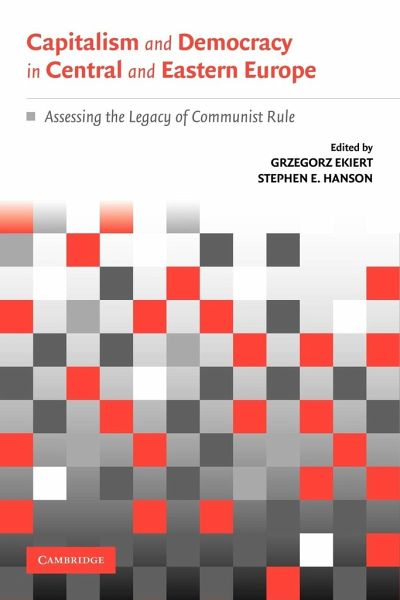
Grzegorz Ekiert / Stephen E. Hanson (eds.)Assessing the Legacy of Communist Rule
Capitalism and Democracy in Central and Eastern Europe
Assessing the Legacy of Communist Rule
Herausgeber: Ekiert, Grzegorz; Hanson, Stephen E.
Grzegorz Ekiert / Stephen E. Hanson (eds.)Assessing the Legacy of Communist Rule
Capitalism and Democracy in Central and Eastern Europe
Assessing the Legacy of Communist Rule
Herausgeber: Ekiert, Grzegorz; Hanson, Stephen E.
- Broschiertes Buch
- Merkliste
- Auf die Merkliste
- Bewerten Bewerten
- Teilen
- Produkt teilen
- Produkterinnerung
- Produkterinnerung
Addresses the problem of assessing institutional change in the wake of communism's collapse in Europe.
Addresses the problem of assessing institutional change in the wake of communism's collapse in Europe.
Produktdetails
- Produktdetails
- Verlag: Cambridge University Press
- Seitenzahl: 392
- Erscheinungstermin: 22. September 2006
- Englisch
- Abmessung: 229mm x 152mm x 23mm
- Gewicht: 635g
- ISBN-13: 9780521529853
- ISBN-10: 0521529859
- Artikelnr.: 21352248
- Herstellerkennzeichnung
- Libri GmbH
- Europaallee 1
- 36244 Bad Hersfeld
- gpsr@libri.de
- Verlag: Cambridge University Press
- Seitenzahl: 392
- Erscheinungstermin: 22. September 2006
- Englisch
- Abmessung: 229mm x 152mm x 23mm
- Gewicht: 635g
- ISBN-13: 9780521529853
- ISBN-10: 0521529859
- Artikelnr.: 21352248
- Herstellerkennzeichnung
- Libri GmbH
- Europaallee 1
- 36244 Bad Hersfeld
- gpsr@libri.de
About the contributors; Acknowledgments; Introduction Grzegorz Ekiert and
Stephen E. Hanson; Part I. Postcommunist Transformations and the Role of
Historical Legacies: 1. Time, space and institutional change in central and
eastern Europe Grzegorz Ekiert and Stephen E. Hanson; 2. Accounting for
postcommunist regime diversity: what counts as a good cause? Herbert
Kitschelt; Part II. Postcommunist Europe: Continuity and Change in Regional
Patterns: 3. Patterns of postcommunist transformation in central and
eastern Europe Grzegorz Ekiert; 4. Postcommunist spaces: a political
geography approach to explaining postcommunist outcomes Jeffrey S. Kopstein
and David A. Reilly; Part III. Institutional Redesign and Historical
Legacies: Case Studies: 5. Redeeming the past: communist successor parties
after 1989 Anna Grzymala-Busse; 6. Leninist legacies and legacies of state
socialism in postcommunist central Europe's constitutional development
Allison Stanger; 7. Historical legacies, institutions and the politics of
social policy in Hungary and Poland, 1989-99 Tomasz Inglot; 8.
Postcommunist unemployment politics: historical legacies and the curious
acceptance of job loss Phineas Baxandall; 9. 'Past' dependence or path
contingency? Institutional design in postcommunist financial systems Juliet
Johnson; 10. Cultural legacies of state socialism: history making and
cultural-political entrepreneurship in postcommunist Poland and Russia Jan
Kubik; Epilogue: from area studies to contextualized comparisons Paul
Pierson; Index.
Stephen E. Hanson; Part I. Postcommunist Transformations and the Role of
Historical Legacies: 1. Time, space and institutional change in central and
eastern Europe Grzegorz Ekiert and Stephen E. Hanson; 2. Accounting for
postcommunist regime diversity: what counts as a good cause? Herbert
Kitschelt; Part II. Postcommunist Europe: Continuity and Change in Regional
Patterns: 3. Patterns of postcommunist transformation in central and
eastern Europe Grzegorz Ekiert; 4. Postcommunist spaces: a political
geography approach to explaining postcommunist outcomes Jeffrey S. Kopstein
and David A. Reilly; Part III. Institutional Redesign and Historical
Legacies: Case Studies: 5. Redeeming the past: communist successor parties
after 1989 Anna Grzymala-Busse; 6. Leninist legacies and legacies of state
socialism in postcommunist central Europe's constitutional development
Allison Stanger; 7. Historical legacies, institutions and the politics of
social policy in Hungary and Poland, 1989-99 Tomasz Inglot; 8.
Postcommunist unemployment politics: historical legacies and the curious
acceptance of job loss Phineas Baxandall; 9. 'Past' dependence or path
contingency? Institutional design in postcommunist financial systems Juliet
Johnson; 10. Cultural legacies of state socialism: history making and
cultural-political entrepreneurship in postcommunist Poland and Russia Jan
Kubik; Epilogue: from area studies to contextualized comparisons Paul
Pierson; Index.
About the contributors; Acknowledgments; Introduction Grzegorz Ekiert and
Stephen E. Hanson; Part I. Postcommunist Transformations and the Role of
Historical Legacies: 1. Time, space and institutional change in central and
eastern Europe Grzegorz Ekiert and Stephen E. Hanson; 2. Accounting for
postcommunist regime diversity: what counts as a good cause? Herbert
Kitschelt; Part II. Postcommunist Europe: Continuity and Change in Regional
Patterns: 3. Patterns of postcommunist transformation in central and
eastern Europe Grzegorz Ekiert; 4. Postcommunist spaces: a political
geography approach to explaining postcommunist outcomes Jeffrey S. Kopstein
and David A. Reilly; Part III. Institutional Redesign and Historical
Legacies: Case Studies: 5. Redeeming the past: communist successor parties
after 1989 Anna Grzymala-Busse; 6. Leninist legacies and legacies of state
socialism in postcommunist central Europe's constitutional development
Allison Stanger; 7. Historical legacies, institutions and the politics of
social policy in Hungary and Poland, 1989-99 Tomasz Inglot; 8.
Postcommunist unemployment politics: historical legacies and the curious
acceptance of job loss Phineas Baxandall; 9. 'Past' dependence or path
contingency? Institutional design in postcommunist financial systems Juliet
Johnson; 10. Cultural legacies of state socialism: history making and
cultural-political entrepreneurship in postcommunist Poland and Russia Jan
Kubik; Epilogue: from area studies to contextualized comparisons Paul
Pierson; Index.
Stephen E. Hanson; Part I. Postcommunist Transformations and the Role of
Historical Legacies: 1. Time, space and institutional change in central and
eastern Europe Grzegorz Ekiert and Stephen E. Hanson; 2. Accounting for
postcommunist regime diversity: what counts as a good cause? Herbert
Kitschelt; Part II. Postcommunist Europe: Continuity and Change in Regional
Patterns: 3. Patterns of postcommunist transformation in central and
eastern Europe Grzegorz Ekiert; 4. Postcommunist spaces: a political
geography approach to explaining postcommunist outcomes Jeffrey S. Kopstein
and David A. Reilly; Part III. Institutional Redesign and Historical
Legacies: Case Studies: 5. Redeeming the past: communist successor parties
after 1989 Anna Grzymala-Busse; 6. Leninist legacies and legacies of state
socialism in postcommunist central Europe's constitutional development
Allison Stanger; 7. Historical legacies, institutions and the politics of
social policy in Hungary and Poland, 1989-99 Tomasz Inglot; 8.
Postcommunist unemployment politics: historical legacies and the curious
acceptance of job loss Phineas Baxandall; 9. 'Past' dependence or path
contingency? Institutional design in postcommunist financial systems Juliet
Johnson; 10. Cultural legacies of state socialism: history making and
cultural-political entrepreneurship in postcommunist Poland and Russia Jan
Kubik; Epilogue: from area studies to contextualized comparisons Paul
Pierson; Index.