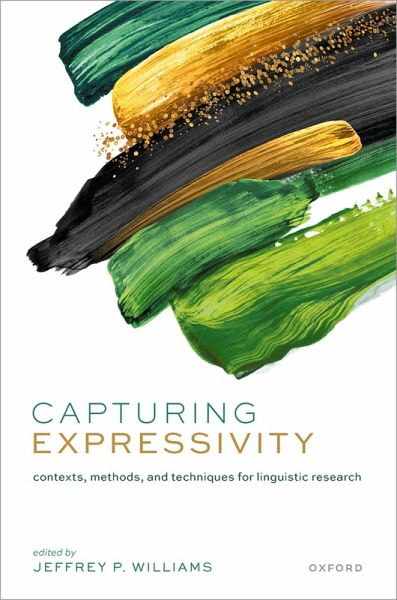
This volume investigates the methods and techniques used for studying expressivity in language, particularly in language documentation settings. The chapters explore a variety of different expressive items from a wide range of languages, focusing on the question of how to 'capture' expressivity in language and culture.
This volume investigates the methods and techniques used for studying expressivity in language, particularly in language documentation settings. The chapters explore a variety of different expressive items from a wide range of languages, focusing on the question of how to 'capture' expressivity in language and culture.
Jeffrey P. Williams is Professor of Ethnology and Linguistics at Texas Tech University, having previously held positions at the University of Sydney, Vanderbilt University, and Cleveland State University. His research is wide ranging and covers topics such as language contact, English dialectology, expressivity in grammar, neurolinguistics, and language documentation and endangerment.
Inhaltsangabe
* 1: Jeffrey P. Williams: Introduction * Part I. Contexts * 2: Christa Kilian-Hatz: Ideophones: How the world speaks to us * 3: Håkan Lundström and Jan-Olof Svantesson: Expressives in Kuanmu singing * Part II. Methods * 4: Iraide Ibarretxe-Antuñano: Eliciting ideophones in the field: The IdEus-Psylex stimuli collection * 5: Bonnie McLean and Mark Dingemanse: Diversifying the toolkit for documentary research on ideophones * 6: Nicolau Dols and Pere Garau: Detecting and analysing expressives in a language corpus * 7: Janis Nuckolls and Tod Swanson: Empathy and indirect methods for fieldwork with ideophones in Pastaza and Upper Napo Kichwa * 8: Olivier Le Guen and Rodrigo Petatillo Chan: Documenting stealth lexicon: Field methods to collect the use of ideophones in Yucatec Maya * 9: Kimi Akita: Studying Japanese mimetics * Part III. Techniques * 10: Harshit Parmar and Jeffrey P. Williams: Is there an aesthetic component of language? * 11: Nathan Badenoch: Learning to learn expressives: Finding cultural salience in linguistic fieldwork
* 1: Jeffrey P. Williams: Introduction * Part I. Contexts * 2: Christa Kilian-Hatz: Ideophones: How the world speaks to us * 3: Håkan Lundström and Jan-Olof Svantesson: Expressives in Kuanmu singing * Part II. Methods * 4: Iraide Ibarretxe-Antuñano: Eliciting ideophones in the field: The IdEus-Psylex stimuli collection * 5: Bonnie McLean and Mark Dingemanse: Diversifying the toolkit for documentary research on ideophones * 6: Nicolau Dols and Pere Garau: Detecting and analysing expressives in a language corpus * 7: Janis Nuckolls and Tod Swanson: Empathy and indirect methods for fieldwork with ideophones in Pastaza and Upper Napo Kichwa * 8: Olivier Le Guen and Rodrigo Petatillo Chan: Documenting stealth lexicon: Field methods to collect the use of ideophones in Yucatec Maya * 9: Kimi Akita: Studying Japanese mimetics * Part III. Techniques * 10: Harshit Parmar and Jeffrey P. Williams: Is there an aesthetic component of language? * 11: Nathan Badenoch: Learning to learn expressives: Finding cultural salience in linguistic fieldwork
Es gelten unsere Allgemeinen Geschäftsbedingungen: www.buecher.de/agb
Impressum
www.buecher.de ist ein Internetauftritt der buecher.de internetstores GmbH
Geschäftsführung: Monica Sawhney | Roland Kölbl | Günter Hilger
Sitz der Gesellschaft: Batheyer Straße 115 - 117, 58099 Hagen
Postanschrift: Bürgermeister-Wegele-Str. 12, 86167 Augsburg
Amtsgericht Hagen HRB 13257
Steuernummer: 321/5800/1497
USt-IdNr: DE450055826