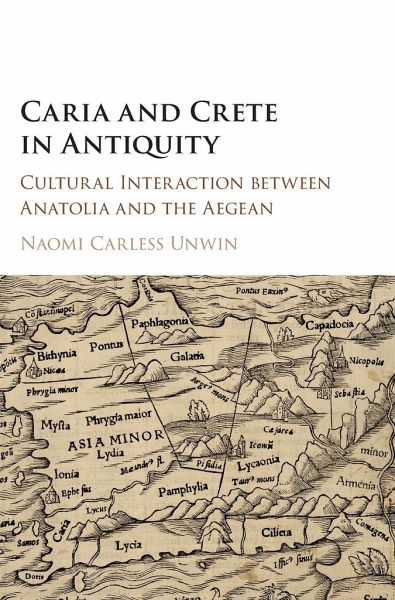
A persistent tradition existed in antiquity linking Caria with the island of Crete. This central theme of regional history is mirrored in the civic mythologies, cults and toponyms of southwestern Anatolia. This book explains why by approaching this diverse body of material with a broad chronological view, taking into account both the origins of this regional narrative and its endurance. It considers the mythologies in the light of archaeologically attested contacts during the Bronze Age, exploring whether such interaction could have left a residuum in later traditions. The continued relevance…mehr
A persistent tradition existed in antiquity linking Caria with the island of Crete. This central theme of regional history is mirrored in the civic mythologies, cults and toponyms of southwestern Anatolia. This book explains why by approaching this diverse body of material with a broad chronological view, taking into account both the origins of this regional narrative and its endurance. It considers the mythologies in the light of archaeologically attested contacts during the Bronze Age, exploring whether such interaction could have left a residuum in later traditions. The continued relevance of this aspect of Carian history is then considered in the light of contacts during the Classical and Hellenistic periods, with analysis of how, and in which contexts, traditions survived. The Carians were an Anatolian people; however, their integration into the mythological framework of the Greek world reveals that interaction with the Aegean was a fundamental aspect of their history.
Naomi Carless Unwin is a Research Fellow at the Center for Hellenic Studies at Harvard University. She has been involved for many years in the archaeological excavations at the sanctuary of Labraunda in Caria, focusing particularly on the epigraphy of the site.
Inhaltsangabe
Introduction. Approaching the topic of Carian-Cretan interaction The Carian-Cretan connection Caria and Crete in the maritime itineraries of the Mediterranean The Labrys and the labyrinth Network formation and cultural exchange Approaching Carian-Cretan interaction 1. Articulating a 'Carian' identity 'The Carians of barbarian speech' Language and identity Delimiting 'Caria' and the 'Carians' 2. The role of Crete in the mythologies, local histories and cults of Caria Ancient engagement with the past Sarpedon, Miletos and Kaunos The 'Minoan' ports of Anatolia The Kr¿tinaion of Magnesia-on-the-Maeander The Carian Kouretes Reading mythological traditions 3. The case of Miletos: archaeology and mythology The processes of transmission and the question of origins Late Bronze Age Miletos Minoan and Mycenaean contacts with Southwestern Anatolia Western Anatolia in the Hittite sources Caria on the interface Miletos: continuities and innovation 4. Interaction and the reception of the Cretan connection during the hellenistic period Tracing interaction between Caria and Crete The Cretan decrees from Mylasa Cretan diplomacy and Cretan piracy Contextualising the Mylasan inscriptions The role of the past in diplomatic discourse 5. Inscribing history at Magnesia- on- the- Maeander: Civic engagement with the past Inscribing history The civic context of the 'origin myth' Shaping the past 6. A 'Cretan- Born' Zeus in Caria: Religious mobility between Caria and Crete The evidence Dynastic influence vs. local dynamics The constitutional reforms at Euromos Interaction and religious mobility Interpreting the Carian cults of Zeus Kretagenes/ Kretagenetas Concluding remarks Appendix 1. I. Magnesia 17 Appendix 2. The 'Cretan Dossier' of Mylasa References Index.
Es gelten unsere Allgemeinen Geschäftsbedingungen: www.buecher.de/agb
Impressum
www.buecher.de ist ein Internetauftritt der buecher.de internetstores GmbH
Geschäftsführung: Monica Sawhney | Roland Kölbl | Günter Hilger
Sitz der Gesellschaft: Batheyer Straße 115 - 117, 58099 Hagen
Postanschrift: Bürgermeister-Wegele-Str. 12, 86167 Augsburg
Amtsgericht Hagen HRB 13257
Steuernummer: 321/5800/1497
USt-IdNr: DE450055826