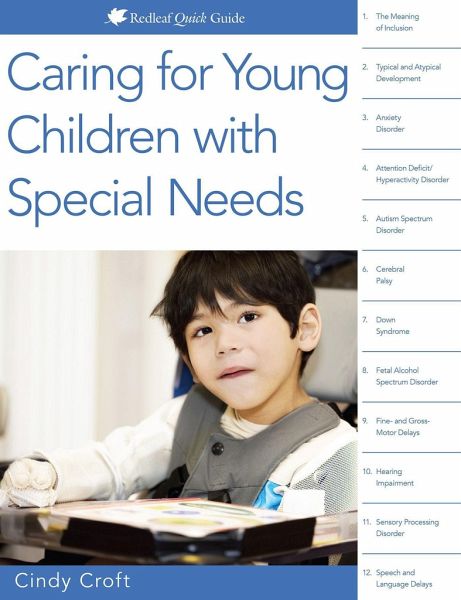
This easy-to-use guide gives you a quick overview on many topics related to working with young children with special needs. Learn about inclusion in early childhood programs and disability law, as well as typical vs. atypical development. The quick guide also covers several specific disabilities/special needs and provides definitions, common characteristics, and practical strategies for adaptation. Cindy Croft is the director of the Center for Inclusive Child Care at Concordia University and on faculty for several university education programs. She has her MA in Education and has worked in the field of early childhood for over twenty years.…mehr
This easy-to-use guide gives you a quick overview on many topics related to working with young children with special needs. Learn about inclusion in early childhood programs and disability law, as well as typical vs. atypical development. The quick guide also covers several specific disabilities/special needs and provides definitions, common characteristics, and practical strategies for adaptation. Cindy Croft is the director of the Center for Inclusive Child Care at Concordia University and on faculty for several university education programs. She has her MA in Education and has worked in the field of early childhood for over twenty years.
Cindy Croft, M.A., is the founding director of the Center for Inclusive Child Care and has worked in the early childhood field for more than 25 years. She provides technical assistance and training to early childhood educators on adapting their physical and emotional environments to meet children's specific behavioral needs. Cindy is also the author of Why Temperament Matters: Guidance Strategies for Young Children.
Inhaltsangabe
Unit 1:Foundations for Success Chapter 1: The Meaning of Inclusion 1. NAEYC DEC Position Statement on Inclusion 2. Program Philosophies of Inclusion 3. Practical Application Chapter 2: Disability Law and Early Childhood 1. The Americans Disabilities Act 2. The Individual with Disabilities Act 3. Practical Application: Why Disability Law Matters to Child Care Unit 2: Setting the Framework Chapter 3: Creating a Sense of Belonging 1. More Alike than Different 2. No Expulsion 3. Practical Application Chapter 4: Typical and Atypical Development 1. Defining typical and atypical development 2. Developmental Milestones 3. Red Flags and Developmental Delays 4. Practical Application Unit 3: Specific Adaptations by Disability Chapter 5: Gross and Fine Motor Delays 1. What is a motor delay? Common causes and implications 2. What is gross and fine motor? 3. Practical Application: Strategies for adaptations Chapter 6: Autism Spectrum Disorder 1. What is ASD? Myths and Facts 2. Major Characteristics of Children with ASD 3. Practical Application: Strategies for Adaptations Chapter 7: Attention Deficit and Hyperactivity Disorder 1. What is ADHD: Fact and Fiction 2. Major characteristics of children with ADHD 3. Practical Application: Strategies for Adaptations Chapter 8: Speech and Language Delays 1. What are Common Speech and Language delays? 2. Speech and language delay impacts on young children 3. Practical Application: Strategies for Adaptations Chapter 9: Sensory Processing Disorder 1. What is SPD 2. Behavioral implications of SPD in Young Children 3. Practical Application: Strategies for adaptations Chapter 10: Hearing and Visual Impairment 1. Types of Hearing and Visual Impairment 2. Implications of hearing and visual impairment to development 3. Practical Application: Designing a program Chapter 11: Anxiety Disorder 1. Defining Terms: Anxiousness or Anxiety Disorder 2. Impact of anxiety and fearfulness on young children in child care settings 3. Practical Application: Strategies for adaptations Final Chapter: Putting it all together 1. Confidentiality 2. Supporting Families 3. Working with other professionals 4. Children are Children First Resources
Unit 1:Foundations for Success Chapter 1: The Meaning of Inclusion 1. NAEYC DEC Position Statement on Inclusion 2. Program Philosophies of Inclusion 3. Practical Application Chapter 2: Disability Law and Early Childhood 1. The Americans Disabilities Act 2. The Individual with Disabilities Act 3. Practical Application: Why Disability Law Matters to Child Care Unit 2: Setting the Framework Chapter 3: Creating a Sense of Belonging 1. More Alike than Different 2. No Expulsion 3. Practical Application Chapter 4: Typical and Atypical Development 1. Defining typical and atypical development 2. Developmental Milestones 3. Red Flags and Developmental Delays 4. Practical Application Unit 3: Specific Adaptations by Disability Chapter 5: Gross and Fine Motor Delays 1. What is a motor delay? Common causes and implications 2. What is gross and fine motor? 3. Practical Application: Strategies for adaptations Chapter 6: Autism Spectrum Disorder 1. What is ASD? Myths and Facts 2. Major Characteristics of Children with ASD 3. Practical Application: Strategies for Adaptations Chapter 7: Attention Deficit and Hyperactivity Disorder 1. What is ADHD: Fact and Fiction 2. Major characteristics of children with ADHD 3. Practical Application: Strategies for Adaptations Chapter 8: Speech and Language Delays 1. What are Common Speech and Language delays? 2. Speech and language delay impacts on young children 3. Practical Application: Strategies for Adaptations Chapter 9: Sensory Processing Disorder 1. What is SPD 2. Behavioral implications of SPD in Young Children 3. Practical Application: Strategies for adaptations Chapter 10: Hearing and Visual Impairment 1. Types of Hearing and Visual Impairment 2. Implications of hearing and visual impairment to development 3. Practical Application: Designing a program Chapter 11: Anxiety Disorder 1. Defining Terms: Anxiousness or Anxiety Disorder 2. Impact of anxiety and fearfulness on young children in child care settings 3. Practical Application: Strategies for adaptations Final Chapter: Putting it all together 1. Confidentiality 2. Supporting Families 3. Working with other professionals 4. Children are Children First Resources
Es gelten unsere Allgemeinen Geschäftsbedingungen: www.buecher.de/agb
Impressum
www.buecher.de ist ein Internetauftritt der buecher.de internetstores GmbH
Geschäftsführung: Monica Sawhney | Roland Kölbl | Günter Hilger
Sitz der Gesellschaft: Batheyer Straße 115 - 117, 58099 Hagen
Postanschrift: Bürgermeister-Wegele-Str. 12, 86167 Augsburg
Amtsgericht Hagen HRB 13257
Steuernummer: 321/5800/1497
USt-IdNr: DE450055826