1. Descartes' Meditations as the prototype of philosophical reflection. I have partieular reason for being glad that I may talk about transeendental phenomenology in this, the most venerable abode of Freneh seienee.l Franee's greatest thinker, Rene Deseartes, gave transeendental phenomenology new impulses through his Meditations; their study aeted quite direetly on the transfor mation of an already developing phenomenology into a new kind of transeendental philosophy. Aeeordingly one might almost eall transeendental phenomenology a neo-Cartesianism, even though it is obliged-and preeisely by…mehr
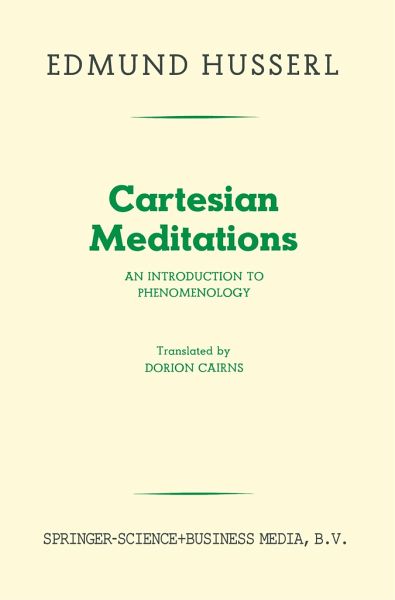
1. Descartes' Meditations as the prototype of philosophical reflection. I have partieular reason for being glad that I may talk about transeendental phenomenology in this, the most venerable abode of Freneh seienee.l Franee's greatest thinker, Rene Deseartes, gave transeendental phenomenology new impulses through his Meditations; their study aeted quite direetly on the transfor mation of an already developing phenomenology into a new kind of transeendental philosophy. Aeeordingly one might almost eall transeendental phenomenology a neo-Cartesianism, even though it is obliged-and preeisely by its radieal development of Cartesian motifs - to rejeet nearly all the well-known doe trinal eontent of the Cartesian philosophy. That being the situation, I ean already be assured of your interest if I start with those motifs in the M editationes de prima philosophia that have, so I believe, an eternal signifieanee and go on to eharaeterize the transformations, and the novel for mations, in whieh the method and problems of transeendental phenomenology originate. Every beginner in philosophy knows the remarkable train of thoughts eontained in the Meditations. Let us reeall its guiding idea. The aim of the Meditations is a eomplete reforming of philosophy into a scienee grounded on an absolute foundation.
Sara Heinämaa is a Professor of Philosophy at the University of Jyväskylä and an Academy Professor (2017-2021). She specializes in classical and contemporary phenomenology, existentialism, and the history of philosophy, and has published extensively in these fields, especially on normativity, emotion, embodiment, and intersubjectivity. She is co-author of Birth, Death, and Femininity (Indiana UP, 2010), and author of Toward a Phenomenology of Sexual Difference (Rowman & Littlefield, 2003), and has co-edited several volumes, including Contemporary Phenomenologies of Normativity (Routledge, 2022), Phenomenology as Critique (Routledge 2022), and Phenomenology and the Transcendental (Routledge, 2014) and Consciousness (Springer, 2007). Anthony J. Steinbock is Professor of Philosophy, at Stony Brook University and Director, of the Phenomenology Research Center. He works in the areas of phenomenology, social ontology, aesthetics, and religious philosophy. His publications include works on generative phenomenology, religious experience, and emotions. He is the author of six books, most recently, Knowing by Heart: Loving as Participation and Critique (Northwestern University Press, 2021) and is the translator of Edmund Husserl's Analyses Concerning Passive and Active Synthesis (Kluwer, 2001). He is Editor-in-Chief, of Continental Philosophy Review, and General Editor, of Northwestern University Press "SPEP" Series. Andrew D. Barrette is currently an Assistant Professor of the Practice in the Philosophy Department at Boston College. He wrote his dissertation on Edmund Husserl's analyses of inquiry and history at Southern Illinois University Carbondale. During that research, he studied at the Husserl-Archives in Leuven, first as a Fulbright Scholar, then again as an International Research Fellow. He then did post-doctorate work at the Lonergan Institute and the Institute for Advanced Jesuit Studies, both at Boston College.
Inhaltsangabe
First Meditation. The Way to the Transcendental Ego.- Second Meditation. The Field of Transcendental Experience Laid Open in Respect of Its Universal Structures.- Third Meditation. Constitutional Problems. Truth and Actuality.- Fourth Meditation. Development of the Constitutional Problems Pertaining to the Transcendental Ego Himself.- Fifth Meditation. Uncovering of the Sphere of Transcendental Being as Monadological Intersubjectivity.- Conclusion.
First Meditation. The Way to the Transcendental Ego.- Second Meditation. The Field of Transcendental Experience Laid Open in Respect of Its Universal Structures.- Third Meditation. Constitutional Problems. Truth and Actuality.- Fourth Meditation. Development of the Constitutional Problems Pertaining to the Transcendental Ego Himself.- Fifth Meditation. Uncovering of the Sphere of Transcendental Being as Monadological Intersubjectivity.- Conclusion.
Es gelten unsere Allgemeinen Geschäftsbedingungen: www.buecher.de/agb
Impressum
www.buecher.de ist ein Internetauftritt der buecher.de internetstores GmbH
Geschäftsführung: Monica Sawhney | Roland Kölbl | Günter Hilger
Sitz der Gesellschaft: Batheyer Straße 115 - 117, 58099 Hagen
Postanschrift: Bürgermeister-Wegele-Str. 12, 86167 Augsburg
Amtsgericht Hagen HRB 13257
Steuernummer: 321/5800/1497
USt-IdNr: DE450055826