
Andere Kunden interessierten sich auch für
 Narrative Theory, Literature, and New Media73,99 €
 The Clouds55,99 €
 Multilingual Currents in Literature, Translation and Culture53,99 €
 Cartographies of Diaspora55,99 €
 Migrating Minds45,99 €
 Cartographies of the Absolute23,99 €
 Moving Border - Alpine Cartographies of Climate Change31,99 €
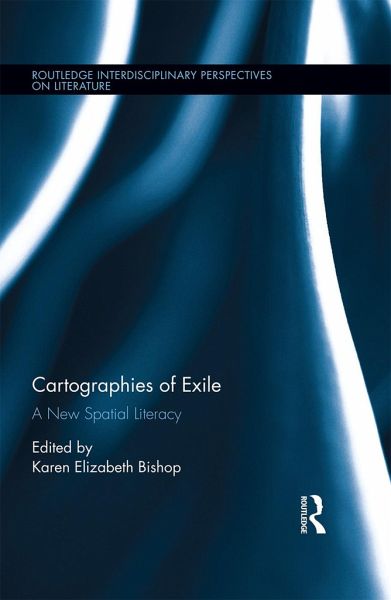
This volume seeks to understand the cartographical imperative inherent in exile, investigating the relationship between exile - understood broadly to include external and internal exile, diaspora, deterritorialization, reterritorialization, expatriation, migrants, refugees, nomads, and the forcibly 'disappeared' - and map-making. Mapping is a certain science that enables emplacement and facilitates movement; yet it is also an aesthetic project that draws on a heightened awareness of space and place, memory, and political and historical imaginaries. This collection explores a number of key questions, such as: what kind of maps do exiles make, and how are they conceived? How do maps provide new ways of thinking about the experience of exile and our changing reading practices? How do authors writing in or about exile represent the doubly ontological and epistemological exercise of map-making? How might a cartographical necessity of exile challenge how we conceive of mapping, its history and future, its function, tools, and media? This book's contributors come from a wide variety of interdisciplinary backgrounds, including literary and cultural studies, art history and architecture, the plastic arts, film and visual studies, and the digital humanities. The Cartographical Necessity of Exile reveals the overwhelming importance of agency in exile that map-making facilitates, and the epistemological displacement that map-making depends upon, to build the known world.
This book proposes a fundamental relationship between exile and mapping. It seeks to understand the cartographic imperative inherent in the exilic condition, the exilic impulses fundamental to mapping, and the varied forms of description proper to both. The vital intimacy of the relationship between exile and mapping compels a new spatial literacy that requires the cultivation of localized, dynamic reading practices attuned to the complexities of understanding space as text and texts as spatial artifacts. The collection asks: what kinds of maps do exiles make? How are they conceived, drawn, read? Are they private maps or can they be shaped collectively? What is their relationship to memory and history? How do maps provide for new ways of imagining the fractured experience of exile and offer up both new strategies for reading displacement and new displaced reading strategies? Where does exilic mapping fit into a history of cartography, particularly within the twentieth-century spatial turn? The original work that makes up this interdisciplinary collection presents a varied look at cartographic strategies employed in writing, art, and film from the pre-Contact Americas to the Renaissance to late postmodernism; the effects of exile, in its many manifestations, on cartographic textual systems, ways of seeing, and forms of reading; the challenges of traversing and mapping unstable landscapes and restrictive social and political networks; and the felicities and difficulties of both giving into the map and attempting to escape the map that provides for exile in the first place. Cartographies of Exile will be of interest to students and scholars working in literary and cultural studies; gender, sexuality, and race studies; anthropology; art history and architecture; film, performance, visual studies; and the fine arts.
This book proposes a fundamental relationship between exile and mapping. It seeks to understand the cartographic imperative inherent in the exilic condition, the exilic impulses fundamental to mapping, and the varied forms of description proper to both. The vital intimacy of the relationship between exile and mapping compels a new spatial literacy that requires the cultivation of localized, dynamic reading practices attuned to the complexities of understanding space as text and texts as spatial artifacts. The collection asks: what kinds of maps do exiles make? How are they conceived, drawn, read? Are they private maps or can they be shaped collectively? What is their relationship to memory and history? How do maps provide for new ways of imagining the fractured experience of exile and offer up both new strategies for reading displacement and new displaced reading strategies? Where does exilic mapping fit into a history of cartography, particularly within the twentieth-century spatial turn? The original work that makes up this interdisciplinary collection presents a varied look at cartographic strategies employed in writing, art, and film from the pre-Contact Americas to the Renaissance to late postmodernism; the effects of exile, in its many manifestations, on cartographic textual systems, ways of seeing, and forms of reading; the challenges of traversing and mapping unstable landscapes and restrictive social and political networks; and the felicities and difficulties of both giving into the map and attempting to escape the map that provides for exile in the first place. Cartographies of Exile will be of interest to students and scholars working in literary and cultural studies; gender, sexuality, and race studies; anthropology; art history and architecture; film, performance, visual studies; and the fine arts.