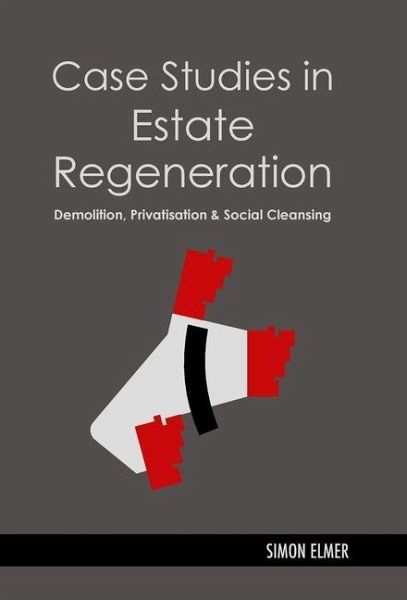
Created in its current form in 1997 by the Labour government of Tony Blair and formalised in 2016 as a national programme by the Conservative government of David Cameron, estate regeneration is the product of a financialised housing market that, since the neoliberal revolution overseen by the governments of Margaret Thatcher in the 1980s, has marketised housing provision in the UK. As such, estate regeneration, which now means demolition and redevelopment, is not merely one aspect of the UK housing crisis but one of its primary instruments. It clears high-value land for redevelopment and…mehr
Created in its current form in 1997 by the Labour government of Tony Blair and formalised in 2016 as a national programme by the Conservative government of David Cameron, estate regeneration is the product of a financialised housing market that, since the neoliberal revolution overseen by the governments of Margaret Thatcher in the 1980s, has marketised housing provision in the UK. As such, estate regeneration, which now means demolition and redevelopment, is not merely one aspect of the UK housing crisis but one of its primary instruments. It clears high-value land for redevelopment and investment by global capital looking for a property market underwritten by government subsidies that artificially raise UK house prices. It builds residential properties for the highest possible price in order to realise the maximum value uplift in land prices. It removes from competition with the market the only housing to have escaped the huge escalation in housing costs this programme is driving. And it evicts the residents of estates on lucrative land through a programme of privatisation and social cleansing designed to remove constituents more likely to be reliant on government and council-funded social services. Originally published between 2016 and 2019, the articles in this book include 13 case studies of estate regeneration schemes; a map of the estate regeneration programme in London; and a report on the social, financial and environmental costs of estate demolition, to which it proposes a design alternative that increases the stock of social housing, the most in-demand housing type in the UK.
Simon Elmer lives between London and Hong Kong. In 2002 he received his PhD in the History and Theory of Art from University College London, and he has taught at the universities of London, Manchester, Reading and Michigan. In 2015 he co-founded Architects for Social Housing, for which he is Head of Research. His books include The Housing Crisis: Finance, Legislation, Policy, Resistance (2025); Architecture is Always Political: A Communist History (2024); The Great Replacement: Conspiracy Theory or Immigration Policy? (2024); The Great Reset: Biopolitics for Stakeholder Capitalism (2023); The Road to Fascism: For a Critique of the Global Biosecurity State (2022); two volumes of collected articles on the UK biosecurity state, Virtue and Terror (2023) and The New Normal (2023); and with Geraldine Dening, Saving St. Raphael's Estate: The Alternative to Demolition (2022), For a Socialist Architecture: Under Capitalism (2021); and Central Hill: A Case Study in Estate Regeneration (2018). Case Studies in Estate Regeneration: Demolition, Privatisation and Social Cleansing is the third volume in the ASH Papers, which collect in book form the most important articles from the ASH website.
Es gelten unsere Allgemeinen Geschäftsbedingungen: www.buecher.de/agb
Impressum
www.buecher.de ist ein Internetauftritt der buecher.de internetstores GmbH
Geschäftsführung: Monica Sawhney | Roland Kölbl | Günter Hilger
Sitz der Gesellschaft: Batheyer Straße 115 - 117, 58099 Hagen
Postanschrift: Bürgermeister-Wegele-Str. 12, 86167 Augsburg
Amtsgericht Hagen HRB 13257
Steuernummer: 321/5800/1497
USt-IdNr: DE450055826