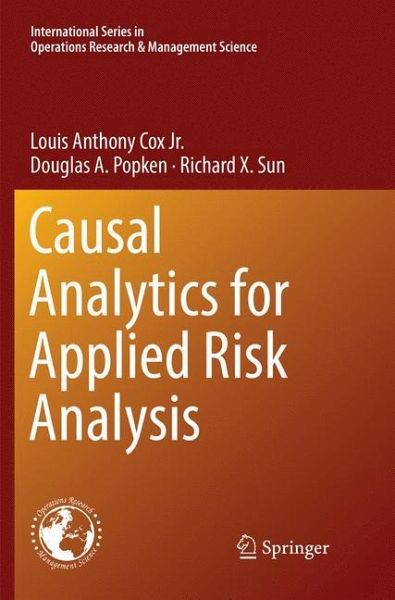
Causal analytics methods can revolutionize the use of data to make effective decisions by revealing how different choices affect probabilities of various outcomes. This book presents and illustrates models, algorithms, principles, and software for deriving causal models from data and for using them to optimize decisions with uncertain outcomes. It discusses how to describe and summarize situations; detect changes; evaluate effects of policies or interventions; learn what works best under different conditions; predict values of as-yet unobserved quantities from available data; and identify the…mehr
Causal analytics methods can revolutionize the use of data to make effective decisions by revealing how different choices affect probabilities of various outcomes. This book presents and illustrates models, algorithms, principles, and software for deriving causal models from data and for using them to optimize decisions with uncertain outcomes. It discusses how to describe and summarize situations; detect changes; evaluate effects of policies or interventions; learn what works best under different conditions; predict values of as-yet unobserved quantities from available data; and identify the most likely explanations for observed outcomes, including surprises and anomalies. The book resents practical techniques for causal modeling and analytics that practitioners can apply to improve understanding of how choices affect probabilities of consequences and, based on this understanding, to recommend choices that are more likely to accomplish their intended objectives.The book begins with a survey of modern analytics methods, focusing mainly on techniques useful for decision, risk, and policy analysis. Chapter 2 introduces free in-browser software, including the Causal Analytics Toolkit (CAT) software, to enable readers to perform the analyses described and to apply modern analytics methods easily to their own data sets. Chapters 3 through 11 show how to apply causal analytics and risk analytics to practical risk analysis challenges, mainly related to public and occupational health risks from pathogens in food or from pollutants in air. Chapters 12 through 15 turn to broader questions of how to improve risk management decision-making by individuals, groups, organizations, institutions, and multi-generation societies with different cultures and norms for cooperation. These chapters examine organizational learning, community resilience, societal risk management, and intergenerational collaboration and justice in managing risks.
Produktdetails
Produktdetails
International Series in Operations Research & Management Science 270
Tony Cox is Professor of Business Analytics at the University of Colorado and President of Cox Associates, a Denver-based applied research company specializing in health, safety, and environmental risk analysis; epidemiology; policy analytics; data science; artificial intelligence; and operations research. Dr. Cox is Editor-in-Chief of Risk Analysis: An International Journal. He is Area Editor for Real World Applications for the Journal of Heuristics, and is on the Editorial Board of the International Journal of Operations Research and Information Systems. He has authored and co-authored over 200 journal articles and book chapters on these fields. His most recent books are Causal Analytics for Risk Analysis (Springer, 2018), Breakthroughs in Decision Science and Risk Analysis (Wiley, 2015), Improving Risk Analysis (Springer, 2013), and the Wiley Encyclopedia of Operations Research and Management Science (Wiley, 2011), which Dr. Cox co-edited. He has over a dozen U.S. patents on applications of artificial intelligence, signal processing, statistics and operations research in telecommunications. His current research interests include computational statistical methods for causal inference in public health risk analysis, data-mining, and advanced analytics for risk management, business, and public policy applications.
Inhaltsangabe
Part 1. Concepts and Methods of Causal Analytics.- Chapter 1. Causal Analytics and Risk Analytics.- Chapter 2. Causal Concepts, Principles, and Algorithms.- Part 2. Descriptive Analytics in Public and Occupational Health.- Chapter 3. Descriptive Analytics for Public Health: Socioeconomic and Air Pollution Correlates of Adult Asthma, Heart Attack, and Stroke Risks.- Chapter 4. Descriptive Analytics for Occupational Health: Is Benzene Metabolism in Exposed Workers More Efficient at Very Low Concentrations?- Chapter 5. How Large are Human Health Risks Caused by Antibiotics Used in Food Animals?- Chapter 6. Quantitative Risk Assessment of Human Risks of Methicillin-Resistant Staphylococcus aureus (MRSA) Caused by Swine Operations Part 3. Predictive and Causal Analytics.- Chapter 7. Attributive Causal Modeling: Quantifying Human Health Risks Caused by Toxoplasmosis From Open System Production Of Swine.- Chapter 8. How Well Can High-Throughput Screening Test Results Predict Whether ChemicalsCause Cancer in Mice and Rats?- Chapter 9. Mechanistic Causality: Biological Mechanisms of Dose-Response Thresholds for Inflammation-Mediated Diseases Caused by Asbestos Fibers and Mineral Particles.- Part 4. Evaluation Analytics.- Chapter 10. Evaluation Analytics for Public Health: Has Reducing Air Pollution Reduced Mortality in the United States?- Chapter 11. Evaluation Analytics for Occupational health: How accurately and consistently do laboratories measure workplace concentrations of respirable crystalline silica?- Part 5. Risk Management: Insights from Prescriptive, Learning, and Collaborative Analytics.- Chapter 12. Improving individual, group and organizational decisions: Overcoming learning aversion in evaluating and managing uncertain risks.- Chapter 13. Improving organizational risk management: From Lame Excuses to Principled Practice.- Chapter 14. Improving institutions of risk management: Uncertain causality and judicial review of regulations.- Chapter 15. Intergenerational justice in protective and resilience investments with uncertain future preferences and resources.
Part 1. Concepts and Methods of Causal Analytics.- Chapter 1. Causal Analytics and Risk Analytics.- Chapter 2. Causal Concepts, Principles, and Algorithms.- Part 2. Descriptive Analytics in Public and Occupational Health.- Chapter 3. Descriptive Analytics for Public Health: Socioeconomic and Air Pollution Correlates of Adult Asthma, Heart Attack, and Stroke Risks.- Chapter 4. Descriptive Analytics for Occupational Health: Is Benzene Metabolism in Exposed Workers More Efficient at Very Low Concentrations?- Chapter 5. How Large are Human Health Risks Caused by Antibiotics Used in Food Animals?- Chapter 6. Quantitative Risk Assessment of Human Risks of Methicillin-Resistant Staphylococcus aureus (MRSA) Caused by Swine Operations Part 3. Predictive and Causal Analytics.- Chapter 7. Attributive Causal Modeling: Quantifying Human Health Risks Caused by Toxoplasmosis From Open System Production Of Swine.- Chapter 8. How Well Can High-Throughput Screening Test Results Predict Whether ChemicalsCause Cancer in Mice and Rats?- Chapter 9. Mechanistic Causality: Biological Mechanisms of Dose-Response Thresholds for Inflammation-Mediated Diseases Caused by Asbestos Fibers and Mineral Particles.- Part 4. Evaluation Analytics.- Chapter 10. Evaluation Analytics for Public Health: Has Reducing Air Pollution Reduced Mortality in the United States?- Chapter 11. Evaluation Analytics for Occupational health: How accurately and consistently do laboratories measure workplace concentrations of respirable crystalline silica?- Part 5. Risk Management: Insights from Prescriptive, Learning, and Collaborative Analytics.- Chapter 12. Improving individual, group and organizational decisions: Overcoming learning aversion in evaluating and managing uncertain risks.- Chapter 13. Improving organizational risk management: From Lame Excuses to Principled Practice.- Chapter 14. Improving institutions of risk management: Uncertain causality and judicial review of regulations.- Chapter 15. Intergenerational justice in protective and resilience investments with uncertain future preferences and resources.
Es gelten unsere Allgemeinen Geschäftsbedingungen: www.buecher.de/agb
Impressum
www.buecher.de ist ein Internetauftritt der buecher.de internetstores GmbH
Geschäftsführung: Monica Sawhney | Roland Kölbl | Günter Hilger
Sitz der Gesellschaft: Batheyer Straße 115 - 117, 58099 Hagen
Postanschrift: Bürgermeister-Wegele-Str. 12, 86167 Augsburg
Amtsgericht Hagen HRB 13257
Steuernummer: 321/5800/1497
USt-IdNr: DE450055826