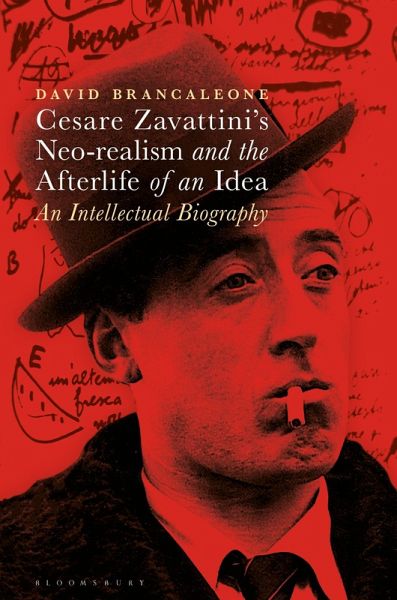
David BrancaleoneCesare Zavattini's Neo-realism and the Afterlife of an Idea
An Intellectual Biography
David Brancaleone is Lecturer in Critical and Contextual Studies, Technological University of the Shannon, Ireland, where he teaches history and theory of art, film, photography and visual culture. An art history graduate from La Sapienza, Rome, he gained an MA in Italian Studies at University College London, UK and, in 2002, his doctorate at the Warburg Institute, University of London, UK. In 2019, he published the two-volume Zavattini, il Neo-realismo e il Nuovo Cinema latino-americano which reconstructs and documents Zavattini's cultural interventions in Latin America and his specific contribution to the global dimension of Neo-realism in the latter half of the twentieth century. This publication provided the critical and contextual basis for the curation of a major retrospective exhibition, 'Zavattini oltre i confini', Reggio Emilia, Italy, 2019.
Introduction 1 Early days 2 Editorial director and screenwriter in Milan 3
Zavattini's early fiction and diary 4 Early screenwriting 5 Post-war
critique of cinema 6 Shoeshine and Bicycle Thieves 7 Cinema as commitment:
The Perugia Conference (1949) 8 First Communion, Miracle in Milan,
Bellissima, Umberto D. and beyond 9 Italia mia, proposal for ethnographic
cinema 10 Neo-realism to come 11 Manifesto films: Love in the City and We
Women 12 The Parma Conference on Neo-realism 13 The Catholic Varese
Conference on Neo-realism 14 Zavattini and cinematic ethnography: Un paese
15 Zavattini's transmission of Neo-realism to Spain 16 Transmission of
Neo-realism to Cuba 17 Transmission of Neo-realism to Mexico 18
Transmission to Argentina 19 Experimenting with non-fiction in the 1960s 20
Zavattini and the 1968 Venice Film Festival 21 Zavattini's Free Newsreels
22 The Truuuuth: Zavattini's testament? Notes Bibliography