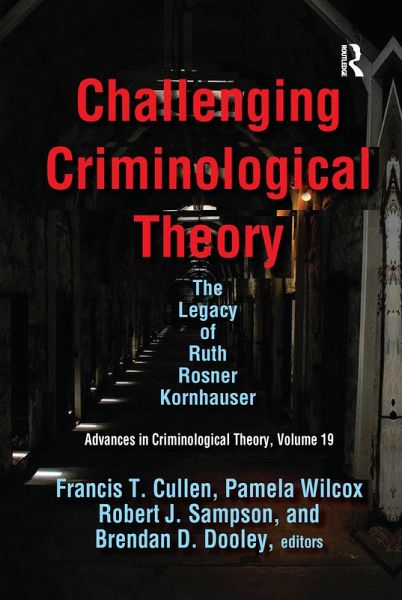
This volume is divided into five sections that, when taken together, offer an informative account of the impact of Ruth Rosner Kornhauser's Social Sources of Delinquency on the development of American criminological thought. This classic book was her major contribution to the field.
This volume is divided into five sections that, when taken together, offer an informative account of the impact of Ruth Rosner Kornhauser's Social Sources of Delinquency on the development of American criminological thought. This classic book was her major contribution to the field.
Introduction: The Legacy of Ruth Rosner Kornhauser Francis T. Cullen and Pamela Wilcox Part I. Ruth Rosner Kornhauser: Life and Criminology 1. Ruth Rosner Kornhauser: A Personal and Intellectual History Anne M. Kornhauser 2. Ruth Rosner Kornhauser's 1963 Manuscript: An Introduction Brendan D. Dooley 3. Theoretical Issues in the Sociological Study of Juvenile Delinquency Ruth Rosner Kornhauser 4. Ruth and Me Travis HirschiPart II: Challenging Criminology 5. Social Sources of Delinquency and the Second Coming of Shaw and McKay Robert J. Bursik, Jr. 6. Social Structure, Culture, and Crime: Assessing Kornhauser's Challenge to Criminology Ross L. Matsueda 7. Challenging Kornhauser's Critique of Strain Theory Robert Agnew and Francis T. CullenPart III: Inspiring New Theoretical Visions 8. Strength of Control Theory Chester L. Britt and Barbara J. Costello 9. Cultural Disorganization and Crime Charis E. Kubrin 10. Social Disorganization, Collective Efficacy, and Macro-Level Theories of Social Control Barbara D. Warner and Robert J. SampsonPart IV: Beyond Kornhauser 11. Social Disorganization and Criminal Opportunity Pamela Wilcox and Kenneth C. Land 12. Concentrated Disadvantage, the Persistence of Legal Cynicism, and Crime: Revisiting the Conception of Culture in Criminology David S. Kirk and Andrew V. Papachristo 13. Neighborhoods, Social Networks, and Crime John R. Hipp and Adam BoessenPart V: Criticizing Kornhauser 14. The Contested Place of Motivation in Criminological Theory David F. Greenberg 15. Taking Criminal Opportunity Seriously: An Actor-Centered Approach Darrell J. Steffensmeier and Jeffery T. Ulmer 16. Bringing Gangs and Girls Back In Cheryl L. MaxsonContributors Index
Introduction: The Legacy of Ruth Rosner Kornhauser Francis T. Cullen and Pamela Wilcox Part I. Ruth Rosner Kornhauser: Life and Criminology 1. Ruth Rosner Kornhauser: A Personal and Intellectual History Anne M. Kornhauser 2. Ruth Rosner Kornhauser's 1963 Manuscript: An Introduction Brendan D. Dooley 3. Theoretical Issues in the Sociological Study of Juvenile Delinquency Ruth Rosner Kornhauser 4. Ruth and Me Travis HirschiPart II: Challenging Criminology 5. Social Sources of Delinquency and the Second Coming of Shaw and McKay Robert J. Bursik, Jr. 6. Social Structure, Culture, and Crime: Assessing Kornhauser's Challenge to Criminology Ross L. Matsueda 7. Challenging Kornhauser's Critique of Strain Theory Robert Agnew and Francis T. CullenPart III: Inspiring New Theoretical Visions 8. Strength of Control Theory Chester L. Britt and Barbara J. Costello 9. Cultural Disorganization and Crime Charis E. Kubrin 10. Social Disorganization, Collective Efficacy, and Macro-Level Theories of Social Control Barbara D. Warner and Robert J. SampsonPart IV: Beyond Kornhauser 11. Social Disorganization and Criminal Opportunity Pamela Wilcox and Kenneth C. Land 12. Concentrated Disadvantage, the Persistence of Legal Cynicism, and Crime: Revisiting the Conception of Culture in Criminology David S. Kirk and Andrew V. Papachristo 13. Neighborhoods, Social Networks, and Crime John R. Hipp and Adam BoessenPart V: Criticizing Kornhauser 14. The Contested Place of Motivation in Criminological Theory David F. Greenberg 15. Taking Criminal Opportunity Seriously: An Actor-Centered Approach Darrell J. Steffensmeier and Jeffery T. Ulmer 16. Bringing Gangs and Girls Back In Cheryl L. MaxsonContributors Index
Es gelten unsere Allgemeinen Geschäftsbedingungen: www.buecher.de/agb
Impressum
www.buecher.de ist ein Internetauftritt der buecher.de internetstores GmbH
Geschäftsführung: Monica Sawhney | Roland Kölbl | Günter Hilger
Sitz der Gesellschaft: Batheyer Straße 115 - 117, 58099 Hagen
Postanschrift: Bürgermeister-Wegele-Str. 12, 86167 Augsburg
Amtsgericht Hagen HRB 13257
Steuernummer: 321/5800/1497
USt-IdNr: DE450055826