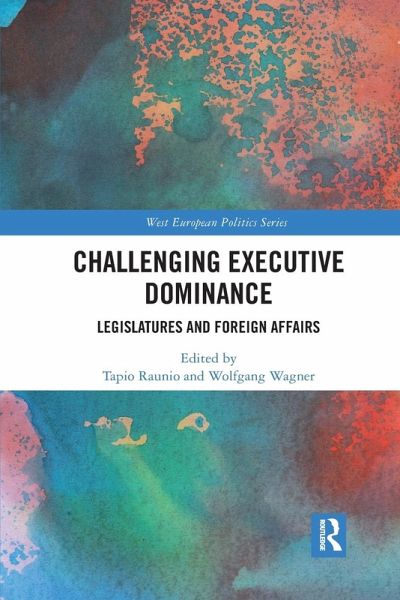
The book examines how legislatures across the world monitor, oversee and control governments in external relations. The chapters origianally published as a special issue in West European Politics.
The book examines how legislatures across the world monitor, oversee and control governments in external relations. The chapters origianally published as a special issue in West European Politics.
Tapio Raunio is professor of political science at the University of Tampere. His research interests cover legislatures and political parties, the Europeanization of domestic politics, semi-presidentialism and the Finnish political system. Wolfgang Wagner is professor of international security at the Department of Political Science and Public Administration at the Vrije Universiteit Amsterdam. His research revolves around domestic politics and international conflict with particular attention given to legislatures and, more recently, political parties.
Inhaltsangabe
1. Towards parliamentarisation of foreign and security policy? Tapio Raunio and Wolfgang Wagner 2. The party politics of legislative-executive relations in security and defence policy Wolfgang Wagner, Anna Herranz-Surrallés, Juliet Kaarbo and Falk Ostermann 3. Legislatures and civil-military relations in the United States and the United Kingdom David P. Auerswald 4. Precedents, parliaments, and foreign policy: historical analogy in the House of Commons vote on Syria Juliet Kaarbo and Daniel Kenealy 5. Curbing the royal prerogative to use military force: the British House of Commons and the conflicts in Libya and Syria Patrick A. Mello 6. France's reluctant parliamentarisation of military deployments: the 2008 constitutional reform in practice Falk Ostermann 7. Public critic or secretive monitor: party objectives and legislative oversight of the military in Canada Philippe Lagassé and Stephen M. Saideman 8. Japan's uncertain security environment and changes in its legislative-executive relations Alexandra Sakaki and Kerstin Lukner 9. Parliamentary scrutiny of the EU's Common Foreign and Security Policy Annika Herbel 10. Energy diplomacy under scrutiny: parliamentary control of intergovernmental agreements with third-country suppliers Anna Herranz-Surrallés 11. TTIP and legislative-executive relations in EU trade policy Davor Jan¿i¿
1. Towards parliamentarisation of foreign and security policy? Tapio Raunio and Wolfgang Wagner 2. The party politics of legislative-executive relations in security and defence policy Wolfgang Wagner, Anna Herranz-Surrallés, Juliet Kaarbo and Falk Ostermann 3. Legislatures and civil-military relations in the United States and the United Kingdom David P. Auerswald 4. Precedents, parliaments, and foreign policy: historical analogy in the House of Commons vote on Syria Juliet Kaarbo and Daniel Kenealy 5. Curbing the royal prerogative to use military force: the British House of Commons and the conflicts in Libya and Syria Patrick A. Mello 6. France's reluctant parliamentarisation of military deployments: the 2008 constitutional reform in practice Falk Ostermann 7. Public critic or secretive monitor: party objectives and legislative oversight of the military in Canada Philippe Lagassé and Stephen M. Saideman 8. Japan's uncertain security environment and changes in its legislative-executive relations Alexandra Sakaki and Kerstin Lukner 9. Parliamentary scrutiny of the EU's Common Foreign and Security Policy Annika Herbel 10. Energy diplomacy under scrutiny: parliamentary control of intergovernmental agreements with third-country suppliers Anna Herranz-Surrallés 11. TTIP and legislative-executive relations in EU trade policy Davor Jan¿i¿
Es gelten unsere Allgemeinen Geschäftsbedingungen: www.buecher.de/agb
Impressum
www.buecher.de ist ein Internetauftritt der buecher.de internetstores GmbH
Geschäftsführung: Monica Sawhney | Roland Kölbl | Günter Hilger
Sitz der Gesellschaft: Batheyer Straße 115 - 117, 58099 Hagen
Postanschrift: Bürgermeister-Wegele-Str. 12, 86167 Augsburg
Amtsgericht Hagen HRB 13257
Steuernummer: 321/5800/1497
USt-IdNr: DE450055826