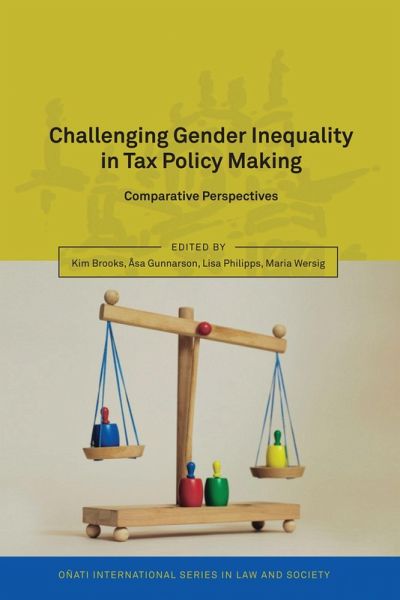
This volume takes a critical look at the gender of tax policy around the world. Contributors based in eight different countries examine the profound effects that gender norms and practices have had in shaping tax law and policy, and how taxation in turn impacts upon the possibilities for equality along gender, race, class, sexuality and other lines. Chapters explore how the gendered fiscal state might be theorised; how structural choices about rates and bases in tax policy design contribute to gender inequality; how tax policy affects family configurations and perceptions of what constitutes…mehr
This volume takes a critical look at the gender of tax policy around the world. Contributors based in eight different countries examine the profound effects that gender norms and practices have had in shaping tax law and policy, and how taxation in turn impacts upon the possibilities for equality along gender, race, class, sexuality and other lines. Chapters explore how the gendered fiscal state might be theorised; how structural choices about rates and bases in tax policy design contribute to gender inequality; how tax policy affects family configurations and perceptions of what constitutes family; how fiscal systems impact on savings and wealth accumulation by women and men; and the role of different policy-making processes and institutions in occluding and sometimes challenging these patterns. Most significantly, perhaps, the book explores these questions in an international frame, traversing countries and continents. The conclusion: fiscal policy has deep rooted, long standing gender implications that affect virtually every aspect of our social, political, and economic lives whether we live in Canada, Australia or Kenya.
Kim Brooks is the Dean at the Schulich School of Law at Dalhousie University in Halifax, Canada. Åsa Gunnarsson is a Professor at the Department of Law of Umeå University, Sweden. Lisa Philipps is a Professor at Osgoode Hall Law School of York University, Toronto, Canada. Maria Wersig is a doctoral candidate at the Otto Suhr Institute of Political Science, Freie Universität Berlin, Germany.
Inhaltsangabe
Introduction Lisa Philipps, Kim Brooks, Åsa Gunnarsson and Maria Wersig Part I: Gendering the Fiscal State 1. The 'Capture' of Women in Law and Fiscal Policy: The Tax/Benefit Unit, Gender Equality, and Feminist Ontologies Kathleen A Lahey 2. Tax, Markets, Gender and the New Institutionalism Ann Mumford 3. Gender Equity in Australia's Tax System: A Capabilities Approach Miranda Stewart 4. Challenging the Benchmarks in Tax Law Theories and Policies from a Gender Perspective-The Swedish Case Åsa Gunnarsson Part II: Bases and Rates: Structural Choices in Tax Policy Design 5. Taxing Surrogacy Bridget J Crawford 6. A Gender Perspective Approach Regarding the Impact of Income Tax on Wage-earning Women in Spain Paloma de Villota 7. Gender and Taxation in Kenya: The Case of Personal Income and Value-added Taxes Bernadette M Wanjala and Maureen Were Part III: The Family in Tax Policy 8. Dismembering Families Anthony C Infanti 9. The Tax/Benefit Implications of Recognizing Same-sex Partnerships Casey Warman and Frances Woolley 10. Income Redistribution Through Child Benefits and Child-related Tax Deductions: A Gender-neutral Approach? Kirsten Scheiwe 11. Overcoming the Gender Inequalities of Joint Taxation and Income Splitting: The Case of Germany Maria Wersig Part IV: Savings, Wealth and Capital Gains 12. Income Splitting and Gender Equality: The Case for Incentivizing Intra-household Wealth Transfers Lisa Philipps 13. Indirect Discrimination in Tax Law: The Case of Tax Deductions for Contributions to Employer-provided Pension Plans in Germany Ulrike Spangenberg 14. Gender and Capital Gains Taxation Marjorie E Kornhauser
Es gelten unsere Allgemeinen Geschäftsbedingungen: www.buecher.de/agb
Impressum
www.buecher.de ist ein Internetauftritt der buecher.de internetstores GmbH
Geschäftsführung: Monica Sawhney | Roland Kölbl | Günter Hilger
Sitz der Gesellschaft: Batheyer Straße 115 - 117, 58099 Hagen
Postanschrift: Bürgermeister-Wegele-Str. 12, 86167 Augsburg
Amtsgericht Hagen HRB 13257
Steuernummer: 321/5800/1497
USt-IdNr: DE450055826