This book was the first comprehensive treatment of credit cards in the global economy. The topic is timely not only because of the attention focused on cards as a contributor to the substantial rise in consumer borrowing, but also because of the role of cards in the recent retrenchment in the US bankruptcy system. Relying on data from the US, the UK, Canada, Australia, and Japan, Charging Ahead includes the first careful statistical analysis of the relation between the rise of credit card use and broader macroeconomic phenomena like consumer borrowing, savings, and bankruptcy. It also provides…mehr
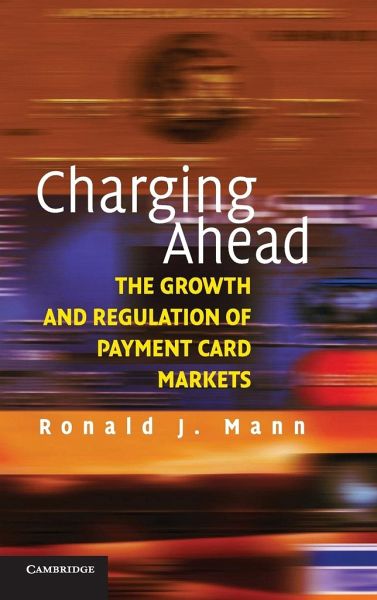
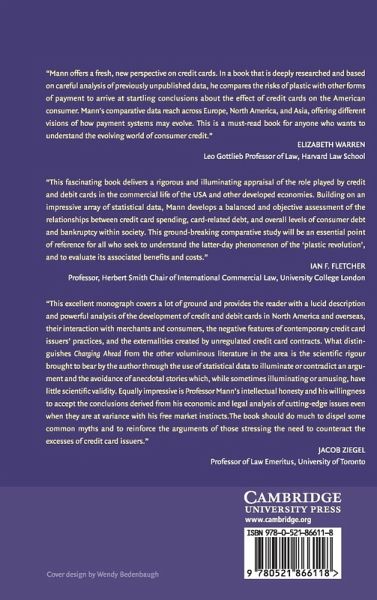
This book was the first comprehensive treatment of credit cards in the global economy. The topic is timely not only because of the attention focused on cards as a contributor to the substantial rise in consumer borrowing, but also because of the role of cards in the recent retrenchment in the US bankruptcy system. Relying on data from the US, the UK, Canada, Australia, and Japan, Charging Ahead includes the first careful statistical analysis of the relation between the rise of credit card use and broader macroeconomic phenomena like consumer borrowing, savings, and bankruptcy. It also provides a broad narrative of how credit cards have come to be used so differently around the world. Finally, it sets out a detailed and coherent program for regulatory intervention grounded in both empirical analysis and the existing theoretical literature.
Ronald A. Mann received his JD from the University of Texas where he graduated first in his class and was the managing editor of the Texas Law Review. After graduation, he clerked for judges on the United States Court of Appeals for the Ninth Circuit and the United States Supreme Court. After three years in private practice, he worked for the Justice Department for four years as an Assistant to the Solicitor General. Before joining the Texas faculty in 2003, he taught for six years at the University of Michigan and for three years at Washington University, St Louis.
Inhaltsangabe
Introduction Part I. The Basics of Payment Cards: 1. Paper or plastic? - payment system functionality 2. The mechanics of payment card transactions Part II. Easy Money: 3. In defense of credit cards 4. The psychology of card payments - card spending and consumer debt 5. Over the brink - credit card debt and bankruptcy Part III. The Puzzle of Payment Cards: 6. Explaining the pattern of global card use 7. The introduction of the payment card 8. Revolving credit 9. Point-of-sale debit 10. Convergence and exceptionalism in the use of cards Part IV. Reforming Payment Systems: 11. Indirect approaches: regulating interchange and encouraging surcharges 12. Contract design 13. Regulating information 14. Product design: affinity and rewards programs and teaser rates Part V. Optimizing Consumer Credit Markets and Bankruptcy Policy: 15. Causation, consumer credit and bankruptcy 16. Regulating consumer credit markets 17. Consumer bankruptcy reform Conclusion Endnotes Bibliography Index.
Es gelten unsere Allgemeinen Geschäftsbedingungen: www.buecher.de/agb
Impressum
www.buecher.de ist ein Internetauftritt der buecher.de internetstores GmbH
Geschäftsführung: Monica Sawhney | Roland Kölbl | Günter Hilger
Sitz der Gesellschaft: Batheyer Straße 115 - 117, 58099 Hagen
Postanschrift: Bürgermeister-Wegele-Str. 12, 86167 Augsburg
Amtsgericht Hagen HRB 13257
Steuernummer: 321/5800/1497
USt-IdNr: DE450055826