In recent years it has become increasingly clear that chemical interactions play a fundamental role in aquatic habitats and have far-reaching evolutionary and ecological consequences. A plethora of studies have shown that aquatic organisms from most taxa and functional groups respond to minute concentrations of chemical substances released by other organisms. However, our knowledge of this "chemical network" is still negligible. Chemical interactions can be divided into two larger sub-areas based on the function of the chemical substance. First, there are interactions where chemical substances…mehr
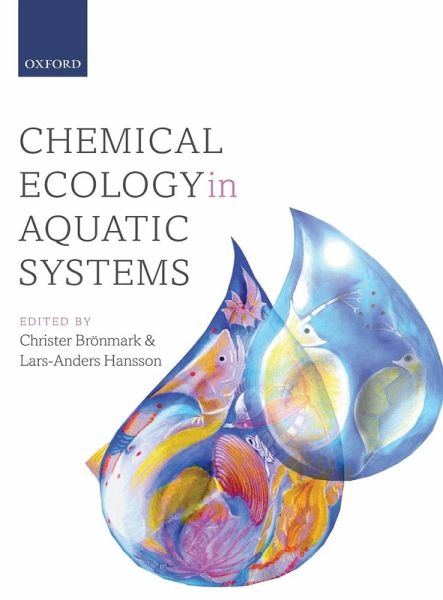
In recent years it has become increasingly clear that chemical interactions play a fundamental role in aquatic habitats and have far-reaching evolutionary and ecological consequences. A plethora of studies have shown that aquatic organisms from most taxa and functional groups respond to minute concentrations of chemical substances released by other organisms. However, our knowledge of this "chemical network" is still negligible. Chemical interactions can be divided into two larger sub-areas based on the function of the chemical substance. First, there are interactions where chemical substances are toxic to other organisms and are used as a defence against consumers (including both herbivores and predators) or a weapon against competitors (allelopathy). Second, chemical substances may be used as a source for information of the environment; for example: how can I find the optimal habitat, the best food, the nicest partner, and avoid being eaten? Aquatic organisms are able to detect and respond to extremely low concentrations of chemical cues to answer all these questions. The book aims at connecting these intriguing chemical interactions with traditional knowledge of organism interactions. Chemical Ecology of Aquatic Systems covers a wide range of studies, both plant and animal, from different geographic regions and habitats - pelagic as well as benthic. Most of the chemical interactions are similar in freshwater and marine habitats and this book therefore strives at integrating work on both systems.
Christer Brönmark is a professor of Limnology at the Department of Biology/Limnology at Lund University, Sweden. His main research interests resolve around the importance of indirect interactions in freshwater food webs and how these affect the structure and function of lake ecosystems. Here, chemical cues from predators have been shown to affect the behaviour and morphology of their prey and such trait-mediated interactions may in turn affect organisms at lower trophic levels. A spectacular example of an inducible morphological defence was shown in the Crucian carp that responded to diet-related chemical cues from piscivorus fish by increasing their body depth. Brönmark has published more than 80 papers in international, peer-reviewed journals and has published a textbook (The Biology of Lakes and Ponds) at OUP (together with Lars-Anders Hansson). Besides research Brönmark has long experience of teaching at both the undergraduate and the graduate levels. Lars-Anders Hansson is a professor of Limnology at the Department of Biology/Limnology at Lund University, Sweden. His main research interests includes direct and indirect interactions in freshwater systems, specifically how organisms use plastic traits and chemical cues to simultaneously handle and compromise among multiple threats. He has performed studies on most aquatic organisms, but the main focus has been on free swimming plankton organisms and the mechanisms behind their migration and movements. Within this research area he has introduced nanoparticles as tracking devices, allowing studies on behaviour, responses to chemical cues and migratory patterns of these small organisms. Hansson is also teaching at undergraduate and graduate courses in aquatic ecology and has a long publication record and has, together with Christer Brönmark written a text book in Limnology (The Biology of Lakes and Ponds) and also co-edited a book on Lake restoration (together with Eva Bergman).
Inhaltsangabe
* Chemical ecology of aquatic systems - an introduction * 1: Jelle Atema: Aquatic odour dispersal fields: opportunities and limits of detection, communication, and navigation * 2: Eric von Elert: Information conveyed by chemical cues * 3: Thomas Breithaupt and Jörg D. Hardege: Pheromones mediating sex and dominance in aquatic animals * 4: Gabriele Gerlach and Cornelia Hinz: Chemical signals and kin biased behaviour * 5: Gabriele Gerlach and Jelle Atema: The use of chemical cues in habitat recognition and settlement * 6: Ole B. Stabell: Migration and navigation * 7: Marc Weissburg: Death from downstream: chemosensory navigation and predator-prey processes * 8: Linda Weiss, Christian Laforsch, and Ralph Tollrian: The taste of predation and the defences of prey * 9: Douglas P. Chivers, Grant E. Brown, and Maud C.O. Ferrari: The evolution of alarm substances and disturbance cues in aquatic animals * 10: Andrew M. Turner and Scott D. Peacor: Scaling up infochemicals: ecological consequences of chemosensory assessment of predation risk * 11: Charles D. Derby and Richard K. Zimmer: Neuroecology of predator-prey interactions * 12: Ulrich K. Steiner and Josh R. Auld: Why is the jack of all trades a master of none? Studying the evolution of inducible defences in aquatic systems * 13: Georg Pohnert: How to explore the sometimes unusual chemistry of aquatic defence chemicals * 14: Elisabeth M. Gross, Catherine Legrand, Karin Rengefors, and Urban Tillmann: Allelochemical interactions among aquatic primary producers * 15: Henrik Pavia, Finn Baumgartner, Gunnar Cervin, Swantje Enge, Julia Kubanek, Göran M. Nylund, Erik Selander, J. Robin Svensson, and Gunilla B. Toth: Chemical defences against herbivores * 16: Cynthia Kicklighter: Chemical defences against predators * 17: Miquel Lürling: Info-disruption: pollutants interfering with the natural chemical information conveyance in aquatic systems * 18: Christer Brönmark and Lars-Anders Hansson: Aquatic chemical ecology: new directions and challenges for the future * Index
* Chemical ecology of aquatic systems - an introduction * 1: Jelle Atema: Aquatic odour dispersal fields: opportunities and limits of detection, communication, and navigation * 2: Eric von Elert: Information conveyed by chemical cues * 3: Thomas Breithaupt and Jörg D. Hardege: Pheromones mediating sex and dominance in aquatic animals * 4: Gabriele Gerlach and Cornelia Hinz: Chemical signals and kin biased behaviour * 5: Gabriele Gerlach and Jelle Atema: The use of chemical cues in habitat recognition and settlement * 6: Ole B. Stabell: Migration and navigation * 7: Marc Weissburg: Death from downstream: chemosensory navigation and predator-prey processes * 8: Linda Weiss, Christian Laforsch, and Ralph Tollrian: The taste of predation and the defences of prey * 9: Douglas P. Chivers, Grant E. Brown, and Maud C.O. Ferrari: The evolution of alarm substances and disturbance cues in aquatic animals * 10: Andrew M. Turner and Scott D. Peacor: Scaling up infochemicals: ecological consequences of chemosensory assessment of predation risk * 11: Charles D. Derby and Richard K. Zimmer: Neuroecology of predator-prey interactions * 12: Ulrich K. Steiner and Josh R. Auld: Why is the jack of all trades a master of none? Studying the evolution of inducible defences in aquatic systems * 13: Georg Pohnert: How to explore the sometimes unusual chemistry of aquatic defence chemicals * 14: Elisabeth M. Gross, Catherine Legrand, Karin Rengefors, and Urban Tillmann: Allelochemical interactions among aquatic primary producers * 15: Henrik Pavia, Finn Baumgartner, Gunnar Cervin, Swantje Enge, Julia Kubanek, Göran M. Nylund, Erik Selander, J. Robin Svensson, and Gunilla B. Toth: Chemical defences against herbivores * 16: Cynthia Kicklighter: Chemical defences against predators * 17: Miquel Lürling: Info-disruption: pollutants interfering with the natural chemical information conveyance in aquatic systems * 18: Christer Brönmark and Lars-Anders Hansson: Aquatic chemical ecology: new directions and challenges for the future * Index
Es gelten unsere Allgemeinen Geschäftsbedingungen: www.buecher.de/agb
Impressum
www.buecher.de ist ein Internetauftritt der buecher.de internetstores GmbH
Geschäftsführung: Monica Sawhney | Roland Kölbl | Günter Hilger
Sitz der Gesellschaft: Batheyer Straße 115 - 117, 58099 Hagen
Postanschrift: Bürgermeister-Wegele-Str. 12, 86167 Augsburg
Amtsgericht Hagen HRB 13257
Steuernummer: 321/5800/1497
USt-IdNr: DE450055826