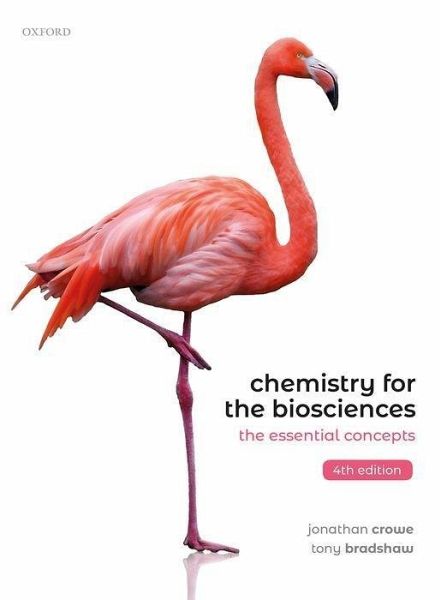
Chemistry for the Biosciences introduces the essential concepts of chemistry central to understanding biological systems. With an emphasis on straightforward explanations, it features biological examples that illustrate how integral chemistry is to the biosciences, and includes learning features to help students master the essentials.
Chemistry for the Biosciences introduces the essential concepts of chemistry central to understanding biological systems. With an emphasis on straightforward explanations, it features biological examples that illustrate how integral chemistry is to the biosciences, and includes learning features to help students master the essentials.
Jonathan Crowe is a publisher and science writer based in Oxford, UK. A biochemist by background, Jonathan has extensive experience of making science accessible to a broad audience both through his science writing and science editing. As well as writing Chemistry for the Biosciences, he is also a visiting lecturer at City, University of London, and associate lecturer at Bath Spa University. Tony Bradshaw is a Principal Lecturer in Biochemistry at Oxford Brookes University.
Inhaltsangabe
* 1: Introduction: why biologists need chemistry * 2: Atoms: the foundations of life * 3: Compounds and chemical bonding: bringing atoms together * 4: Molecular interactions: holding it all together * 5: Moles, concentrations, and dilutions: making sense of chemical numbers * 6: Hydrocarbons: the framework of life * 7: Functional groups: adding function to the framework of life * 8: Molecular shape and structure: life in three dimensions * 9: Isomerism: generating chemical variety * 10: Biological macromolecules: the infrastructure of life * 11: Metals in biology: life beyond carbon * 12: Chemical reactions, oxidation, and reduction: bringing molecules to life * 13: Reaction mechanisms: the chemical changes that drive the chemistry of life * 14: Energy: what makes reactions go? * 15: Equilibria: how far do reactions go? * 16: Kinetics: what affects the speed of a reaction? * 17: Acids, bases, and buffer solutions: life in an aqueous environment * 18: Chemical analysis: characterizing chemical compounds
* 1: Introduction: why biologists need chemistry * 2: Atoms: the foundations of life * 3: Compounds and chemical bonding: bringing atoms together * 4: Molecular interactions: holding it all together * 5: Moles, concentrations, and dilutions: making sense of chemical numbers * 6: Hydrocarbons: the framework of life * 7: Functional groups: adding function to the framework of life * 8: Molecular shape and structure: life in three dimensions * 9: Isomerism: generating chemical variety * 10: Biological macromolecules: the infrastructure of life * 11: Metals in biology: life beyond carbon * 12: Chemical reactions, oxidation, and reduction: bringing molecules to life * 13: Reaction mechanisms: the chemical changes that drive the chemistry of life * 14: Energy: what makes reactions go? * 15: Equilibria: how far do reactions go? * 16: Kinetics: what affects the speed of a reaction? * 17: Acids, bases, and buffer solutions: life in an aqueous environment * 18: Chemical analysis: characterizing chemical compounds
Es gelten unsere Allgemeinen Geschäftsbedingungen: www.buecher.de/agb
Impressum
www.buecher.de ist ein Internetauftritt der buecher.de internetstores GmbH
Geschäftsführung: Monica Sawhney | Roland Kölbl | Günter Hilger
Sitz der Gesellschaft: Batheyer Straße 115 - 117, 58099 Hagen
Postanschrift: Bürgermeister-Wegele-Str. 12, 86167 Augsburg
Amtsgericht Hagen HRB 13257
Steuernummer: 321/5800/1497
USt-IdNr: DE450055826