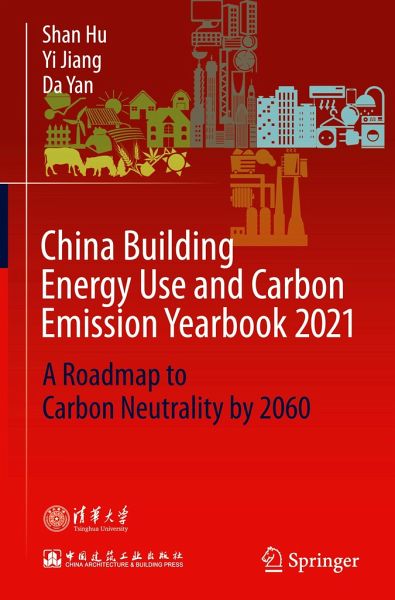
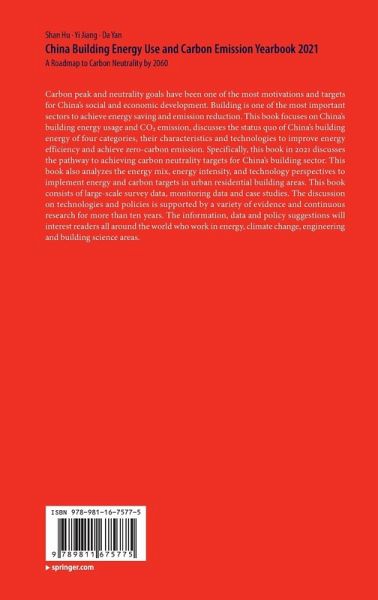
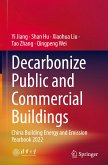
Double carbon targets have been one of the most motivations and targets for China's social and economic development. Building is one of the most important sectors to achieve energy savings and emission reductions. This book focuses on China's building energy usage and CO2 emissions, discusses the status quo of China's building energy of four categories, their characteristics and technologies to improve energy efficiency and achieve zero-carbon emissions. Specifically, this book in 2021 discussed the pathways to achieve carbon neutrality targets for China's building sector. This book also…mehr
Double carbon targets have been one of the most motivations and targets for China's social and economic development. Building is one of the most important sectors to achieve energy savings and emission reductions. This book focuses on China's building energy usage and CO2 emissions, discusses the status quo of China's building energy of four categories, their characteristics and technologies to improve energy efficiency and achieve zero-carbon emissions. Specifically, this book in 2021 discussed the pathways to achieve carbon neutrality targets for China's building sector. This book also analyzed the energy mix, energy intensity, and technology perspectives to implement energy and carbon targets in urban residential building areas. This book consists of large-scale survey data, monitoring data and case studies. The discussion on technologies and policies is supported by a variety of evidence and continuous research for more than ten years. The information, data and policy suggestions will interest readers all around the world who work in energy, climate change, engineering and building science areas.
Yi Jiang is Professor of Tsinghua University, Head of the Building Energy Research Center, and Member of the Chinese Academy of Engineering. Prof. Jiang has been Faculty Member of Tsinghua University since 1985. He has been involved in a number of international collaboration projects such as International Energy Agency (IEA) Annex 21, 25, 34, 53, and 59. He is also Member of China's Energy Advisory Committee under the State Council and Member of China's Climate Change Advisory Committee. His major research field is building energy efficiency. He is Chief Editor of the annual reports of building energy efficiency in China. He received four national science awards for controls of district heating system, liquid desiccant air process, indirect evaporative cooling, and building energy simulation (DeST). Dr. Shan Hu is Assistant Professor of Tsinghua University. Dr. Shan Hu graduated from Tsinghua University in 2018, worked in the Building Energy Group of the International Energy Agency in 2018, and joined the Building Energy Research Center of Tsinghua University in 2020. She is engaged in modeling and policy research related to building energy and climate change. Her main research results include "Annual Development Research Report on Building Energy Efficiency in China", "China Building Energy Use", "Building energy use in China" (joint report with IEA), "The future of cooling in China" (joint report with IEA (joint report with IEA), and articles in English and Chinese, which are important reference materials for domestic and international understanding of energy consumption and emissions in China's building sector. Dr. Shan Hu is also Chapter Scientist and Contributing Author of the Sixth Assessment Report of the United Nations Intergovernmental Panel on Climate Change (IPCC). Dr. Tao Zhang is an Assistant Professor of Tsinghua University. After graduated from School of Architecture, Tsinghua University, he worked in the Building Energy Research Center of Tsinghua University since 2015 as a post-doctor and Assistant Professor. He is engaged in thermal theory, solution dehumidification, air humidity treatment devices, and temperature and humidity independent control air conditioning system (THIC). His main research results include "Thermal Principle of Indoor Built Environment", "Humid Air Handling Process Using Desiccants", "Air-conditioning Systems in Buildings", and more than 60 scientific papers published in academic publications including 40 SCI indexed papers. As a Professor and Doctoral Supervisor, LIU Xiaohua is the Deputy Director of Institute of Built Environment, School of Architecture of Tsinghua University. She has been elected by the National "Ten Thousand Talents Program", Chang Jiang Youth Scholars Program and the Excellent Youth Scientists Fund supported by NSFC. She engages in researches on building energy conservation and HVAC equipment and system, and studies in-depth the temperature and humidity independent control (THIC) system and liquid desiccant dehumidification method. Prof. Qingpeng Wei received his B.Sc., M.Sc., and Ph.D. degrees in building services engineering from Tsinghua University. As the team leader on energy efficiency in commercial buildings research, Prof. Wei established an on-line energy monitoring and benchmarking system of commercial buildings through detailed metering data. By this monitoring and benchmarking system, current situation, characteristics and saving potentials of energy consumption for HVAC, lighting, office appliances in commercial buildings are clearly disclosed with real time energy consumption data. Therefore, Prof. Wei develops data-driven model and data mining methodology for retro-commissioning in commercial buildings and HVAC systems.
Inhaltsangabe
CHAPTER 1 Introduction.- CHAPTER 2 Carbon neutrality pathways for China's building sector.- CHAPTER 3 China's building energy use and GHG emissions.- CHAPTER 4 Urban residential buildings energy and emissions.
CHAPTER 1 Introduction.- CHAPTER 2 Carbon neutrality pathways for China's building sector.- CHAPTER 3 China's building energy use and GHG emissions.- CHAPTER 4 Urban residential buildings energy and emissions.
Es gelten unsere Allgemeinen Geschäftsbedingungen: www.buecher.de/agb
Impressum
www.buecher.de ist ein Internetauftritt der buecher.de internetstores GmbH
Geschäftsführung: Monica Sawhney | Roland Kölbl | Günter Hilger
Sitz der Gesellschaft: Batheyer Straße 115 - 117, 58099 Hagen
Postanschrift: Bürgermeister-Wegele-Str. 12, 86167 Augsburg
Amtsgericht Hagen HRB 13257
Steuernummer: 321/5800/1497
USt-IdNr: DE450055826