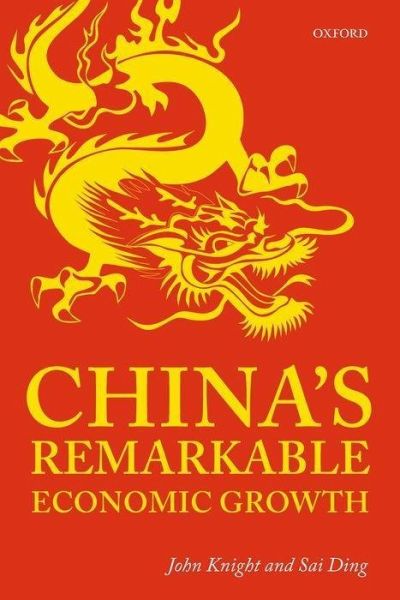
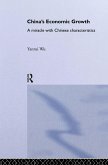
How has the Chinese economy managed to grow at such a remarkable rate--no less than ten per cent per annum--for over three decades? This well-integrated book combines economic theory, empirical estimation, and institutional analysis to address one of the most important questions facing contemporary economists. A common thread that runs throughout the book is the underlying political economy: why China became a developmental state, and how it has maintained itself as a developmental state. The book examines the causal processes at work in the evolution of China's institutions and policies. It…mehr
How has the Chinese economy managed to grow at such a remarkable rate--no less than ten per cent per annum--for over three decades? This well-integrated book combines economic theory, empirical estimation, and institutional analysis to address one of the most important questions facing contemporary economists. A common thread that runs throughout the book is the underlying political economy: why China became a developmental state, and how it has maintained itself as a developmental state. The book examines the causal processes at work in the evolution of China's institutions and policies. It estimates cross-country and cross-province growth equations to shed light on the proximate, and some of the underlying determinants of the growth rate. It explores important consequences of China's growth, posing a series of key questions, such as: is the economy running out of unskilled labor; why and how has inequality risen; has economic growth raised happiness; what are the social costs of the overriding priority accorded to growth objectives; can China continue to grow rapidly, or will the maturing economy, or the macroeconomic imbalances, or financial crisis, or social instability, bring it to an end? Based mainly on original research, this book will be of interest to growth economists, development economists, transition economists, China specialists, policy-makers, and indeed all those who are intrigued by the Chinese growth phenomenon.
John Knight has conducted research on the Chinese economy for more than two decades, and has published many journal articles, including papers on income distribution, poverty, wages, migration, education, subjective well-being, and economic growth. His books on China include The Rural-Urban Divide: Economic Disparities and Interactions in China and Towards a Labour Market in China (both with Lina Song and both published by OUP). The latter book received the Richard A. Lester Prize, awarded at Princeton University, for "the outstanding book in Labor Economics and Industrial Relations published in 2005." He is a long-serving editor of the Oxford Bulletin of Economics and Statistics. Sai Ding graduated from Nankai University and obtained her doctorate at Birmingham University before becoming a Research Fellow in Oxford, where she collaborated with John Knight on the research for this book. Her current research is on corporate investment and finance in China.
Inhaltsangabe
PART 1: INTRODUCTION 1: Setting the Stage 2: Approaches to Understanding Economic Growth 3: The Evolution of Economic Reform PART II: THE DETERMINANTS OF CHINA'S ECONOMIC GROWTH 4: China in a Cross-Country Growth Perspective 5: The Basic Cross-Province Growth Equation 6: The Role of Physical and Human Capital Formation 7: The Role of Structural Change: Trade, Ownership, Industry 8: Why Does China Invest so Much? PART III: THE CONSEQUENCES OF CHINA'S ECONOMIC GROWTH 9: Economic Growth and the Labour Market 10: Economic Growth and Inequality 11: Economic Growth and Happiness PART IV: CONCLUSION 12: Economic Growth in China: Prospect 13: Economic Growth in China: Retrospect
PART 1: INTRODUCTION 1: Setting the Stage 2: Approaches to Understanding Economic Growth 3: The Evolution of Economic Reform PART II: THE DETERMINANTS OF CHINA'S ECONOMIC GROWTH 4: China in a Cross-Country Growth Perspective 5: The Basic Cross-Province Growth Equation 6: The Role of Physical and Human Capital Formation 7: The Role of Structural Change: Trade, Ownership, Industry 8: Why Does China Invest so Much? PART III: THE CONSEQUENCES OF CHINA'S ECONOMIC GROWTH 9: Economic Growth and the Labour Market 10: Economic Growth and Inequality 11: Economic Growth and Happiness PART IV: CONCLUSION 12: Economic Growth in China: Prospect 13: Economic Growth in China: Retrospect
Es gelten unsere Allgemeinen Geschäftsbedingungen: www.buecher.de/agb
Impressum
www.buecher.de ist ein Internetauftritt der buecher.de internetstores GmbH
Geschäftsführung: Monica Sawhney | Roland Kölbl | Günter Hilger
Sitz der Gesellschaft: Batheyer Straße 115 - 117, 58099 Hagen
Postanschrift: Bürgermeister-Wegele-Str. 12, 86167 Augsburg
Amtsgericht Hagen HRB 13257
Steuernummer: 321/5800/1497
USt-IdNr: DE450055826