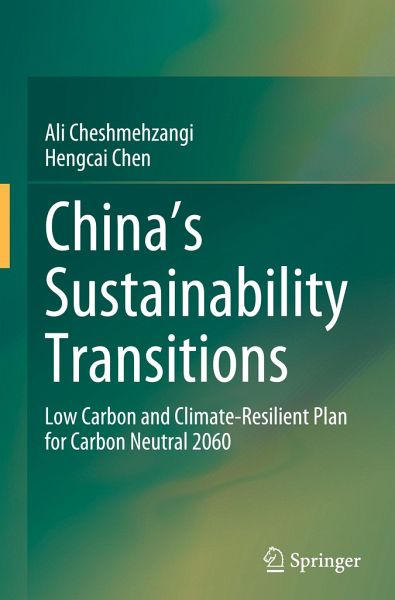
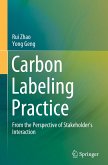
This book considers the impact of global climate change, advocating to promote sustainable development from the perspective of low carbon and climate resilience, by reducing carbon emissions in different aspects of urban and regional development. As the world's largest emitter of carbon dioxide, China is continuously exploring a sustainable path to achieve the momentous goal of 2060 carbon neutrality. In addition, this book reviews and summarizes China's green development and predicts the transformation of China's carbon emission and energy structure before and after the peak of carbon…mehr
This book considers the impact of global climate change, advocating to promote sustainable development from the perspective of low carbon and climate resilience, by reducing carbon emissions in different aspects of urban and regional development. As the world's largest emitter of carbon dioxide, China is continuously exploring a sustainable path to achieve the momentous goal of 2060 carbon neutrality. In addition, this book reviews and summarizes China's green development and predicts the transformation of China's carbon emission and energy structure before and after the peak of carbon emission in 2030. It examines the role of governance in decarbonization efforts, focusing on decision making processes, policies and regulations, as well as the significance of regions, cities, and communities. This book highlights typical methods of implementing and achieving low carbon development in light of China's practical situation, which helps to resolve some of the problems that may arise in achieving the carbon neutral goal. Therefore, this book is suitable for the reference of scholars in low-carbon environment science, sustainable urban development, and other related fields. It also provides inspiration for China's medium and long-term sustainable development plans in the future.
Ali Cheshmehzangi is a Full Professor of Architecture and Urban Design with a Ph.D. Degree in Architecture and Urban Design, a Masters Degree in Urban Design, a Graduate Certificate in Professional Studies in Architecture, and a Bachelor Degree in Architecture. He is an urbanist and urban designer by profession and by heart. He studies cities and city transitions, sustainable urbanism, and integrated urban design strategies. Ali is Head of the Department of Architecture and Built Environment, Director of the Centre for Sustainable Energy Technologies (CSET), and Director of Urban Innovation Lab at the University of Nottingham Ningbo China. He is also a Specially-Appointed Professor at Hiroshima University, Japan. More recently, he works on two research projects on Integrated Urban Modelling Framework, and ICT-based smart technologies for resilient cities. Some of his previous projects are: smart eco-cities in China and Europe, low-carbon town planning in China, green infrastructure ofcities, nature-based solutions in China, toolkit for resilient cities, sponge city program and green development in China, low carbon and climate-resilient planning, and other urban transition studies. So far, Ali has +135 published journal papers and nine other published books, titled 'Designing Cooler Cities' (2017), the award-winning 'Eco-development in China' (2018), 'Sustainable Urban Development in the Age of Climate Change' (2019), 'Identity of Cities and City of Identities' (2020), the double award-winning 'The City in Need' (2020), 'Urban Memory in City Transitions' (2021), 'China's Sustainability Transitions' (2021), 'Sustainable Urbanism in China' (2021), 'Urban Health, Sustainability, and Peace in the Day the World Stopped' (2021), and 'Green Infrastructure in Chinese Cities' (2022).
Inhaltsangabe
Current Progress on Sustainable and Climate-Resilient Development.- Innovations and Transitions: Urban Factors and Low Carbon Strategies.- Overview of China's Low Carbon Progress: Past, Present, and Future.- Low carbon Transitions in Practice: Low Carbon Development in China.- Lessons and Paradigms to Meet the 2030 Targets and the 2060 Plan.- Key Suggestions and Steps Ahead.
Current Progress on Sustainable and Climate-Resilient Development.- Innovations and Transitions: Urban Factors and Low Carbon Strategies.- Overview of China's Low Carbon Progress: Past, Present, and Future.- Low carbon Transitions in Practice: Low Carbon Development in China.- Lessons and Paradigms to Meet the 2030 Targets and the 2060 Plan.- Key Suggestions and Steps Ahead.
Es gelten unsere Allgemeinen Geschäftsbedingungen: www.buecher.de/agb
Impressum
www.buecher.de ist ein Internetauftritt der buecher.de internetstores GmbH
Geschäftsführung: Monica Sawhney | Roland Kölbl | Günter Hilger
Sitz der Gesellschaft: Batheyer Straße 115 - 117, 58099 Hagen
Postanschrift: Bürgermeister-Wegele-Str. 12, 86167 Augsburg
Amtsgericht Hagen HRB 13257
Steuernummer: 321/5800/1497
USt-IdNr: DE450055826