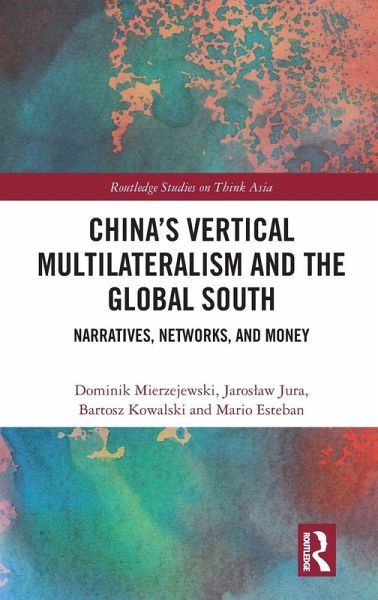
This book provides an in-depth analysis of China-led multilateralism and decodes China's narratives, and political and business practices, both from theoretical and practical dimensions.
This book provides an in-depth analysis of China-led multilateralism and decodes China's narratives, and political and business practices, both from theoretical and practical dimensions.
Dominik Mierzejewski is Associate Professor at the University of ¿ód¿, where he leads the Department of Asian Studies and the Centre for Asian Affairs (think-tank), specialising in China's political discourse, local China and China's international behaviours. Mierzejewski studied at Shanghai International Studies University and was a visiting professor at the Chinese Academy of Social Sciences. He is the author of China's Provinces and the Belt and Road Initiative (Routledge, 2021) and has published in journals such as Asian Affairs and the Journal of Contemporary China. He serves as a principal investigator in grants supported by the Polish National Science Centre and the Ministry of Foreign Affairs in Poland. Jaros¿aw Jura is Assistant Professor at Lazarski University in Warsaw, specialising in China-Africa relations, Chinese soft power and the global projection of Chinese influence. He has published on FDI spillovers, media representations and political discourse in journals such as African Affairs and Journal of Contemporary China. He has conducted field research on China's presence in Africa, Southeast Asia and Latin America. Jura has contributed to research projects funded by the Polish National Science Centre, including studies on China's vertical multilateralism in the Global South, spillover effects of Chinese FDI in Africa and China's diplomacy at the UN. Bartosz Kowalski is Associate Professor in the Department of Asian Studies of the University of ¿ód¿, Poland. His research explores China's foreign policy, particularly its engagement with Central and Eastern Europe and the Global South. He has published widely on China's regional diplomacy in Central and Eastern Europe and Chinese ideological narratives. His most recenct book is Relacyjnö¿ w polityce Chin wobec Europy ¿rodkowo-Wschodniej: Przypadek Czech (2024). Mario Esteban is Full Professor and Director of the Centre for East Asian Studies at the Autonomous University of Madrid. He is also Senior Fellow at the Elcano Royal Institute. He was the president of the Spanish Association for East Asian Studies (2020-2024), a visiting professor at Beijing Foreign Studies University and a visiting researcher at the Chinese Academy of Social Sciences and Chengchi National University. His most recent books are Introducción a la China actual (2024) and China and International Norms: Evidence from the Belt and Road Initiative (Routledge, 2023).
Inhaltsangabe
Introduction Section 1. Chapter 1. Framing civilisation and contemporary histories in China's multilateral formats. Chapter 2. Chapter 3. . Section 2. China's Networks in the Global South: Elite-Centred Relations and Media Messaging Chapter 4. Elite-centred diplomacy under China's vertical multilateralism in the Global South. Chapter 5. Networking through ambassadorial activities during the COVID-19 pandemic. Chapter 6. China's diplomats and policymakers' presence in local newspapers in the Global South countries. Section 3. Trade, Infrastructure and Technology: Pillars of China's Economic Statecraft Toward the Global South Chapter 7. China's Trading Power and the Risk of Sectoral Overreliance in the Global South Chapter 8. Financial commitments, investments and construction projects under China's Vertical Multilateralism Chapter 9. China's technological and digital engagement and Huawei's rise in the Global South. Conclusion
Introduction Section 1. Chapter 1. Framing civilisation and contemporary histories in China's multilateral formats. Chapter 2. Chapter 3. . Section 2. China's Networks in the Global South: Elite-Centred Relations and Media Messaging Chapter 4. Elite-centred diplomacy under China's vertical multilateralism in the Global South. Chapter 5. Networking through ambassadorial activities during the COVID-19 pandemic. Chapter 6. China's diplomats and policymakers' presence in local newspapers in the Global South countries. Section 3. Trade, Infrastructure and Technology: Pillars of China's Economic Statecraft Toward the Global South Chapter 7. China's Trading Power and the Risk of Sectoral Overreliance in the Global South Chapter 8. Financial commitments, investments and construction projects under China's Vertical Multilateralism Chapter 9. China's technological and digital engagement and Huawei's rise in the Global South. Conclusion
Es gelten unsere Allgemeinen Geschäftsbedingungen: www.buecher.de/agb
Impressum
www.buecher.de ist ein Internetauftritt der buecher.de internetstores GmbH
Geschäftsführung: Monica Sawhney | Roland Kölbl | Günter Hilger
Sitz der Gesellschaft: Batheyer Straße 115 - 117, 58099 Hagen
Postanschrift: Bürgermeister-Wegele-Str. 12, 86167 Augsburg
Amtsgericht Hagen HRB 13257
Steuernummer: 321/5800/1497
USt-IdNr: DE450055826