
Andere Kunden interessierten sich auch für
 More Chinese Characters") Japanese Reading For Beginners (Volume Iii) More Chinese Characters26,99 €
Japanese Reading For Beginners (Volume Iii) More Chinese Characters26,99 €![The Simple Way to Learn English [Chinese to English Workbook]]( "The Simple Way to Learn English [Chinese to English Workbook]") The Simple Way to Learn English [Chinese to English Workbook]32,99 €
The Simple Way to Learn English [Chinese to English Workbook]32,99 € The Hakka Dialect63,99 €
 Pronunciation of Chinese Medicine Terms in Mandarin and Cantonese21,99 €
 Tone Sandhi62,99 €
 China's Peril And Promise39,99 €
 China's Peril and Promise45,99 €
![The Simple Way to Learn English [Chinese to English Workbook]](https://bilder.buecher.de/produkte/59/59454/59454628m.jpg "The Simple Way to Learn English [Chinese to English Workbook]")

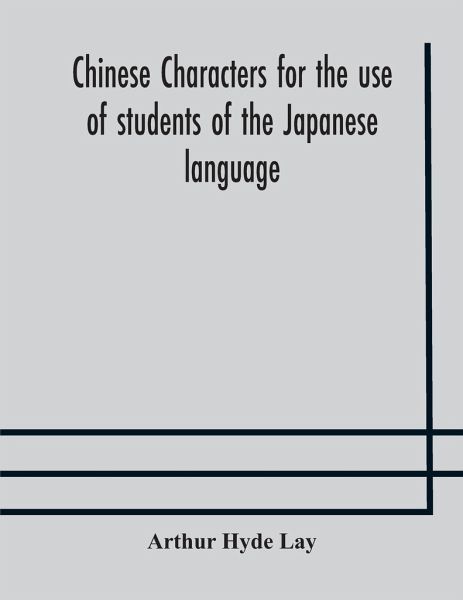
Unlock the bridge between Japanese and Chinese scripts with Arthur Hyde Lay's enduring classic, crafted for the earnest student and the curious mind alike. Chinese Characters For The Use Of Students Of The Japanese Language stands as a vital educational textbook, demystifying the intricacies of kanji for those embarking on Japanese language learning or exploring the wider world of East Asian languages. Every page reflects Lay's meticulous approach, offering a practical language acquisition tool that clarifies the roots, meanings, and connections of Chinese characters as they appear in Japanese-a resource as relevant now as it was in the 19th century. This volume is more than a comparative linguistics guide; it is a window into the cross-cultural communication that shaped modern language study. Lay's work, celebrated among student language resources, illuminates the shared heritage and subtle distinctions between Chinese and Japanese, enriching the journey for Japanese learners and collectors of classic language study collections. Republished by Alpha Editions in a careful modern edition, this volume preserves the spirit of the original while making it effortless to enjoy today-a heritage title prepared for readers and collectors alike. For anyone passionate about Arthur Hyde Lay's works or the evolution of language, this book is both a scholarly touchstone and a cultural treasure.