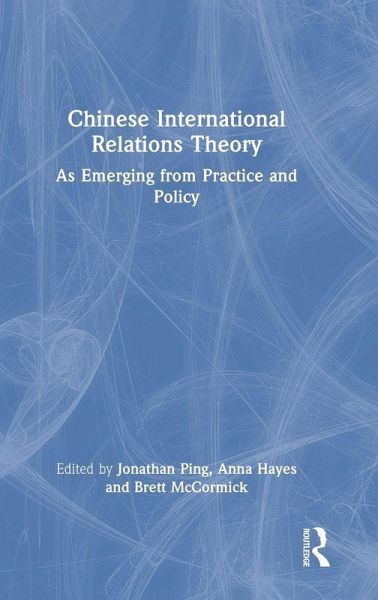
This book explores how fundamental aspects of China's rapidly evolving arena of international relations theory are emerging directly from the realms of practice and policy.
This book explores how fundamental aspects of China's rapidly evolving arena of international relations theory are emerging directly from the realms of practice and policy.
Jonathan Ping is an Associate Professor of International Relations at Bond University, Australia. Anna Hayes is Senior Lecturer of International Relations at James Cook University, Australia. Brett McCormick is Professor of History and Chair of the Department of Human Sciences at the University of New Haven, USA.
Inhaltsangabe
1. Towards a Chinese theory of international relations evidenced in practice and policy 2. Chinese international relations theory of statecraft and party 3. Conceptualizing peace in China: Mao Zedong, Deng Xiaoping, and their strategic thinking 4. Exploring illiberal practices in China's Belt and Road Initiative: Towards norms creation and democratic diffusion-proofing? 5. The discursive and affective dimensions of the 'China Dream' 6. Global 'civilization politics' with 'civilization value' 7. A new model of major power relations and sources of insecurity in the region: Third country perspectives 8. The divergence between Vietnamese Communist Party and the Chinese Communist Party 9. Confronting China's realpolitik approach in the South China Sea Dispute: The Philippines' changing grand strategies 10. Beijing's public diplomacy: From soft power to sharp power and the Australian experience 11. China's international relations theory and India 12. International relations theory in a post-Great Power world
1. Towards a Chinese theory of international relations evidenced in practice and policy 2. Chinese international relations theory of statecraft and party 3. Conceptualizing peace in China: Mao Zedong, Deng Xiaoping, and their strategic thinking 4. Exploring illiberal practices in China's Belt and Road Initiative: Towards norms creation and democratic diffusion-proofing? 5. The discursive and affective dimensions of the 'China Dream' 6. Global 'civilization politics' with 'civilization value' 7. A new model of major power relations and sources of insecurity in the region: Third country perspectives 8. The divergence between Vietnamese Communist Party and the Chinese Communist Party 9. Confronting China's realpolitik approach in the South China Sea Dispute: The Philippines' changing grand strategies 10. Beijing's public diplomacy: From soft power to sharp power and the Australian experience 11. China's international relations theory and India 12. International relations theory in a post-Great Power world
Es gelten unsere Allgemeinen Geschäftsbedingungen: www.buecher.de/agb
Impressum
www.buecher.de ist ein Internetauftritt der buecher.de internetstores GmbH
Geschäftsführung: Monica Sawhney | Roland Kölbl | Günter Hilger
Sitz der Gesellschaft: Batheyer Straße 115 - 117, 58099 Hagen
Postanschrift: Bürgermeister-Wegele-Str. 12, 86167 Augsburg
Amtsgericht Hagen HRB 13257
Steuernummer: 321/5800/1497
USt-IdNr: DE450055826