
Andere Kunden interessierten sich auch für
- From Poverty to Powerhouse, China's Political Will and the Economic Revolution, How China's Decisions Drove Its Economic Miracle, Prosperity through Market and Rural Revitalization") Chinese Politics (Part 7)- From Poverty to Powerhouse, China's Political Will and the Economic Revolution, How China's Decisions Drove Its Economic Miracle, Prosperity through Market and Rural Revitalization48,99 €
Chinese Politics (Part 7)- From Poverty to Powerhouse, China's Political Will and the Economic Revolution, How China's Decisions Drove Its Economic Miracle, Prosperity through Market and Rural Revitalization48,99 €- Governing Modern China, The Policies and Philosophy of President Xi Jinping¿Leadership Vision, Corruption Crackdown, Transparency and Accountability, Socialist Governance with Chinese Characteristics") Chinese Politics (Part 4)- Governing Modern China, The Policies and Philosophy of President Xi Jinping¿Leadership Vision, Corruption Crackdown, Transparency and Accountability, Socialist Governance with Chinese Characteristics48,99 €
Chinese Politics (Part 4)- Governing Modern China, The Policies and Philosophy of President Xi Jinping¿Leadership Vision, Corruption Crackdown, Transparency and Accountability, Socialist Governance with Chinese Characteristics48,99 €- China's Political System, Structure, Function, and Adaptability in the 21st Century, The Chinese Communist Party and Modern Governance, Dynamics, and Evolution of Political Ideologies") Chinese Politics (Part 5)- China's Political System, Structure, Function, and Adaptability in the 21st Century, The Chinese Communist Party and Modern Governance, Dynamics, and Evolution of Political Ideologies48,99 €
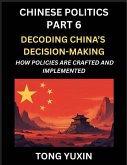
Chinese Politics (Part 5)- China's Political System, Structure, Function, and Adaptability in the 21st Century, The Chinese Communist Party and Modern Governance, Dynamics, and Evolution of Political Ideologies48,99 €- Decoding China's Decision-Making, How Policies Are Crafted and Implemented, Transforming Ideology into Action, The Art of Chinese Governance, The Inner Workings of China's Policy Machine") Chinese Politics (Part 6)- Decoding China's Decision-Making, How Policies Are Crafted and Implemented, Transforming Ideology into Action, The Art of Chinese Governance, The Inner Workings of China's Policy Machine48,99 €
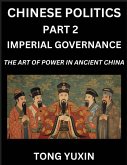
Chinese Politics (Part 6)- Decoding China's Decision-Making, How Policies Are Crafted and Implemented, Transforming Ideology into Action, The Art of Chinese Governance, The Inner Workings of China's Policy Machine48,99 €- Imperial Governance, The Art of Power in Ancient China, The Mandate of Heaven, Government, Statecraft and Authority in Imperial China, Strategies and Secrets of Ancient Chinese Rule") Chinese Politics (Part 2)- Imperial Governance, The Art of Power in Ancient China, The Mandate of Heaven, Government, Statecraft and Authority in Imperial China, Strategies and Secrets of Ancient Chinese Rule48,99 €
Chinese Politics (Part 2)- Imperial Governance, The Art of Power in Ancient China, The Mandate of Heaven, Government, Statecraft and Authority in Imperial China, Strategies and Secrets of Ancient Chinese Rule48,99 € The Roots Of Christianity In Mosaism25,99 €
") A Lexicon Of The Hebrew Roots (1843)19,99 €
A Lexicon Of The Hebrew Roots (1843)19,99 €
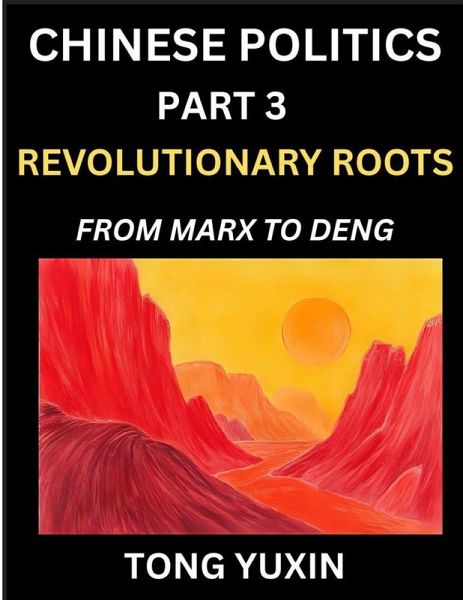
China's political identity has never been carved in stone. It's a story of constant reinvention-a nation shaped by revolutions that upended centuries of tradition, then reshaped again by reforms that defied its own revolutionary ideals. From the fiery rhetoric of Marxist class struggle (¿¿¿¿ M¿liè zh¿yì) that fueled the 1949 Communist Revolution to the Maoist cult of personality (¿¿¿¿¿ Máo Zéd¿ng s¿xi¿ng) that redefined governance, and later to the Dengist pragmatism (¿¿¿¿¿ Dèng Xi¿opíng l¿lùn) that prioritized economic survival over ideological purity, China's path is a testament to how ideas evolve when thrust into the crucible of power.This book isn't about drawing neat lines between eras. It's about tracing the messy, often contradictory, ways China's rulers have wielded ideology as both a weapon and a shield. The Communist Party didn't just "inherit" Marxism-it rewrote it, stripping away European socialist dogma to fit a peasant-majority society. Mao didn't simply apply Marxist theory; he weaponized it, turning concepts like "continuous revolution" (¿¿¿¿¿ Bùduàn gémìng lùn) into tools for consolidating power. And when Mao's utopianism nearly collapsed the economy, Deng Xiaoping didn't abandon Marxism-he redefined it, declaring "to get rich is glorious" (¿¿¿¿ Zhìfù güngróng) while keeping the Party firmly in control.What emerges is a political DNA forged in adaptability. The CCP's survival hinges on its ability to morph ideologies: Mao's "permanent revolution" became Deng's "stable governance" (¿¿¿¿ W¿ndìng zhìguó); revolutionary egalitarianism softened into meritocratic hierarchy; anti-imperialist rhetoric coexisted with reliance on Western markets. Even today, phrases like "seeking truth from facts" (¿¿¿¿ Shíshì qiúshì)-a Maoist slogan repurposed to justify market reforms-reveal a party that quotes its past to legitimize its present.But this agility comes at a cost. The CCP walks a tightrope between honoring revolutionary roots and embracing a future that demands compromise. How does a party that once vilified capitalism now manages the world's second-largest economy? Can Mao's legacy of mass mobilization coexist with Deng's vision of a technocratic elite? And as China asserts itself globally, will its political identity remain rooted in 20th-century ideologies or forge a new, uncharted path?This book rejects simplistic labels like "authoritarian" or "socialist with Chinese characteristics." Instead, it examines the ideological tensions that define China's rise: the clash between revolutionary myth-making and bureaucratic pragmatism, between nationalist assertion and global integration, between Party control and market freedom. The journey from Marx to Deng isn't a story of progress-it's a story of survival, where yesterday's radicals become today's pragmatists, and where the ghosts of revolutions past linger in the halls of power.