

Andere Kunden interessierten sich auch für
 White-Collar Crime and Criminal Careers67,99 €
 The White Collar Working Class88,99 €
 Professional and White-Collar Employments116,99 €
 Choosing Life After Rape11,99 €
 Blue-Collar Women at Work with Men70,99 €
 Blue Collar Bayou87,99 €
 Professional and White-Collar Employments116,99 €




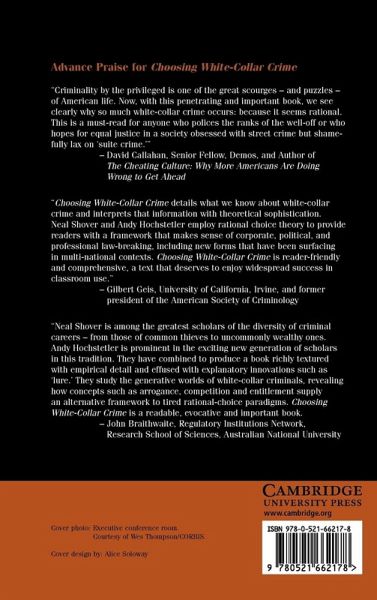
For more than three decades, rational-choice theory has reigned as the dominant approach both for interpreting crime and as underpinning for crime-control programs. Although it has been applied to an array of street crimes, white-collar crime and those who commit it have thus far received less attention. Choosing White-Collar Crime is a systematic application of rational-choice theory to problems of explaining and controlling white-collar crime. It distinguishes ordinary and upperworld white-collar crime and presents reasons theoretically for believing that both have increased substantially in recent decades. Reasons for the increase include the growing supply of white-collar lure and non-credible oversight. Choosing White-Collar Crime also examines criminal decision making by white-collar criminals and their criminal careers. The book concludes with reasons for believing that problems of white-collar crime will continue unchecked in the increasingly global economy and calls for strengthened citizen movements to rein in the increases.