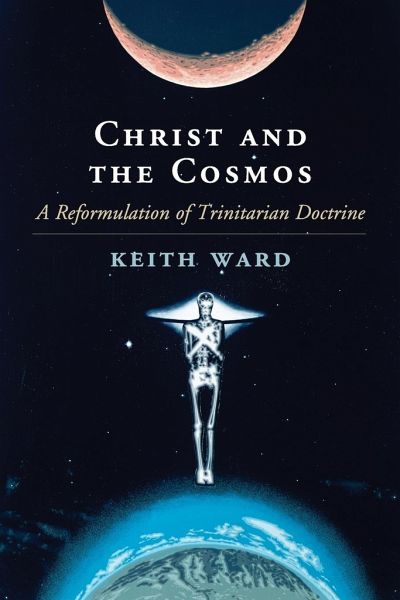
The concept of the 'social Trinity', which posits three conscious subjects in God, radically revised the traditional Christian idea of the Creator. It promoted a view of God as a passionate, creative and responsive source of all being. Keith Ward argues that social Trinitarian thinking threatens the unity of God, however, and that this new view of God does not require a 'social' component. Expanding on the work of theologians such as Barth and Rahner, who insisted that there was only one mind of God, Ward offers a coherent, wholly monotheistic interpretation of the Trinity. Christ and the…mehr
The concept of the 'social Trinity', which posits three conscious subjects in God, radically revised the traditional Christian idea of the Creator. It promoted a view of God as a passionate, creative and responsive source of all being. Keith Ward argues that social Trinitarian thinking threatens the unity of God, however, and that this new view of God does not require a 'social' component. Expanding on the work of theologians such as Barth and Rahner, who insisted that there was only one mind of God, Ward offers a coherent, wholly monotheistic interpretation of the Trinity. Christ and the Cosmos analyses theistic belief in a scientific context, demonstrating the necessity of cosmology to theological thinking that is often overly myopic and anthropomorphic. This important volume will benefit those who seek to understand what the Trinity is, why it matters and how it fits into a scientific account of the universe.
Keith Ward is Regius Professor of Divinity Emeritus at the University of Oxford, Professor of the Philosophy of Religion at Roehampton University, and a Fellow of the British Academy. He is a Canon of Christ Church, Oxford.
Inhaltsangabe
Part I. The Threefold Nature of the Divine Being: 1. Introduction: talking about the Trinity 2. Why we may need to restate the ways in which we talk about the Trinity 3. The doctrine of divine simplicity 4. Cosmological and axiological explanation 5. Divine potentiality and temporality Part II. The Biblical Sources of Trinitarian Thought: 6. Three centres of consciousness? 7. The synoptic Gospels 8. John's Gospel 9. The Trinity in the Epistles 10. The idea of incarnation Part III. The Trinity, Immanent and Economic: 11. Why three? 12. Trinity and revelation 13. Hegel and modern theology 14. The immanent Trinity 15. The identity of the immanent and the economic Trinity 16. Hegel again 17. What creation adds to the Trinity 18. The epistemic priority of the economic Trinity 19. The Trinity and naive realism 20. The Trinity and the cosmos 21. Revelation and the immanent Trinity Part IV. The Social Trinity: 22. Persons and substances 23. The idea of a personal and free creation 24. The logical uniqueness of persons 25. The divine nature and freedom 26. Freedom in God and in creatures 27. Persons as necessarily relational 28. An ontology of the personal? 29. Intra-Trinitarian love 30. Infinite goods 31. Divine love and necessity 32. Love and alterity 33. Trinity versus Monotheism 34. The passion of Christ 35. God and abandonment Part V. The Cosmic Trinity: 36. The doctrine of perichoresis 37. The convergence of social and unipersonal models of the Trinity 38. Life-streams and persons 39. Modalism and necessity 40. The cosmic Trinity.
Es gelten unsere Allgemeinen Geschäftsbedingungen: www.buecher.de/agb
Impressum
www.buecher.de ist ein Internetauftritt der buecher.de internetstores GmbH
Geschäftsführung: Monica Sawhney | Roland Kölbl | Günter Hilger
Sitz der Gesellschaft: Batheyer Straße 115 - 117, 58099 Hagen
Postanschrift: Bürgermeister-Wegele-Str. 12, 86167 Augsburg
Amtsgericht Hagen HRB 13257
Steuernummer: 321/5800/1497
USt-IdNr: DE450055826