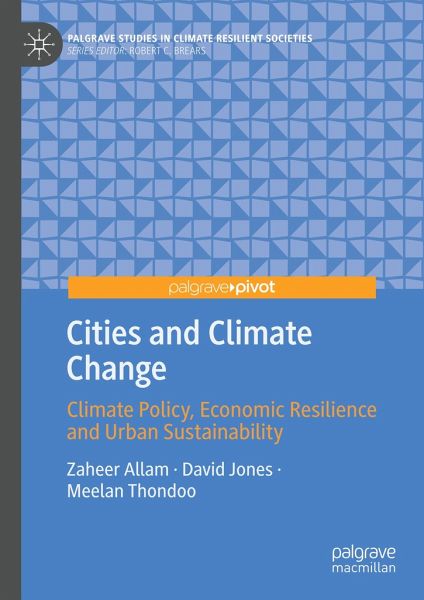
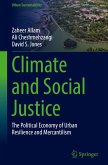
This book explores climate change responsiveness policies for cities and discusses why they have been slow to gain traction despite having been on the international agenda for the last 30 years. The contributing role of cities in accentuating the effects of climate change is increasingly demonstrated in the literature, underscoring the unsustainable models on which urban life has been made to thrive. As these issues become increasingly apparent, there are global calls to adopt more sustainable and equitable models, however doing so will mean the disruption of economies that have historically…mehr
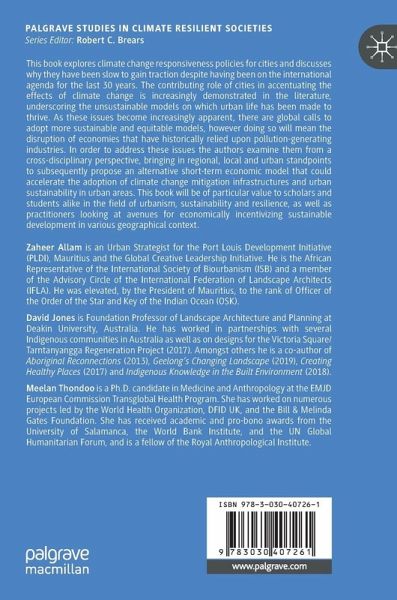
This book explores climate change responsiveness policies for cities and discusses why they have been slow to gain traction despite having been on the international agenda for the last 30 years. The contributing role of cities in accentuating the effects of climate change is increasingly demonstrated in the literature, underscoring the unsustainable models on which urban life has been made to thrive. As these issues become increasingly apparent, there are global calls to adopt more sustainable and equitable models, however doing so will mean the disruption of economies that have historically relied upon pollution-generating industries. In order to address these issues the authors examine them from a cross-disciplinary perspective, bringing in regional, local and urban standpoints to subsequently propose an alternative short-term economic model that could accelerate the adoption of climate change mitigation infrastructures and urban sustainability in urban areas. This book will be of particular value to scholars and students alike in the field of urbanism, sustainability and resilience, as well as practitioners looking at avenues for economically incentivizing sustainable development in various geographical context.
Dr. Zaheer Allam holds a PhD in Humanities, a Master of Arts (Res), an MBA, and a Bachelor of Applied Science in Architectural Science from universities in Australia and the United Kingdom. Based in Mauritius, he is the Chairperson of the National Youth Environment Council (NYEC) and a board member of the Mauritius Renewable Energy Agency (MARENA) and works on several projects on the thematic of Smart Cities and on strategies dwelling in the increasing role of technology in Culture and the Society. Zaheer is also the African Representative of the International Society of Biourbanism (ISB), member of the Advisory Circle of the International Federation of Landscape Architects (IFLA), and a member of several other international bodies. He holds several awards and commendations and is the author of over 125 peer reviewed publications and author of 8 books about Smart, Sustainable and Future Cities. Peter Newman is the Professor of Sustainability at Curtin University. Peter has written 23 books and over 400 papers on sustainable cities and decarbonization policy and is one of the most highly cited authors in sustainable urban planning. He created the term automobile dependence in the 1980's which is now standard terminology in urban planning and his book with Jeff Kenworthy has been called 'one of the most influential planning books of all time'. Peter has worked to deliver his ideas in all levels of government having been an elected councillor, seconded to advise three Premiers in Western Australia (1986, 1989, 2001-3) and on the Board of Infrastructure Australia 2008-14. He has been involved in IPCC for ten years and is presently the Co-ordinating Lead Author for the IPCC on Transport. In 2014 he was awarded an Order of Australia for his contributions to urban design and sustainable transport. In 2018/19 he was the Western Australian Scientist of the Year. He is the Editor-in-Chief of the journal Sustainable Earth Reviews.
Inhaltsangabe
Chapter 1: Urban Resilience And Climate Change.- Chapter 2: Regional Decarbonisation And Urban Sustainability.- Chapter 3: Climate Change Mitigation And Urban Liveability.- Chapter 4: Economically Incentivising Urban Sustainability And Resilience.- Chapter 5: Achieving Resilience Within The Capitalist Movement.