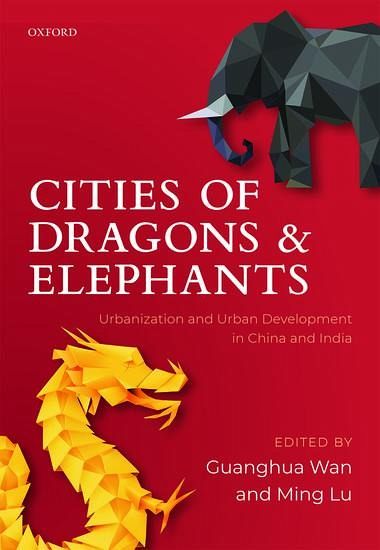
Urbanization is one of the most important phenomena in economic development. In the past three decades, Asian urban populations expanded by almost one billion, a figure expected to double in the next three decades. Clearly, both the scale and pace of urbanization in Asia is unprecedented in human history and will dominate the global urbanization landscape. Asia's urbanization, in turn, is dominated by what is happening in China and India, the two most populous, fastest growing economies in the world. Cities of Dragons and Elephants: Urbanization and Urban Development in China and India aims at…mehr
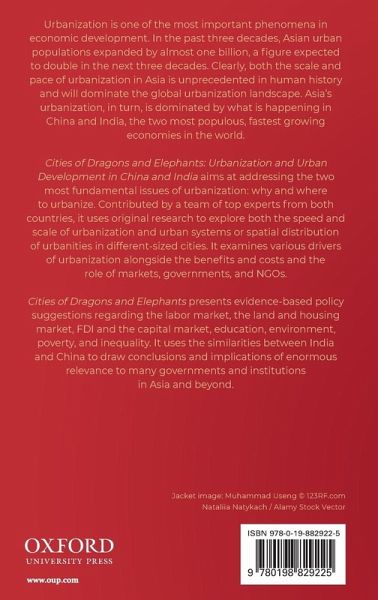
Urbanization is one of the most important phenomena in economic development. In the past three decades, Asian urban populations expanded by almost one billion, a figure expected to double in the next three decades. Clearly, both the scale and pace of urbanization in Asia is unprecedented in human history and will dominate the global urbanization landscape. Asia's urbanization, in turn, is dominated by what is happening in China and India, the two most populous, fastest growing economies in the world. Cities of Dragons and Elephants: Urbanization and Urban Development in China and India aims at addressing the two most fundamental issues of urbanization: why and where to urbanize. Contributed by a team of top experts from both countries, it uses original research to explore both the speed and scale of urbanization and urban systems or spatial distribution of urbanities in different-sized citites. It examines various drivers of urbanization alongside the benefits and costs and the role of markets, governments, and NGOs. Cities of Dragons and Elephants presents evidence-based policy suggestions regarding the labor market, the land and housing market, FDI and the capital market, education, environment, poverty, and inequality. It uses the similarities betwen India and China to draw conclusions and implications of enormous relevance to many governments and institutions in Asia and beyond.
Guanghua Wan is Director of the Institute of World Economy, Fudan University, China. Previously he was the Research Director and Head of the Poverty and Inequality Group at the Asian Development Bank. He has also previously held positions as a Senior Economist at the United Nations and taught at a number of universities in Australia and China. Trained in development economis and econometrics, Prof Wan is a multi-award winning scholar on the Chinese economy and an expert on Asia, with a publication record encompassing over 150 articles and numerous books. Dr Wan is an Honorary Professor of over ten top universities in China, and is among the top 4% economists in Asia. Ming Lu is a Distinguished Professor of Economics and Director of the Shanghai Institute for the National Economy, and a Research Fellow at the China Institute of Urban Governance at Shanghai Jiao Tong University. He is also an Adjunct Professor at Fudan University, Singapore Management University, and Dongbei University of Finance and Economics. He has consulted for the World Bank and Asian Development Bank. His research covers labor economics, regional and urban-rural development, and the Chinese economy. His most recent work evaluates urban and regional development policies and their effects on resource allocation and economic sustainability.
Inhaltsangabe
* 1: Introduction * Part I: Urbanization and Rural Development * 2: Urbanization and Rural Development in the People's Republic of China * 3: Costs and Benefits of Urbanization: The Indian Case * Part II: Urban Systems * 4: Urban System and Urban Development in the People's Republic of China * 5: City-Size Distributions in a Quasi-Open Economy The India Evidence * Part III: Migration * 6: Migration in the People's Republic of China * 7: Rural to Urban Migration and Urban Labour Market * Part IV: Land and Housing * 8: Housing Systems and Urbanization in the People's Republic of China * 9: Land Policy and Urbanization in the People's Republic of China * 10: Urbanization, Land and Housing in India: Options Amidst the State and the Market Failures * Part V: Capital Flow and FDI * 11: Foreign Direct Investment, Capital Flows, and Urbanization * 12: Regional and Urban Impacts of Foreign Direct Investment in India * Part VI: Infrastructure * 13: Infrastructure * 14: Infrastructure and Urbanization in India: Issues and Challenges * Part VII: Human Capital * 15: Human Capital and Urbanization in the People's Republic of China * 16: Human Capital and Urbanization in India * Part VIII: Congestion and Pollution * 17: Congestion and Pollution in Chinese Cities * 18: Urbanization and Water Supply and Sanitation in India * 19: Air Pollution and Traffic Congestion in Urban India * Part IX: Poverty and Inequality in Urbanization * 20: Urbanization, Inequality and Poverty in the People's Republic of China * 21: Growth, Inequality, Poverty and Urbanization
* 1: Introduction * Part I: Urbanization and Rural Development * 2: Urbanization and Rural Development in the People's Republic of China * 3: Costs and Benefits of Urbanization: The Indian Case * Part II: Urban Systems * 4: Urban System and Urban Development in the People's Republic of China * 5: City-Size Distributions in a Quasi-Open Economy The India Evidence * Part III: Migration * 6: Migration in the People's Republic of China * 7: Rural to Urban Migration and Urban Labour Market * Part IV: Land and Housing * 8: Housing Systems and Urbanization in the People's Republic of China * 9: Land Policy and Urbanization in the People's Republic of China * 10: Urbanization, Land and Housing in India: Options Amidst the State and the Market Failures * Part V: Capital Flow and FDI * 11: Foreign Direct Investment, Capital Flows, and Urbanization * 12: Regional and Urban Impacts of Foreign Direct Investment in India * Part VI: Infrastructure * 13: Infrastructure * 14: Infrastructure and Urbanization in India: Issues and Challenges * Part VII: Human Capital * 15: Human Capital and Urbanization in the People's Republic of China * 16: Human Capital and Urbanization in India * Part VIII: Congestion and Pollution * 17: Congestion and Pollution in Chinese Cities * 18: Urbanization and Water Supply and Sanitation in India * 19: Air Pollution and Traffic Congestion in Urban India * Part IX: Poverty and Inequality in Urbanization * 20: Urbanization, Inequality and Poverty in the People's Republic of China * 21: Growth, Inequality, Poverty and Urbanization
Es gelten unsere Allgemeinen Geschäftsbedingungen: www.buecher.de/agb
Impressum
www.buecher.de ist ein Internetauftritt der buecher.de internetstores GmbH
Geschäftsführung: Monica Sawhney | Roland Kölbl | Günter Hilger
Sitz der Gesellschaft: Batheyer Straße 115 - 117, 58099 Hagen
Postanschrift: Bürgermeister-Wegele-Str. 12, 86167 Augsburg
Amtsgericht Hagen HRB 13257
Steuernummer: 321/5800/1497
USt-IdNr: DE450055826