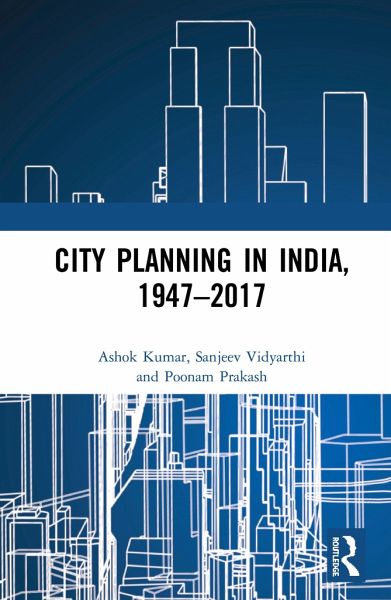
This book is a comprehensive history of city planning in post-independence India. It explores how the conceptualization of city-planning, the challenges of urban development and policymaking have evolved in the changing socio-political context over the past hundred years in India and the global south.
This book is a comprehensive history of city planning in post-independence India. It explores how the conceptualization of city-planning, the challenges of urban development and policymaking have evolved in the changing socio-political context over the past hundred years in India and the global south.
Ashok Kumar is a professor of physical planning at the School of Planning and Architecture, New Delhi, India. Trained as a human geographer and spatial planner, he believes in planning that aims at reducing spatial injustices, a task that is not well accomplished without comprehending and linking planning with broader political and economic processes. For him, collaborative planning remains at the core of planners' efforts, where plans are participatory and pragmatic. Ashok lives and works in Delhi. He has studied in India and the UK. His most recent edited books include (with D.S. Meshram and Krishne Gowda) Urban and Regional Planning Education - Learning for India (Springer, 2016) and (with Poonam Prakash) Public Participation in Planning in India (Cambridge Scholars Publishing, 2016). Sanjeev Vidyarthi is a professor of urban planning and policy and director of the Master of City Design program at the University of Illinois, Chicago. Trained as an architect, urban designer, and spatial planner, Sanjeev employs an integrative research approach to studying the meaning and purpose of planning for places. His recent work explores plan-making and city-designing efforts in a variety of urban settings like planned neighborhoods, historic settlements, and rapidly-growing urban regions. Sanjeev has lived, worked, and studied in the Middle East, Western Europe, and the United States while studying the case of independent India using a comparative lens and insider/outsider perspective. He works with progressive scholars and professional practitioners worldwide. Poonam Prakash is a professor of physical planning and head, Department of Physical Planning at the School of Planning and Architecture, New Delhi, an institute of National Importance. She has a doctoral degree in Housing from the School of Planning and Architecture, New Delhi. She has been teaching for the last 23 years. Her research interests relate to low-income housing, participatory planning, decision-making processes in planning, and planning pedagogy. Her approach toward teaching is to facilitate self-reflection through experiential learning. She was the nodal officer for Housing and Urban Development Corporation's Chair for research and documentation in housing and urban development between 2012 and 2017. In 2016, she was nominated for the In-residence Programme for Inspired Teachers at Rashtrapati Bhawan.
Inhaltsangabe
List of Figures. List of Tables. List of Boxes. Preface. 1. Introduction City Planning in India 2. Shifts and Transitions: Legacies of Pre Independence Planning 3. Efforts to Build a Modern Nation: Planning From 1947 to Late 1960s 4. Paper Plans Meet the Actual Ground: 1960s to 1980s 5. Post Liberalization Planning: 1985 2005 6. Recent Planning Efforts: 2005 2017. Appendix. References. Index.
List of Figures. List of Tables. List of Boxes. Preface. 1. Introduction City Planning in India 2. Shifts and Transitions: Legacies of Pre Independence Planning 3. Efforts to Build a Modern Nation: Planning From 1947 to Late 1960s 4. Paper Plans Meet the Actual Ground: 1960s to 1980s 5. Post Liberalization Planning: 1985 2005 6. Recent Planning Efforts: 2005 2017. Appendix. References. Index.
Es gelten unsere Allgemeinen Geschäftsbedingungen: www.buecher.de/agb
Impressum
www.buecher.de ist ein Internetauftritt der buecher.de internetstores GmbH
Geschäftsführung: Monica Sawhney | Roland Kölbl | Günter Hilger
Sitz der Gesellschaft: Batheyer Straße 115 - 117, 58099 Hagen
Postanschrift: Bürgermeister-Wegele-Str. 12, 86167 Augsburg
Amtsgericht Hagen HRB 13257
Steuernummer: 321/5800/1497
USt-IdNr: DE450055826