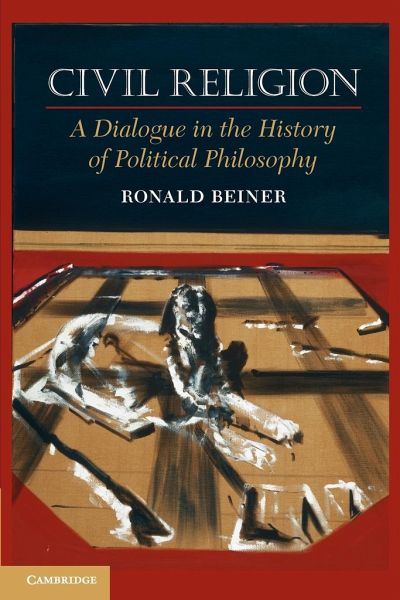
Civil Religion offers philosophical commentaries on more than twenty thinkers stretching from the sixteenth to the twentieth century. It examines four important traditions within the history of modern political philosophy. The civil religion tradition, principally defined by Machiavelli, Hobbes and Rousseau, seeks to domesticate religion by putting it solidly in the service of politics. The liberal tradition pursues an alternative strategy of domestication by seeking to put as much distance as possible between religion and politics. Modern theocracy is a militant reaction against liberalism,…mehr
Civil Religion offers philosophical commentaries on more than twenty thinkers stretching from the sixteenth to the twentieth century. It examines four important traditions within the history of modern political philosophy. The civil religion tradition, principally defined by Machiavelli, Hobbes and Rousseau, seeks to domesticate religion by putting it solidly in the service of politics. The liberal tradition pursues an alternative strategy of domestication by seeking to put as much distance as possible between religion and politics. Modern theocracy is a militant reaction against liberalism, reversing the relationship of subordination asserted by civil religion. Finally, a fourth tradition is defined by Nietzsche and Heidegger. Aspects of their thought are not just modern, but hyper-modern, yet they manifest an often-hysterical reaction against liberalism that is fundamentally shared with the theocratic tradition. Together, these four traditions compose a vital dialogue that carries us to the heart of political philosophy itself.
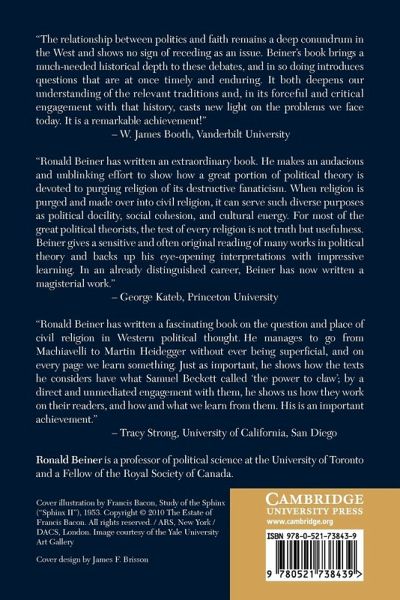
Ronald Beiner is a Professor of Political Science at the University of Toronto and a Fellow of the Royal Society of Canada. He has edited Hannah Arendt's Lectures on Kant's Political Philosophy; his other books include Political Judgment; What's the Matter with Liberalism? (winner of the Canadian Political Science Association's 1994 Macpherson Prize); Philosophy in a Time of Lost Spirit; and Liberalism, Nationalism, Citizenship.
Inhaltsangabe
Part I. Machiavelli, Hobbes, Rousseau: Three Versions of the Civil Religion Project: 1. Rousseau's problem 2. The Machiavellian solution: paganization of Christianity 3. Moses and Mohammed as founder-princes or legislators 4. Re-founding and 'filiacide': Machiavelli's debt to Christianity 5. The Hobbesian solution: Judaicization of Christianity 6. Behemoth: Hobbesian 'theocracy' versus the real thing 7. Geneva Manuscript: the apparent availability of a Rousseauian solution 8. Social Contract: the ultimate unavailability of a Rousseauian solution Part II. Responses to (and Partial Incorporations of) Civil Religion within the Liberal Tradition: 9. Baruch Spinoza: from civil religion to liberalism 10. Philosophy and piety: problems in Spinoza's case for liberalism (owing to a partial reversion to civil religion) 11. Spinoza's interpretation of the Commonwealth of the Hebrews, and why civil religion is a continuing presence in his version of liberalism 12. John Locke: the liberal paradigm 13. 'The gods of the philosophers' I: Locke and John Toland 14. Bayle's republic of atheists 15. Montesquieu's pluralized civil religion 16. The Straussian rejection of the enlightenment as applied to Bayle and Montesquieu 17. 'The gods of the philosophers' II: Rousseau and Kant 18. Hume as a successor to Bayle 19. Adam Smith's sequel to Hume (and Hobbes) 20. Christianity as civil religion: Tocqueville's response to Rousseau 21. John Stuart Mill's project to turn atheism into a religion 22. Mill's critics 23. John Rawls's genealogy of liberalism 24. Prosaic liberalism: Montesquieu versus Machiavelli, Rousseau, Nietzsche Part III. Theocratic Responses to Liberalism: 25. Joseph de Maistre: the theocratic paradigm 26. Maistrean politics 27. Maistre and Rousseau: theocracy versus civil religion 28. Carl Schmitt's 'theocratic' critique of Hobbes Part IV. Post-Modern 'Theism': Nietzsche and Heidegger's Continuing Revolt Against Liberalism: 29. Nietzsche, Weber, Freud: the twentieth century confronts the death of God 30. Nietzsche's civil religion 31. Heidegger's sequel to Nietzsche: the longing for new gods 32. Conclusion.
Part I. Machiavelli, Hobbes, Rousseau: Three Versions of the Civil Religion Project: 1. Rousseau's problem 2. The Machiavellian solution: paganization of Christianity 3. Moses and Mohammed as founder-princes or legislators 4. Re-founding and 'filiacide': Machiavelli's debt to Christianity 5. The Hobbesian solution: Judaicization of Christianity 6. Behemoth: Hobbesian 'theocracy' versus the real thing 7. Geneva Manuscript: the apparent availability of a Rousseauian solution 8. Social Contract: the ultimate unavailability of a Rousseauian solution Part II. Responses to (and Partial Incorporations of) Civil Religion within the Liberal Tradition: 9. Baruch Spinoza: from civil religion to liberalism 10. Philosophy and piety: problems in Spinoza's case for liberalism (owing to a partial reversion to civil religion) 11. Spinoza's interpretation of the Commonwealth of the Hebrews, and why civil religion is a continuing presence in his version of liberalism 12. John Locke: the liberal paradigm 13. 'The gods of the philosophers' I: Locke and John Toland 14. Bayle's republic of atheists 15. Montesquieu's pluralized civil religion 16. The Straussian rejection of the enlightenment as applied to Bayle and Montesquieu 17. 'The gods of the philosophers' II: Rousseau and Kant 18. Hume as a successor to Bayle 19. Adam Smith's sequel to Hume (and Hobbes) 20. Christianity as civil religion: Tocqueville's response to Rousseau 21. John Stuart Mill's project to turn atheism into a religion 22. Mill's critics 23. John Rawls's genealogy of liberalism 24. Prosaic liberalism: Montesquieu versus Machiavelli, Rousseau, Nietzsche Part III. Theocratic Responses to Liberalism: 25. Joseph de Maistre: the theocratic paradigm 26. Maistrean politics 27. Maistre and Rousseau: theocracy versus civil religion 28. Carl Schmitt's 'theocratic' critique of Hobbes Part IV. Post-Modern 'Theism': Nietzsche and Heidegger's Continuing Revolt Against Liberalism: 29. Nietzsche, Weber, Freud: the twentieth century confronts the death of God 30. Nietzsche's civil religion 31. Heidegger's sequel to Nietzsche: the longing for new gods 32. Conclusion.
Es gelten unsere Allgemeinen Geschäftsbedingungen: www.buecher.de/agb
Impressum
www.buecher.de ist ein Internetauftritt der buecher.de internetstores GmbH
Geschäftsführung: Monica Sawhney | Roland Kölbl | Günter Hilger
Sitz der Gesellschaft: Batheyer Straße 115 - 117, 58099 Hagen
Postanschrift: Bürgermeister-Wegele-Str. 12, 86167 Augsburg
Amtsgericht Hagen HRB 13257
Steuernummer: 321/5800/1497
USt-IdNr: DE450055826