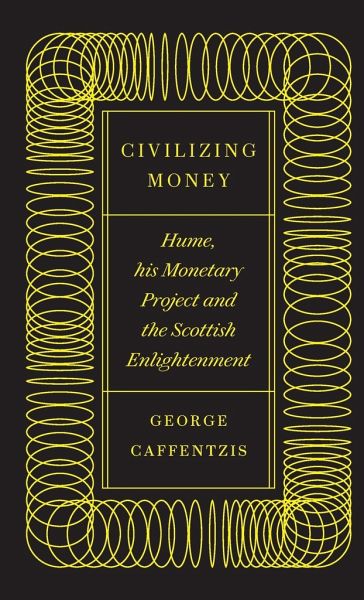
Taking the Scottish Enlightenment philosopher David Hume as its subject, this book breaks new ground in focusing its lens on a little-studied aspect of Hume's thinking: his understanding of money. George Caffentzis makes both an intervention in the field of monetary philosophy and into Marxian conceptions of the relation between philosophy and capitalist development. He vividly charts the ways in which Hume's philosophy directly informed the project of 'civilizing' the people of the Scottish Highlands and pacifying the English proletariat in response to the revolts of both groups at the heart…mehr
Taking the Scottish Enlightenment philosopher David Hume as its subject, this book breaks new ground in focusing its lens on a little-studied aspect of Hume's thinking: his understanding of money. George Caffentzis makes both an intervention in the field of monetary philosophy and into Marxian conceptions of the relation between philosophy and capitalist development. He vividly charts the ways in which Hume's philosophy directly informed the project of 'civilizing' the people of the Scottish Highlands and pacifying the English proletariat in response to the revolts of both groups at the heart of the empire. Built on careful historical and philosophical detective work, Civilizing Money offers a stimulating and radical political reading of the ways in which Hume's fundamental philosophical claims performed concrete political functions.'Capitalist critique and proletarian reasoning fit for our time' - Peter Linebaugh Taking the Scottish Enlightenment philosopher David Hume as its subject, this book breaks new ground in focusing its lens on a little-studied aspect of Hume's thinking: his understanding of money. George Caffentzis makes both an intervention in the field of monetary philosophy and into Marxian conceptions of the relation between philosophy and capitalist development. He vividly charts the ways in which Hume's philosophy directly informed the project of 'civilizing' the people of the Scottish Highlands and pacifying the English proletariat in response to the revolts of both groups at the heart of the empire. Built on careful historical and philosophical detective work, Civilizing Money offers a stimulating and radical political reading of the ways in which Hume's fundamental philosophical claims performed concrete political functions.
George Caffentzis is an activist and Marxist scholar from Brooklyn, New York. His life has been devoted to analyzing and confronting the mechanisms of capital, from the anti-nuclear movement in the 1970s, student struggles in Nigeria in the 1980s, to the Zapatistas in Mexico in the 1990s, to the streets of Manhattan and the Occupy movement in the 2000s, and beyond. Caffentzis' work on the philosophy of money, the IMF and the World Bank, machines, work, and the ever-present energy crisis, was solidified as a founding member of the Midnight Notes Collective and continued in his books In Letters of Blood and Fire: Work, Machines, and the Crisis of Capitalism and No Blood for Oil: Essays on Energy, Class Struggle and War, among others. He is also the author of an academic trilogy on the philosophies of Locke, Berkeley, and Hume. At the Edge of Everything is his first published book of poems spanning his youth in New York and Greece, life in Nigeria, struggles and travels across the globe, to the present day.
Inhaltsangabe
List of Figures and Tables Acknowledgments Foreword An Autobiographical Preface Introduction: Who is a Philosopher of Money? PART I: HUME AND HIS CLASS'S PROBLEMATIC 1. On the Scottish Origins of Civilization 2. Civilizing the Highlands: Hume, Money and the Annexing Act 3. Hume's Monetary Education in Bristol PART II: HUME'S PHILOSOPHY AND HIS STRATEGY 4. Why was Hume a Metallist? 5. Did Hume read Berkeley's The Querist? Notions and Conventions in their Philosophies of Money 6. Fiction or Counterfeit? Specie or Paper? 7. Wages and Money: Pegasus' Mirror Conclusion: Locke, Berkeley and Hume as Philosophers of Money Coda: A Critique of Marx's Thesis 11 on Feuerbach Notes Bibliography Index
List of Figures and Tables Acknowledgments Foreword An Autobiographical Preface Introduction: Who is a Philosopher of Money? PART I: HUME AND HIS CLASS'S PROBLEMATIC 1. On the Scottish Origins of Civilization 2. Civilizing the Highlands: Hume, Money and the Annexing Act 3. Hume's Monetary Education in Bristol PART II: HUME'S PHILOSOPHY AND HIS STRATEGY 4. Why was Hume a Metallist? 5. Did Hume read Berkeley's The Querist? Notions and Conventions in their Philosophies of Money 6. Fiction or Counterfeit? Specie or Paper? 7. Wages and Money: Pegasus' Mirror Conclusion: Locke, Berkeley and Hume as Philosophers of Money Coda: A Critique of Marx's Thesis 11 on Feuerbach Notes Bibliography Index
Es gelten unsere Allgemeinen Geschäftsbedingungen: www.buecher.de/agb
Impressum
www.buecher.de ist ein Internetauftritt der buecher.de internetstores GmbH
Geschäftsführung: Monica Sawhney | Roland Kölbl | Günter Hilger
Sitz der Gesellschaft: Batheyer Straße 115 - 117, 58099 Hagen
Postanschrift: Bürgermeister-Wegele-Str. 12, 86167 Augsburg
Amtsgericht Hagen HRB 13257
Steuernummer: 321/5800/1497
USt-IdNr: DE450055826