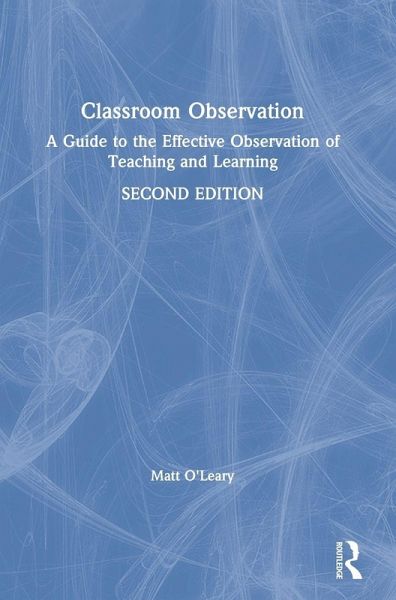
Building on recent changes and debates surrounding the use of observation, this fully updated second edition of Classroom Observation explores the role of lesson observation in the preparation, assessment and professional learning of teachers, lecturers and educators.
Building on recent changes and debates surrounding the use of observation, this fully updated second edition of Classroom Observation explores the role of lesson observation in the preparation, assessment and professional learning of teachers, lecturers and educators.
Matt O'Leary is Professor of Education and Director of the education research centre CSPACE at Birmingham City University, UK. His research on classroom/lesson observation has had significant impact in the UK and internationally on education policy and the thinking and practice of education leaders, practitioners and researchers working in all education sectors.
Inhaltsangabe
Introduction to Second Edition. Introducing the book. Part I: Exploring the role of classroom observation in teaching and learning. Chapter 1: Classroom observation in context: understanding the background to its emergence and its role in the teaching profession. Chapter 2: A review of classroom observation in the English education system: understanding its role in schools, colleges and universities. Chapter 3: Typologies of classroom observation: contexts, models and purposes. Part II: Classroom observation as a means of studying and assessing the effectiveness of teaching and learning. Chapter 4: Classroom observation as a method for studying teaching and learning: ways of recording what you see. Chapter 5: What is learning? What is teaching? Can we really observe them? Chapter 6: Being an effective teacher: models of teacher effectiveness. Part III: Classroom observation as a means of improving teachers' professional learning and development. Chapter 7: Classroom observation as a tool for expansive professional learning: observing practice and the role of critical reflection. Chapter 8: Peer-based models of observation: the benefits of collaborative learning. Chapter 9: Using digital video technology to observe, inform and improve teacher learning. Chapter 10: Lesson study. Conclusion.
Introduction to Second Edition. Introducing the book. Part I: Exploring the role of classroom observation in teaching and learning. Chapter 1: Classroom observation in context: understanding the background to its emergence and its role in the teaching profession. Chapter 2: A review of classroom observation in the English education system: understanding its role in schools, colleges and universities. Chapter 3: Typologies of classroom observation: contexts, models and purposes. Part II: Classroom observation as a means of studying and assessing the effectiveness of teaching and learning. Chapter 4: Classroom observation as a method for studying teaching and learning: ways of recording what you see. Chapter 5: What is learning? What is teaching? Can we really observe them? Chapter 6: Being an effective teacher: models of teacher effectiveness. Part III: Classroom observation as a means of improving teachers' professional learning and development. Chapter 7: Classroom observation as a tool for expansive professional learning: observing practice and the role of critical reflection. Chapter 8: Peer-based models of observation: the benefits of collaborative learning. Chapter 9: Using digital video technology to observe, inform and improve teacher learning. Chapter 10: Lesson study. Conclusion.
Es gelten unsere Allgemeinen Geschäftsbedingungen: www.buecher.de/agb
Impressum
www.buecher.de ist ein Internetauftritt der buecher.de internetstores GmbH
Geschäftsführung: Monica Sawhney | Roland Kölbl | Günter Hilger
Sitz der Gesellschaft: Batheyer Straße 115 - 117, 58099 Hagen
Postanschrift: Bürgermeister-Wegele-Str. 12, 86167 Augsburg
Amtsgericht Hagen HRB 13257
Steuernummer: 321/5800/1497
USt-IdNr: DE450055826